


Excessive steering wheel play
Steering component ball joints worn or loose. Tighten fasteners or replace defective components.
The steering gear is worn out or its adjustment is disturbed. If after adjustment the steering wheel play does not return to normal, it is necessary to overhaul the steering mechanism with the replacement of defective components and final adjustment.
Worn transverse torque rod bushings. Replace bushings.
The landing of the bipod of the steering mechanism on the sector shaft has weakened. Tighten the fixing nut.
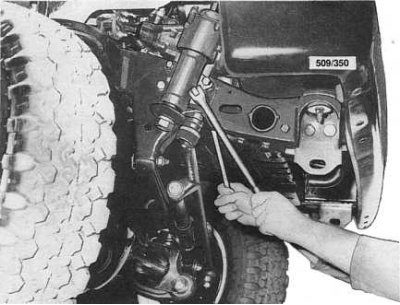
Steering gear assembly mounting bolts loosened (see accompanying illustration). Tighten the fastener.
Faulty flexible coupling or steering shaft universal joints. Replace defective components.
Note. The play of the steering gear components is best manifested when the vehicle is lowered onto the front wheels. Have an assistant turn the steering wheel and visually inspect the steering drive components for wear. If the slack in the steering mechanism is clearly manifested when the front wheels of the car are in a straight line, the adjustment of the mechanism is most likely disturbed. If the play does not disappear after the adjustment is made, the steering gear must be removed for a major overhaul.
Steering wheel is too tight
Tires are too weak or unevenly inflated. Check inflation pressure, correct if necessary.
The level of hydraulic fluid in the reservoir of the power steering system has dropped. Check the system for signs of leaks and make any necessary repairs and/or replacements. Add fluid to the required level.
Steering gear out of alignment. Check and make any necessary adjustments.
The steering shaft is jammed. Find out the cause of jamming, replace defective components.
The steering pump does not provide proper pressure. Check the condition and tension of the pump drive belt, as well as the level of hydraulic fluid in the reservoir of the hydraulic booster system. Replace pump if necessary.
Note. Check that the tread depth is sufficient and that the tire inflation pressures of both front wheels are correct.
Before proceeding to check the geometric parameters of the steering gear, evaluate the degree of wear of the front axle components.
A car pulls to one side when driving straight on a horizontal surface
Tires unevenly worn or inflated. Check the condition and inflation pressure of the tires. Change tires or adjust pressure if necessary.
The adjustment of the angles of installation of the front wheels is broken. Check, make adjustments. "tacked on" front wheel brakes. Check the calipers for signs of brake fluid leaks and piston seizure. Replace defective components.
Damaged front suspension components or front chassis beams. Check. Replace defective components.
Note. If the vehicle's front tires are found to be in good condition, raise the front of the vehicle and rotate both front wheels to check the brakes for "tacking".
To check the front wheel alignment angles, measure the distance from the center of the front wheel disks to the center of the rear wheel disks on both sides of the vehicle. With the front wheels in a straight position, the measurement results should match.
There is lateral runout or angular oscillatory movement of the steered wheels, which occurs at low speeds (shimmy)
Loose steering gear. Adjust or overhaul the steering gear.
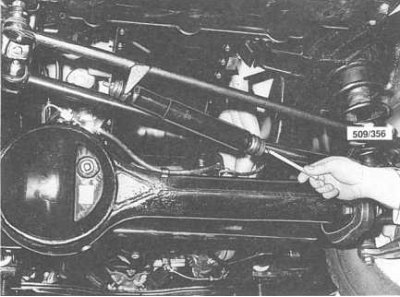
The shock absorber of the steering mechanism is faulty or its rubber bushings are destroyed as a result of aging of the material. Remove shock absorber and check its condition (see accompanying illustration). replace rubber bushings if necessary.
Tires unevenly worn or incorrectly inflated. Check the condition and inflation pressure of the tires. Change tires or adjust pressure if necessary.
Wheel balance out of alignment. Check and balance.
There is damage to components or a violation of the geometry of the front end of the car. Check and make any necessary corrections or adjustments to the geometry.
The front wheel bearings are worn out, or their adjustment is grossly violated. Check the condition of the bearings, correct the preload, or replace the bearings.
The adjustment of the angles of installation of the front wheels of the car is violated. Check and make any necessary adjustments.
Ball joints worn or loose. Check, tighten fasteners, or replace defective components.
Note. Check the condition of the steering gear components. Raise the front of the vehicle to check and adjust the wheel bearing preload. To check the condition of the bearings, alternately pull the wheels in the transverse direction, grabbing them at the top and bottom. Backlash should be completely absent.
There is a violation of vehicle control or loss of directional stability
The adjustment of the angles of installation of the front wheels is broken. Check and correct if necessary.
Front tire tread worn out. Check and replace tires if necessary.
Excessive steering play. Check, replace worn components, if necessary, adjust the steering mechanism.
Exceeded or too low tire inflation pressure. Check and correct pressure.
Weak or incorrectly set front wheel bearing preload. Check and make any necessary adjustments.
Excessive play in ball joints. Check and replace defective components. Also check up a condition of covers of spherical hinges.
Serviceability of functioning of the hydraulic booster of a wheel is broken
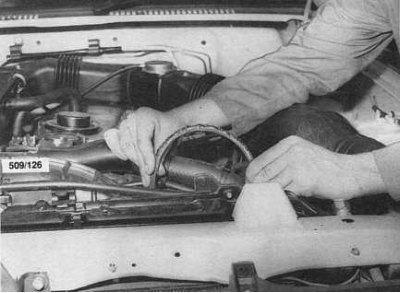
The steering pump drive belt is broken, or the adjustment of its tension force is broken. Check belt condition (see accompanying illustration), replace, or tighten the belt with the required force.
The fluid level in the reservoir of the power steering system has dropped. Check for fluid leaks, make necessary repairs, or replace defective components. Add fluid to the required level.
The steering pump does not provide proper pressure. Check and replace the pump if necessary.
Faulty hydraulic power steering assembly. Remove the assembly, overhaul it.
There are hydraulic fluid leaks
Hydraulic fluid reservoir, steering pump or steering gear damaged or loose. Check, tighten fasteners, or replace defective components.
Hydraulic hoses damaged or destroyed as a result of material aging. Check and replace defective hoses.
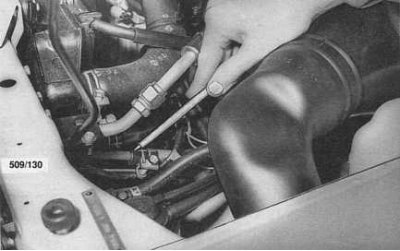
Carefully check all hydraulic lines of the power steering system for signs of leakage (see accompanying illustration).
There are noises from the hydraulic power steering
Steering pump drive belt damaged or loose. Adjust the belt tension or replace it.
Air has entered the hydraulic system. Pump the system.
Hydraulic hoses and tubes are connected incorrectly or their fittings are loose. Connect the lines correctly, tighten the fittings.
Steering pump support brackets are misaligned or loose. Correct the position of the brackets, tighten the fasteners.
Note. Violation of the patency of the hydraulic lines can also be the cause of noise in the steering mechanism. Carefully inspect the hoses and tube lines for kinks or twists.