


Table of contents: Checking on carburetor engines ↓ Checking on an injection engine ↓ Recirculation valve ↓ Check valve ↓ TVR on a carburetor engine ↓ Solenoid valve on an injection engine ↓ Exhaust gas monitoring sensor ↓ Neutralizer ↓ Exhaust gas sensor ↓
The system consists of a recirculation valve, a check valve and a thermal vacuum distribution valve (TVD).
Checking on carburetor engines
1. To check, disconnect the hoses from these valves and blow through them; air should flow freely through the hoses.
2. The TVR test is described in subsection 6.4.1.1.2.
3. To check the recirculation valve, disconnect the vacuum hose at the top. Attach the auxiliary hose and create a vacuum in it. Check the movement of the diaphragm by placing your finger on the bottom of the valve. If the diaphragm does not move, replace the valve.
4. If the TVR is working properly, check the check valve. To do this, warm up the engine and disconnect the vacuum hose from the recirculation valve. Put your finger on the hose, sharply increase and decrease the engine speed. When the speed increases, a vacuum should be felt in the hose, which should weaken slightly when the speed decreases. Otherwise, replace the check valve.
Checking on an injection engine
The testing procedure is the same as on a carburetor engine, except that instead of the TVR, the solenoid valve is tested.
The solenoid valve is no different from the valve of the gasoline vapor recovery system and is checked in the same way (see subsection 6.4.1.1.2).
Recirculation valve
Replacement
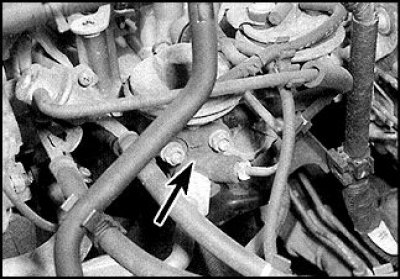
1. EGR valve on injection engine (indicated by the arrow) mounted on the left side of the intake manifold. To access the valve, it is recommended to remove the air filter and check valve. Disconnect the vacuum hose from the valve.
2. Loosen the union nuts and disconnect the recirculation and check valve tubes.
3. Unscrew 2 nuts, remove the valve and gasket.
Check valve
Replacement
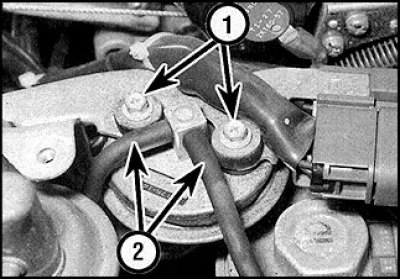
1. The valve is mounted on the left side of the intake manifold (1 - screws, 2 - vacuum hoses). To access the valve, it is recommended to remove the air filter.
2. Disconnect the vacuum hoses from the valve.
3. Unscrew 2 screws and remove the valve.
4. The valve is installed in the reverse order.
TVR on a carburetor engine
Replacement
Cm. subsection 6.4.1.1.2.
Solenoid valve on an injection engine
Replacement
Cm. subsection 6.4.1.1.2.
Exhaust gas monitoring sensor
Checking on carburetor engines
1. Adjust the idle mixture quality.
2. Open the diagnostic connector, which is located under the fuse box.
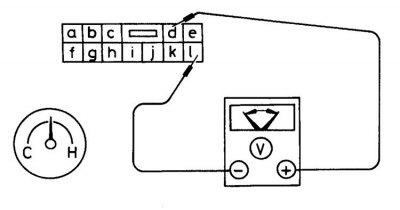
3. Connect a voltmeter to the connector terminals.
4. Start the engine, bring the speed up to 2000 rpm and watch the voltmeter for 2 minutes. If the sensor is working properly, the voltmeter readings should change five times from 0 to 12 V every 10 seconds. Otherwise, the sensor is faulty and a more precise check at a car service is required.
Checking on an injection engine
If the CO content in the exhaust gases exceeds the norm, it is necessary to check the serviceability of the exhaust gas sensor using the self-diagnostic function of the processor unit.
Neutralizer
Replacement
Cm. subsection 6.1.14 and subsection 6.2.16.
Exhaust gas sensor
Replacement
Warning! The sensor may fail after a fall or strong impact.
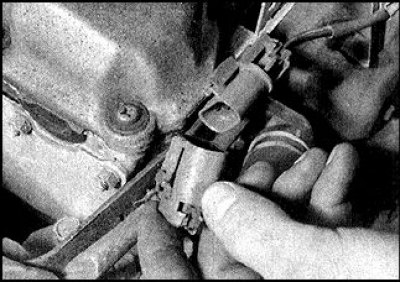
1. Disconnect the connector from the exhaust gas sensor.
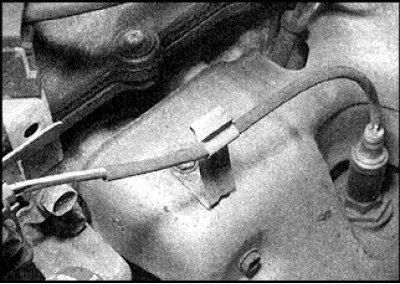
2. Remove the wires from the brackets.
[The original is available on the web page: www.NissanBook.ru]
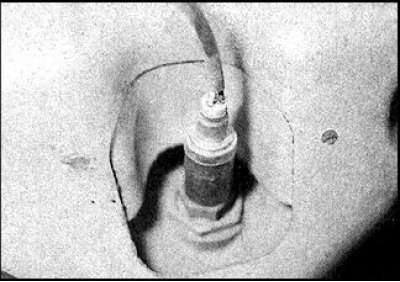
2. Unscrew the sensor and remove it together with the gasket.
3. Install the sensor in the reverse order. Lubricate the sensor threads with high-melting grease.