


Table of contents: Examination ↓ Solenoid valve ↓ Air ejection valve ↓ Idle speed corrector ↓ Air shock absorber ↓
The exhaust gas after-oxidation system reduces the content of hydrocarbons and CO in emissions by injecting filtered air into the exhaust manifold. Before the gases enter the neutralizer, they undergo additional oxidation. The system includes a solenoid valve.
To check the serviceability, it is recommended to remove the solenoid valve (see below).
Examination
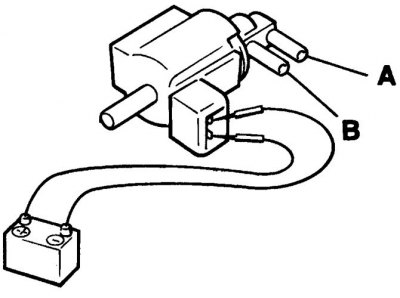
1. When power is applied (12V), air should flow freely through ports A and B.
2. If the test result is negative, the valve should be replaced.
3. Remove the air ejection valve (see below).
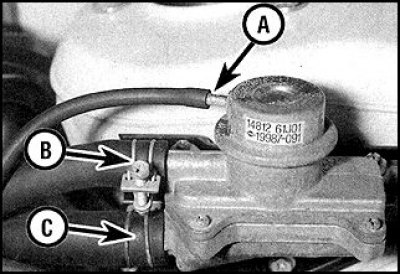
4. When blowing through the fitting B, air should not pass. If a vacuum is created on the fitting A, then air should pass from B to C, in the opposite direction (from C to B) air should not pass under any conditions (A is the vacuum hose from the solenoid valve, B is the hose from the air filter, C is to the exhaust manifold).
5. If the test result is negative, the valve should be replaced.
Solenoid valve
Replacement
1. The solenoid valve is screwed into the left side of the intake manifold.
2. Disconnect the battery from ground, disconnect the connector.
3. Mark the order in which all hoses are connected.
4. Loosen the clamps and disconnect the hoses.
5. Remove the valve from the bracket.
6. Installation is carried out in reverse order.
Air ejection valve
Replacement
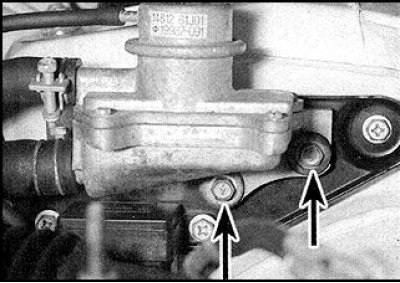
1. The air ejection valve is mounted on the left suspension cap.
Information copied from the portal (NISSANBOOK.RU)
2. To replace the valve, disconnect the hoses (indicated by arrows).
3. Loosen the bolts and remove the valve.
4. Installation is carried out in reverse order.
Idle speed corrector
Examination
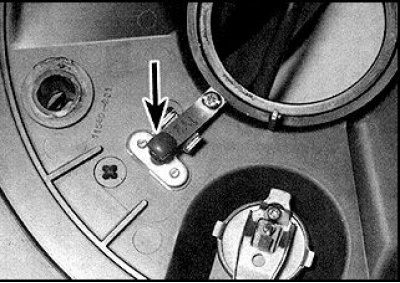
1. Remove the air cleaner cover. Idle speed control valve (indicated by the arrow) mounted in the bottom of the filter housing.
2. Prepare a thermometer and a hair dryer. Heat the valve with a hair dryer. The valve should be closed at a temperature below 55°C, slightly open in the range of 55–65°C and fully open at a temperature above 65°C. If there are 2 valves, then the temperature characteristics of one valve are exactly the same, and the second valve is closed at a temperature below 65°C, slightly opens in the range of 65–75°C and fully opens at a temperature above 75°C. When completely cooled, the valve should be fully closed.
3. If the test results are negative, replace the valve.
Replacement of the correction valve
1. Remove the air filter.
2. Disconnect the hose, unscrew the screws and remove the valve.
3. The valve is installed in the reverse order.
Air shock absorber
Examination
When pushing the air shock absorber rod, resistance should be felt, and when releasing, the rod should quickly return to its original position.
Otherwise, replace the air shock absorber.
Replacement
1. On carburetor engines, unscrew the 2 screws and remove the valve from the carburetor.
2. On injection engines: Loosen the nut and remove the valve from the throttle body bracket.
3. Install the air shock absorber in the reverse order and check the adjustment. On a warm engine, the air shock absorber rod should touch the adjusting screw at 1900±200 rpm. To adjust, unscrew the lock nut and set the screw to the desired position at the specified speed, check the adjustment again.