


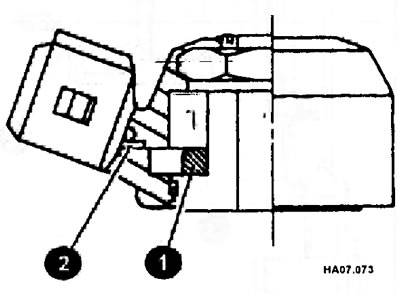
1 - piezoelectric element; 2- contact
The knock sensor is an additional sensor that is used to detect the onset of detonation.
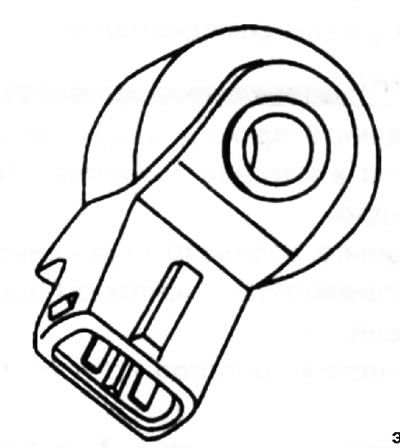
When the knock sensor detects vibrations from detonation knocks, it signals the electronic control unit (ECM), which immediately reduces the ignition timing, i.e., the ignition timing is retarded by several degrees until the detonation stops.
The most obvious symptom of a knock sensor malfunction is an audible ringing (detonation), especially during low-load acceleration. Minor detonation usually does not cause damage, but severe detonation over a long period of time will cause engine damage. Knock sensors sometimes confuse detonation sounds with other sounds, such as connecting rod knocks or worn pistons. The result of constant retarded ignition timing will be reduced fuel economy and reduced engine power.
It should also be kept in mind that most engine detonations are not caused by the knock sensor. The reasons may be the following:
♦ too high compression due to carbon deposits in the cylinders;
♦ too much ignition advance;
♦ lean air-fuel mixture;
♦ vacuum leaks;
♦ engine overheating;
♦ low-octane gasoline.
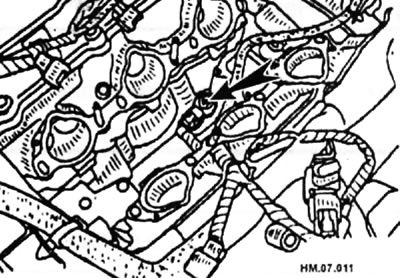
Knock sensor (arrow in the figureNM.07.011) is installed on the cylinder block and can be seen if the intake manifold is removed.
To determine the fault code:
- After starting the engine, let it idle for 5 seconds.
- After turning the ignition key to the OFF position, wait 3 seconds, then turn it to the ON position.
- Turn on self-diagnosis mode.
Examination
- Connect the inductive timing light wire to the ignition coil of the first cylinder.
- Connect an AC voltmeter or oscilloscope to the knock sensor terminals.
- Let the engine idle.
- To check the knock sensor, tap the intake manifold with a wrench (not too hard, otherwise you can damage the collector) or on the cylinder block near the sensor when the engine is idling. Never tap on the sensor itself. Use a strobe light to observe the ignition timing marks. The vibrations from the key strikes are sufficient for the knock sensor to signal the computer to adjust the ignition timing. The ignition timing should immediately shift toward the retarded position, and a small voltage (approximately 1 V) should be detected on the oscilloscope or voltmeter. If nothing happens, check the wires, connectors, or the electronic control unit (ECM) itself for obvious shorts or faults.
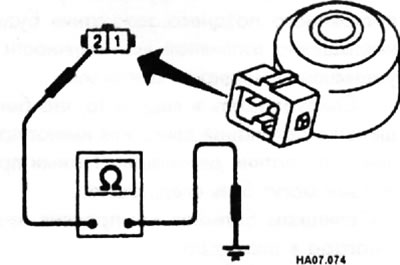
- After disconnecting the knock sensor harness connector, check the resistance between contact (2) and ground.
The required resistance value is 500-620 kOhm (at 25°C).