


Front Axle and Suspension Assembly Components (and related ones) hardtop and Station Wagon models
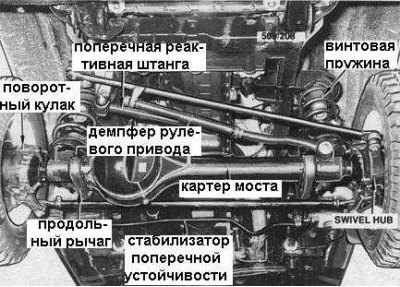
All models have a final drive ratio of 4.111:1, with the exception of the Patrol ST and Ti manual transmissions, the 3.0L, and the Maverick XL. The 3.0L has a final drive ratio of 4.375:1, while the ST, XL, and Ti have a final drive ratio of 3.900:1.
The driven gear assembly of the main transmission with the differential is mounted in two tapered roller bearings, and the radial play and preload are adjusted using special nuts.
The drive pinion is also installed in two tapered roller bearings, the preload of which is determined by selecting an adjusting washer of the required thickness installed between them. The seating depth of the drive pinion is adjusted by selecting an adjusting washer installed between the pinion and the cone of the inner bearing.
The drive shafts are equipped with non-separable Birfield constant velocity joints (CV joints) at their outer ends. In case of failure, the CV joint is replaced together with the drive shaft. The outer end of the drive shaft is installed in a needle roller bearing enclosed in the pivot pin. Axial support is provided by means of a brass washer installed between the CV joint and the pivot pin, and axial play is adjusted by selecting a fastening locking ring of the required thickness.
The steering knuckle is mounted on the axle housing journal in two tapered roller bearings. Preload is achieved by selecting adjusting washers of the required thickness installed between the bearing caps and the knuckle. The drive shafts transmit their rotation to the front wheel hubs via a disengaging drive.
The disengaging drive allows the drive shafts to be disconnected from the wheel hubs when there is no need to use the all-wheel drive mode. All models, except the Nissan Patrol Ti, are equipped with hubs with a manual drive disengagement. Disengagement is performed by rotating the selector handle. In the locked (LOCK) position, the friction-gear assembly of the disengaging drive is engaged with the clutch gear, which is connected by means of splines to the end of the drive shaft.
Nissan Patrol Ti models are equipped with an automatic front hub disengagement drive. Disengagement can also be duplicated manually using a wrench. In the LOCK position, the automatic drive functions in the same way as the manual one. In the AUTO position, with 4WD mode selected, rotation of the drive shaft causes the cam inside the hub assembly to rise up along the guide on the inner brake assembly. This causes the sliding pinion equipped with splines to shift along the drive shaft and engage with the pinion located inside the hub assembly. Vehicle movement in the opposite direction causes the drive to instantly disengage before the cam rises along the opposite guide.
If the disengaging drive fails to operate, it should be replaced as an assembly. However, it should be noted that the manual shift drive can be partially disassembled for the purpose of performing regular maintenance procedures, in addition, the clutch gear is a replaceable part.
To maintain the lubrication of the front axle components at the required level, the vehicle should be driven monthly for a distance of at least 16 km with the front wheel hub drive turned on in the LOCK position.
The front suspension can be made either on leaf springs or on coil springs.
In the first case, the leading front axle of the car is suspended on semi-elliptical leaf springs (leaf springs) and is equipped with double-acting shock absorbers. The springs are mounted on rubber cushions, their front side is secured by means of a shackle, the rear side - by an anchor pin.
The shock absorbers are also mounted on rubber cushions. The shock absorber is attached to the spring U-bolt support plate at the bottom, while its upper part is attached to the vehicle chassis frame.
Front leaf spring suspension components
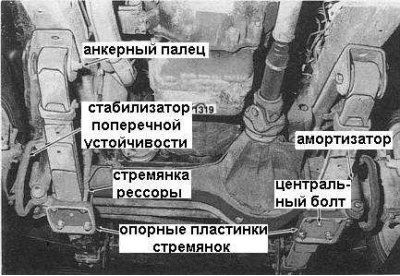
The front axle rests on springs and is fixed to them with a central bolt. The axle is secured with U-shaped bolts on the stirrups.
The anti-roll bar is secured to the front axle housing by means of two support brackets fitted with rubber-metal bushings, while its outer ends are secured to the chassis brackets by means of struts and rubber bushings.
In the case of a spring suspension, the leading front axle is suspended by means of longitudinal levers and a transverse reaction rod. The long travel of the coil springs is controlled by double-acting hydraulic shock absorbers. On some models, an anti-roll bar connects the longitudinal suspension arms to the vehicle chassis, making the vehicle easier to control by limiting the rocking process of the body during movement. The role of the axial bearings of the components is performed by maintenance-free rubber bushings, which significantly reduces the level of noise emitted by the suspension. Rubber compression limiters are installed at the top of the coil spring supports, preventing direct contact of the metal components when the springs are fully compressed.
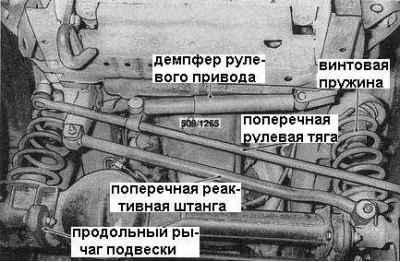
The steering damper can be mounted either on the transverse reaction bar of the suspension or on the chassis frame (see accompanying illustration).
The design of the coil spring suspension, installed as an additional equipment on the 4.2 L EFI models with Utility (Van) and Mini-truck bodies of the late years of production (since 1992), is similar to that for the Hardtop and Estate models. The order of all the procedures described below remains unchanged, with the exception that the tightening force of the nut fastening the transverse torque rod to the front axle housing on models produced since October 1994 is 91÷121 Nm.