


Table of contents: Checking the brake fluid level ↓ Checking brake lines ↓ Replacing brake fluid ↓ Procedure for removing air from the…↓
Checking the brake fluid level
Make sure that the brake fluid level in the expansion tank is within the acceptable limits (between the "MAX" and "MIN" marks).
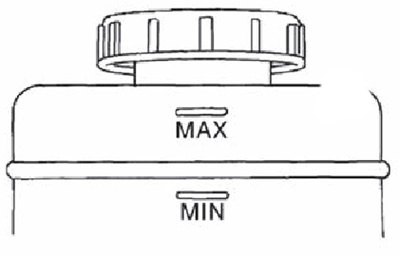
Visually check for any signs of leaks around the expansion tank.
If the brake fluid level is too low (below the "MIN" mark), check the brake system for leaks.
(The text was borrowed from here: NissanBook)
Release the parking brake lever and make sure that the brake warning light goes out. If not, check the brake system for leaks.
Checking brake lines
1. Check the brake lines (pipelines and hoses) for cracks, deformation or other damage. Replace any damaged parts with new ones.
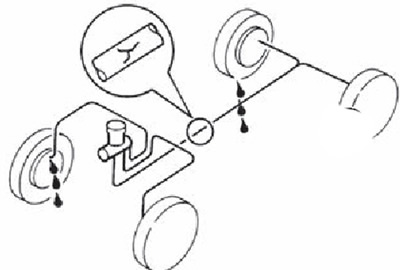
2. Check the tightness of the system by pressing the brake pedal all the way while the engine is running.
Attention: If leaks are detected, tighten the connections or, if necessary, replace damaged parts.
Replacing brake fluid
Attention.
- Avoid contact of triose fluid with painted surfaces. If this does happen, remove brake fluid immediately and wash the area with plenty of water.
- Before replacing the brake fluid, turn off the ignition and disconnect the ABS electronic control unit connector or the negative terminal of the battery.
1. Connect the vinyl tube to the bleed nipple.
2. Press the brake pedal and unscrew the bleeder screw to gradually drain the brake fluid.
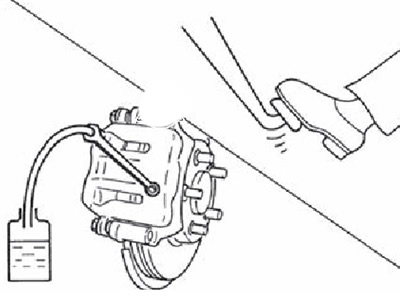
3. Make sure there are no foreign substances in the expansion tank, then fill it with fresh brake fluid.
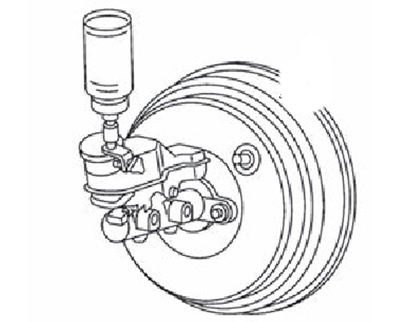
Caution: Do not reuse drained brake fluid.
4. Loosen the bleed screw, slowly press the brake pedal all the way down and release. Repeat this procedure at 2-3 second intervals until fresh brake fluid starts to flow out, then screw in the bleed screw with the brake pedal pressed. Repeat this procedure for each tire.
5. Remove air from the brake system.
Procedure for removing air from the brake system (bleeding)
Attention.
- Before carrying out work, disconnect the ABS drive and electronic control unit connectors or the negative terminal of the battery.
- While bleeding, monitor the brake fluid level in the master cylinder.
- Use only fresh brake fluid for filling.
1. Connect the vinyl tube to the rear right bleed nipple.
2. Press the brake pedal all the way down 4-5 times.
3. With the brake pedal fully depressed, loosen the bleed screw to release air, then immediately tighten it.
4. Repeat steps 2 and 3 until no more air comes out.
5. Tighten the bleed nipple to the specified tightening torque.
6. Repeating steps 1 through 5, with the master cylinder reservoir at least half full, bleed air from the rear right, front left, rear left and front right brake mechanisms in the order given.
7. After the air removal procedure, make sure that the brake fluid level is within the permissible limits. If necessary, top up the brake fluid to the required level.