


Caution: Broken valve springs and damaged valve stem seals can be replaced without removing the cylinder head. This operation typically requires specialized tools and a source of compressed air, so please read this section carefully and purchase or rent the necessary tools before beginning. If you do not have a source of compressed air, you can use a piece of nylon rope to prevent the valves from falling into the cylinder while you do this job.
- Remove the cover from the cylinder head.
- Remove the camshafts and tappets.
- Remove all spark plugs.
- Turn the crankshaft so that the piston of the desired cylinder is in the TDC position of the compression stroke. When replacing all valve stem seals, start with the first cylinder and work on each cylinder in turn. Move from cylinder to cylinder in firing order (1-2-3-4-5-6).
- Screw the adapter into the spark plug hole and connect a hose from a compressed air source to it. This adapter can be purchased at specialized auto stores. Many cylinder compression testers use a screw-in adapter that can be installed in this case.
- Direct compressed air into the cylinder.
Caution: The piston may be forced downwards by compressed air, causing the crankshaft to rotate unexpectedly. If the wrench used to turn the crankshaft is still on the crankshaft pulley mounting bolt, an unexpected rotation of the crankshaft may cause injury.
- The valves must be held in place using compressed air. If the valve or seat surfaces are in poor condition, leaks may prevent compressed air from holding the valves - refer to the alternative method described below.
- If you don't have a source of compressed air, you can use an alternative method. To do this, set the piston to the position before TDC on the compression stroke, then pass a long piece of nylon rope through the spark plug hole until it fills the combustion chamber. Be sure to leave the end of the rope hanging out of the engine so it can be easily pulled out. Using a large wrench, turn the crankshaft in the normal direction of rotation until a slight resistance is felt.
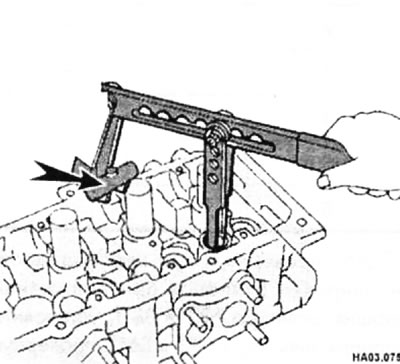
- Using a special spring compressor (arrow), remove the valve keepers with small, needle-nose pliers.
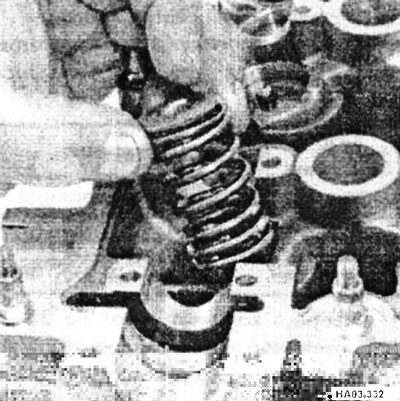
- Remove the spring plate, valve spring.
- Remove the valve guide seal (arrow) and spring seat.
Caution: The valve guide bushing is very fragile, do not break it when removing the oil seal.
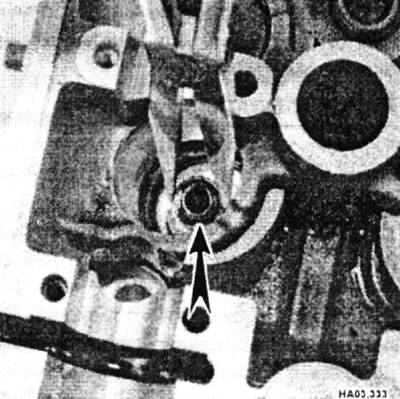
- Wrap a rubber band or tape around the top of the valve stem to prevent the valve from falling into the combustion chamber, then shut off the air supply to the engine cylinder.
Caution: If a nylon rope was used instead of air pressure, turn the crankshaft slightly in the direction opposite to normal rotation.
- Check the valve stem for damage. Rotate the valve in the guide bushing and check for movement of the eccentric at the end, which would indicate that the valve is bent.
- Move the valve up and down in the guide bushing and make sure it does not stick. If the valve stem sticks, it means either the valve is bent or the guide bushing is damaged. In any case, it is necessary to remove the head for repair.
- Reapply air pressure to the cylinder to hold the valve closed, then remove the rubber band or film from the valve stem. If a nylon rope was used, turn the crankshaft in the direction of normal rotation until a slight resistance is felt.
- Install the spring seat.
- Lubricate the valve stem with engine oil and install a new seal.
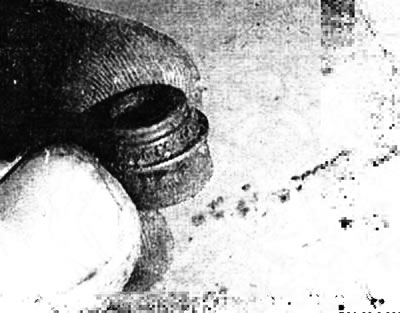
Attention: The oil seal is considered to be correctly installed if the height (H) from the valve spring seat to the oil seal shoulder is 14.6±0.3 mm.
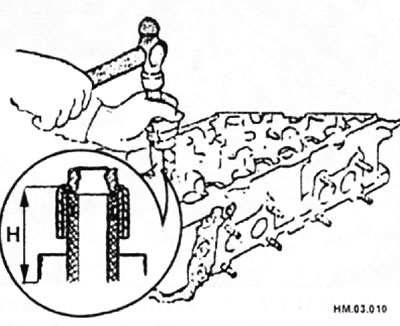
- Install the spring and spring plate
[The text is published on the website Nissanbook.ru]
- Compress the spring with a spring puller and carefully insert the crackers into the groove. Apply a small amount of grease to the inside of each cracker to hold it in place.
- Relieve pressure from the compressor and ensure that the crackers are properly seated.
- Use a rubber hammer to tap the valve down.
- Disconnect the compressed air hose and remove the adapter from the spark plug hole. If a nylon rope was used instead of compressed air, remove it from the cylinder.
- Install the camshafts and adjust the valve clearance.
- Install the cylinder head cover.
- Start the engine and let it run, then check for leaks and/or unusual sounds coming from the valve cover.