


2. Check the clutch linings for usability by measuring the distance from the top surface of the lining to the top side of the rivets (illustration below). If the dimension is less than 0.30 mm, the disc should be replaced. The disc should be replaced, and if this dimension approaches the wear limit.
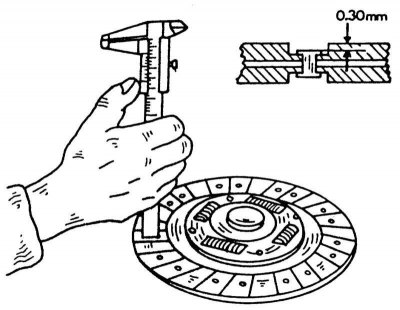
Measuring the thickness of the driven disk lining to the rivet heads.
3. To check the runout of the driven disk, it should be clamped between the centers of a lathe on a suitable rod or clutch shaft. Install a dial indicator next to the disk so that the measuring probe is adjacent to the edge of the disk, namely 95 mm (carburetor engine) or 102.5 mm (other engines) from the midpoint of the disc ("R" in the illustration below). Slowly rotate the disc and read the readings. If the reading is greater than 1.0 mm, the disc can be carefully aligned with pliers. Otherwise, replace the disc. Check the mating of the driven disc hub on the splined connection of the clutch shaft. To do this, put the disc on and grasp it by the outer edge with your thumb and forefinger. Move the disc back and forth in the direction of rotation. If there is play greater than 0.8 mm, there is wear in the splined connection. In most cases, the cause of this should be sought in the driven disc. Check the inner ends of the diaphragm spring pins for wear. If there are deep traces of wear, the entire clutch must be replaced. The ends of the diaphragm spring should be level within 0.8 mm.
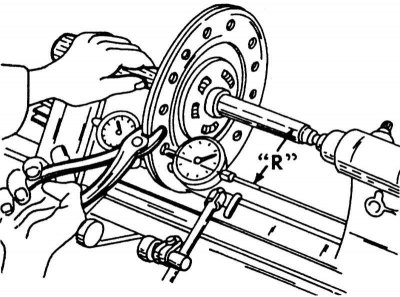
Measuring the runout of the driven disk. Set the indicator according to the radius size "R". If necessary, align slightly with pliers.
4. Bent fingers can be straightened. This usually involves using a special tool as shown in the illustration below, but you can also cut a slit in a steel strip and bend the ends as shown in the illustration.
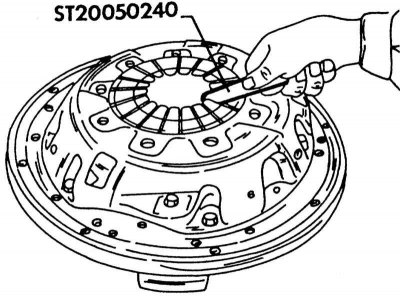
Bending the ends of the diaphragm spring fingers.