


Note: Default values for all tests are given in the section "Service data and specification" at the end of this chapter.
Cylinder head deformation
Note: When performing this check, it is also necessary to check the cylinder block for deformation.
1. Use a scraper to remove oil and water film from the surface (as inclusions), gasket, sealant, carbon deposits, etc.
Note: Be careful not to allow water or gasket particles to enter the lubrication passages.
2. Using a straightedge and a set of flat feeler gauges, measure the non-flatness of the cylinder head surface in six directions (A-F). If the results exceed the maximum permissible value, it is necessary to replace the cylinder head with a new one.
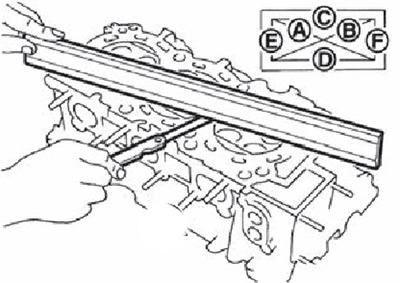
If the measured values are not within the norm, replace the cylinder head with the upper part.
Note: The cylinder head is machined together with the upper part, so it is not possible to replace these parts separately. Replace the cylinder head only as a set with the upper part.
Valve sizes
Check the dimensions of each valve.
If the dimensions are not within the norm, replace the valve and check the fit in the valve seat.
[Information copied from the portal: nissanbook]
Valve guide clearance
Using a micrometer (A), measure the diameter of the valve stem.
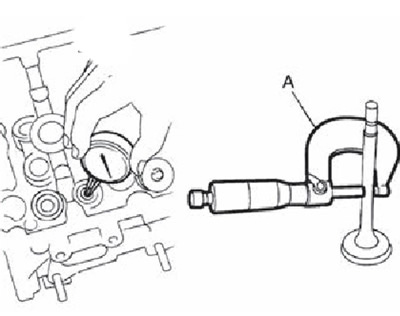
Measure the inside diameter of the valve guide bushing using a bore gauge.
Calculate the valve guide clearance:
(Clearance in the guide bushing) - (Inner diameter of guide bushing) - (Valve stem diameter)
If the obtained value does not correspond to the norm, replace the valve and/or the cylinder head with the upper part.
Valve seating
After checking that the valve sizes and guide bushings correspond to the nominal values, check that the valve is seated correctly in the seat.
Apply a thin coat of Prussian blue to the valve bevel. Press the working bevel of the valve against the seat, but do not rotate the valve. Then remove the valve and inspect the seat and the valve bevel.
If the paint is printed all the way around the valve seat, the guide bushing and valve seat are aligned.
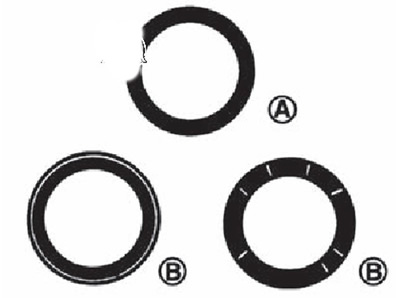
A. It's fine.
B. Not normal.
If not, regrind the chamfer and check again. Replace the valve seat with a new one if the valve cannot be seated correctly in the seat.
Spring dimensions and elasticity characteristics
Check the load created at a certain valve spring height using a special stand.
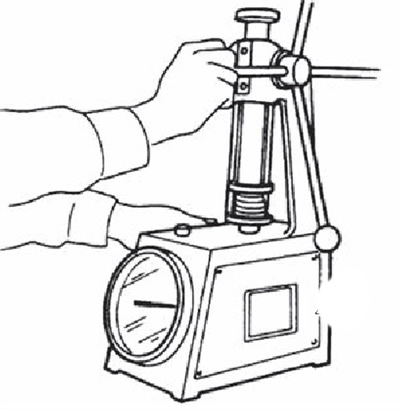
If at least one of the obtained values does not correspond to the norm, replace the valve spring with a new one.