

Description
When a malfunction occurs in xenon headlights (for example, the headlight does not light up, blinks, etc.), it can be assumed that this is due to insufficient light intensity.
In most cases, the cause of this malfunction is considered to be the xenon lamp.
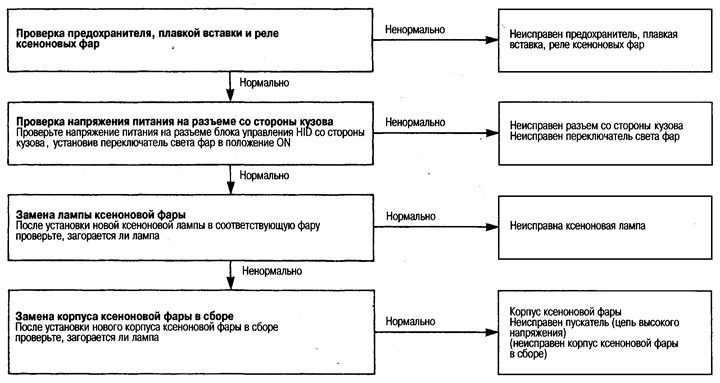
Since it is unlikely that the high-voltage gas discharge lamp (HID) control unit and the headlight housing will malfunction, it is necessary to find out problem area by following the procedure described below.
Attention:
Disconnect and connect the connector with the headlight switch in the OFF position.
When the headlight is on (headlight switch in the ON position), do not touch the wires and HID control unit inside the headlight or the metal parts of the headlight with your hands.
Check the operation of the headlight by connecting a working power source to the connector on the body side.
If the cause of the malfunction is in the electrical system, check whether the fuse or fuse link is blown, whether there is a broken wire near the connector, whether the contacts are damaged, whether the connector is tightly connected, etc.
Do not work with wet hands.
Electrical diagram
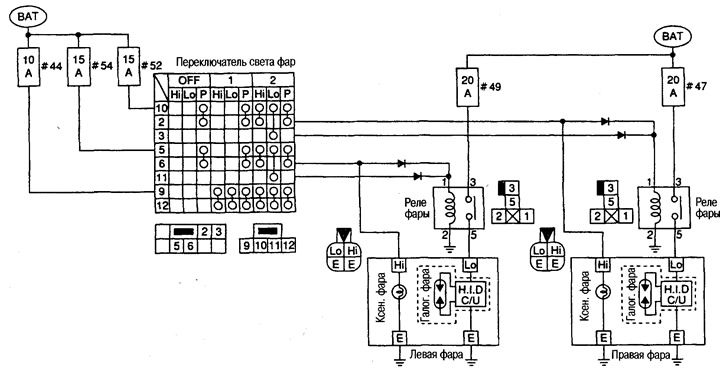
The text was borrowed from here (www.NissanBook.ru)
Attention:
Do not attempt to diagnose the HID control unit circuit using a tester.
Do not disassemble the HID control unit (lamp socket wiring and control unit wiring).
Note:
Immediately after the headlight comes on, the light intensity and color of the glow fluctuate, but this is not a malfunction.
When the lamp reaches the end of its service life, the light intensity decreases significantly and/or the lamp flickers frequently and the light color takes on a reddish tint.
Diagnostic procedure