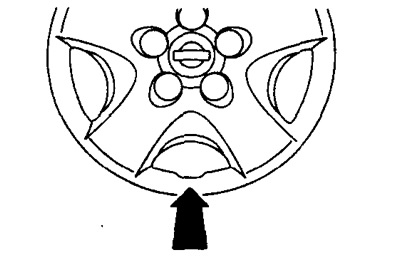


Stop the vehicle on a level, hard surface where you can work safely without disturbing traffic.
Remove the vehicle tool kit, jack and spare wheel from the luggage compartment.
If necessary, put up a warning triangle or warning light.
2. Raise the car with a jack.
Turn the jack by hand until the jack groove fits into the mounting location on the vehicle body.
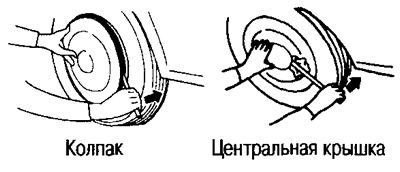
3. Using a suitable tool, carefully, without scratching (put a rag underneath), remove the cap or center cover.
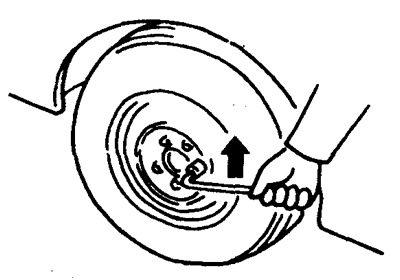
4. Using a wheel wrench, loosen the nuts approximately one turn counterclockwise.
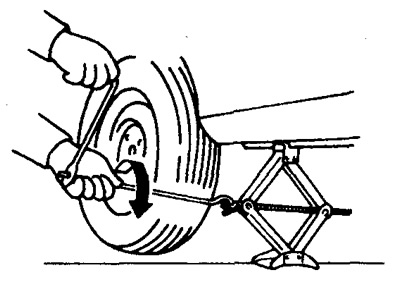
5. Rotate the jack using the handle to raise the car so that the wheel is slightly raised off the ground.
6. Unscrew the nuts and remove the punctured wheel.
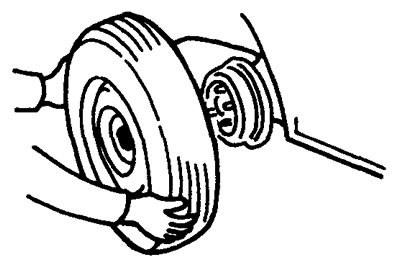
7. Wipe the contact surfaces of the hub and disc and install the spare wheel.
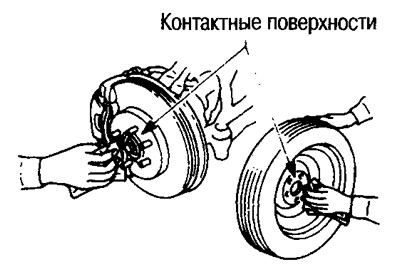
Note:
If there is dirt on the contact surfaces, the nuts may loosen and the wheel may come off while driving.
Install the spare tire with the side with the sticker facing outward.
8. Tighten the nuts clockwise and tighten them slightly.
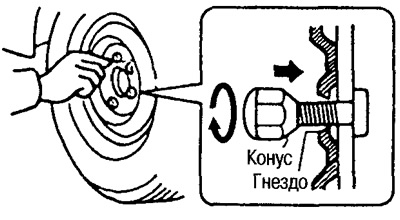
Note: Do not lubricate the bolts and nuts with oil or grease, as this may cause the nuts to loosen while riding.
9. Tighten the nuts in 2-3 passes in the sequence shown in the figure.
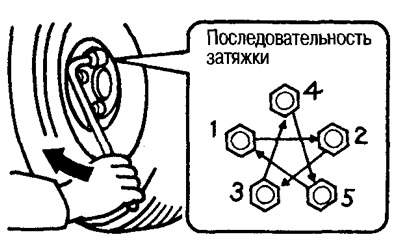
10. Lower and remove the jack, then tighten the nuts again in the sequence indicated in step 9.
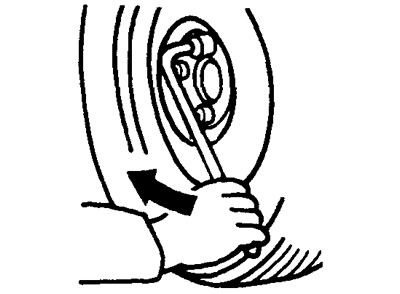
Wheel nut tightening torque: 98.1-117 Nm (10.0-12.0 kg·m)
Caution: Do not tighten the nuts with excessive force, such as by stepping on the wrench with your foot or placing a tube over the wrench, as this may cause the bolts to break.
11. Place the tool kit and jack in the luggage compartment. Install the punctured tire in place of the spare tire.
Caution: After a short mileage, check the tightness of the wheel nuts.
Note:
A cap cannot be placed on the spare tire.
Replace the spare tire with a road tire as soon as possible.
When installing the cap on a road wheel, align the recess on the cap with the air valve.