


Attention! Proceed with the procedure only after the engine has completely cooled down! See also the warnings at the beginning of the Section Antifreeze - general information. Remember that when the ignition is on, the cooling fan may operate even when the engine is turned off.
Examination
1. The system for indicating the temperature of the coolant consists of a meter mounted in the instrument panel and an information sensor placed on the engine. There are several CTS sensors on the vehicle, however, only one of them is used in the display system.
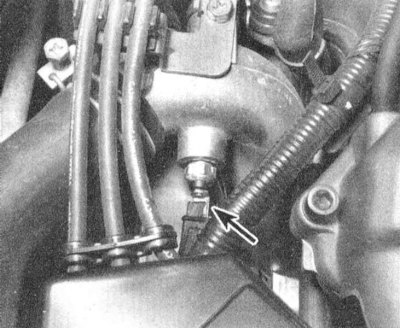 | 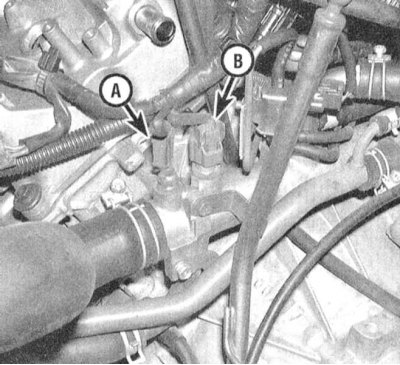 |
2. If the meter detects overheating with the engine clearly cold, check the wiring in the circuit section between the instrument panel and the sensor unit for signs of a short to ground.
3. If the meter does not function at all (the arrow remains stationary even after a 10-minute warm-up of the engine) with good fuses, stop the engine and disconnect the wiring from the temperature sensor. Use a jumper wire to connect the sensor wire to ground. Switch on the ignition for a short time without starting the engine. If the indicator needle deviates to the end of the scale, replace the sensor.
4. To check the sensor, disconnect the electrical wiring from it and connect an ohmmeter between the pin at the top of the sensor and the mass of the power unit. With a slightly warm engine (about 60°С) the ohmmeter reading should be about 70 ÷ 90 ohms for models before 1998 rev. and 170 ÷ 200 Ohm for 1999 models. After the engine has warmed up to a temperature of 100°C, the instrument reading should drop to the value (21 ÷ 24) / (47 ÷ 53) Ohm respectively, otherwise replace the temperature sensor.
Replacement
Remove the sensor from the engine (prepare to collect spilled liquid) and quickly install a new one in its place, the threads of which must first be lubricated with conductive sealant (not teflon tape or fum tape). Finally, check the coolant level.