


Warning! Avoid touching the impeller blades with your hands, tools, or clothing. To avoid injury or equipment damage, do not start the engine if the fan is faulty. Do not attempt to repair broken impeller blades - replace the entire impeller!
Examination
1. All models are equipped with a two-speed cooling fan assembly, housed in a plastic casing, fixed behind the radiator.
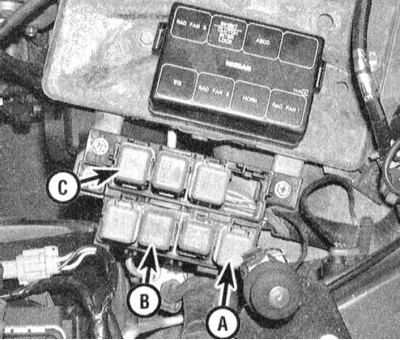
A - Low speed relay
B - High Speed Relay No.1
C - High Speed Relay No.2
2. The operation of the fans is controlled by the PCM via a set of high-speed mode relays. The ECT sensor informs the PCM of the current coolant temperature and the module, based on the analysis of incoming data, switches on the corresponding fan speed mode. At idle speed, the low-speed mode is switched on. When the coolant temperature reaches 106°C, the PCM switches on high-speed mode No.1 or No.2. The presence of the second high-speed mode guarantees proper operation of the fans even if one of the relays fails. The relays continue to function properly even if the ECT sensor fails.
3. If the fan continues to operate continuously, the condition of the relay and coolant temperature sensor should be checked. The procedure for diagnosing the sensor is described in Chapter 6. The diagnostics of the relay is described in Chapter On-board electrical equipment.
4. Warm up the engine to normal operating temperature - the fans should turn on, otherwise check the condition of the corresponding fuses in the fuse box located in the engine compartment or in the passenger compartment of the car (see Chapter On-board electrical equipment).
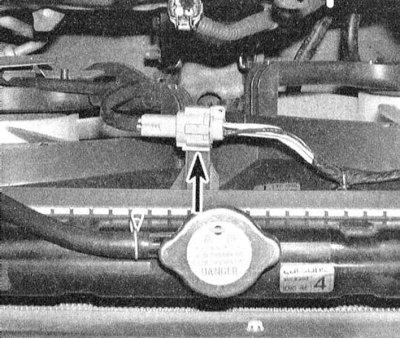
5. If the fuses are OK, disconnect the wiring from the fan motor. Using a fused jumper wire, connect either of the two motor power terminals to the battery. Ground the black wire terminal to ground. If the fan does not operate, it must be replaced.
6. If the fan operates properly when power is supplied directly from the battery, connect a voltmeter to the chassis ground and test both terminals of the electric motor power supply on the harness side. With the engine warmed up to normal operating temperature, (according to the temperature gauge in the instrument panel) there should be battery voltage at one of the terminals.
7. Using an ohmmeter, check the condition of the ground loop - there should be a resistance of no more than 5 ohms between the black wire terminal and the chassis ground. If the device readings are higher, the cause of the violation should be determined and eliminated.
8. If during the check described in paragraph 6 there is no power at the connector terminals, check the serviceability of its supply to the low-grade mode relay. At one of the receiving terminals of the relay socket, the battery voltage should be present constantly, at the other - only in the ON or START position of the ignition key.
9. If the power supply to the socket is correct, check the conductivity of the relay itself (see Chapter On-board electrical equipment).
Replacement
1. Disconnect the negative cable from the battery.
Warning! If the car stereo system is equipped with a security code, make sure you have the correct combination to activate the audio system before disconnecting the battery!
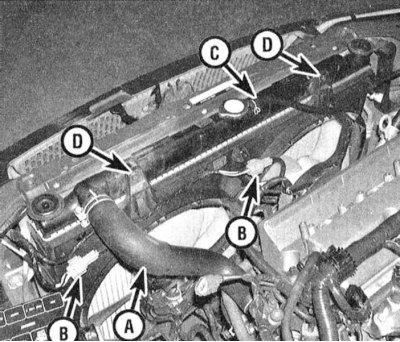
2. Disconnect the upper and overflow hoses from the radiator.
(See the source on the portal: «www.nissanbook.ru»)
3. Remove the two casing mounting bolts and remove the fan assembly from the vehicle.
Note: The lower part of the shroud is secured to the radiator using clamps.
4. Loosen the impeller mounting nut to the motor shaft.
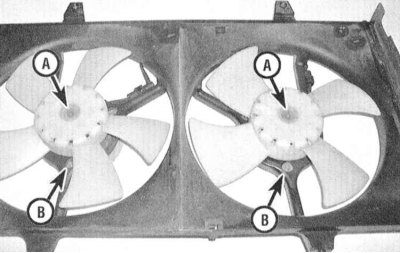
5. Remove the screws securing the motor to the casing.
6. Using an assistant, tap the motor shaft out of the housing assembly with a hammer.
7. Installation is carried out in reverse order.