


2. There are two ways to check the water pump without removing it from the engine. A faulty pump must be replaced. The first is the simplest: with the engine running and warmed up to normal operating temperature, squeeze the upper radiator hose. If the water pump is functioning properly, you should clearly hear liquid pulsations inside the hose.
Caution! Avoid touching the fan blades of the cooling system!
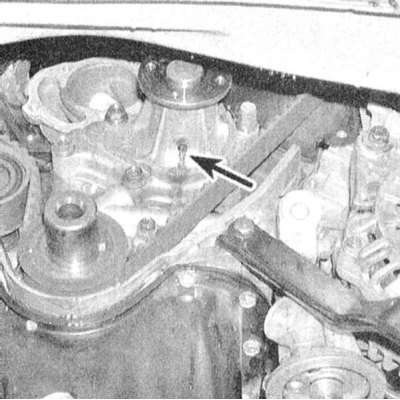
3. The water pump is equipped with an inspection/vent hole. If the seal fails, coolant will start to leak from the hole. On SOHC engines, remove the timing cover. Have a flashlight and a small mirror ready - the hole is located at the bottom of the pump body. The presence of brownish deposits around the hole indicates a faulty seal - slight discoloration of the surface (light gray ring) should not be a concern. On DOHC engines, the inspection hole vents coolant to the outside between the timing cover and the engine block.
4. When the pump shaft bearings fail, a howling sound may be heard at the front of the engine while the engine is running, which should not be confused with the whistling sound made by the drive belt when it is released. On SOHC engines, bearing wear can be detected by the presence of play when the pump pulley is rocked (don't forget to turn off the engine and remove the belt from the pulley first). On DOHC engines, loosen the main timing chain and remove the special pump access cover - the access hole is provided in the front timing cover. Bearing wear is determined by the presence of play in the shaft when rocking the pump drive sprocket
[The article is located on the website: www.nissanbook.ru]
5. Even in the absence of external signs of wear, a final conclusion about the condition of the water pump can only be made after removing it and examining it in more detail - often the blades on the back of the rotor are severely damaged by corrosion, which leads to a significant decrease in pump performance.
Replacement
Warning! Proceed with the procedure only after the engine has completely cooled down! See also warnings at the beginning of the Section Antifreeze - general information.
1. Disconnect the negative cable from the battery.
Warning! If the car stereo system is equipped with a security code, make sure you have the correct combination to activate the audio system before disconnecting the battery!
2. Drain the cooling system (see Chapter Settings and ongoing maintenance). If the coolant has been changed recently, save it for future use (see warning in Section Antifreeze - general information).
3. Remove the drive belts (see Chapter Settings and ongoing maintenance).
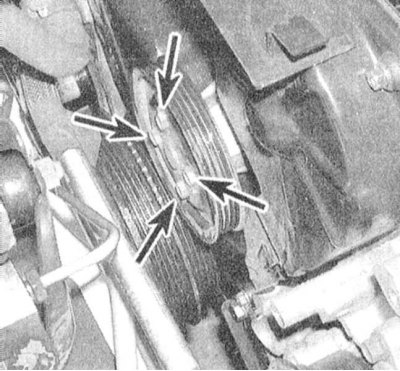
4. On SOHC engines, lock the water pump pulley from turning with a strap wrench and loosen the four mounting bolts. Remove the pulley and timing belt covers.
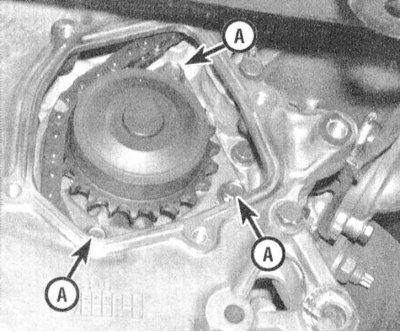
5. On DOHC engines, remove the drive belt idler pulley bracket and the right powertrain mount assembly with its brackets. Also remove the main timing chain tensioner cover from the front timing cover. Press the chain tensioner piston inward and insert a pin of the appropriate diameter into the tensioner locking hole. Rotate the crankshaft 20° counterclockwise to loosen the chain on the water pump sprockets.
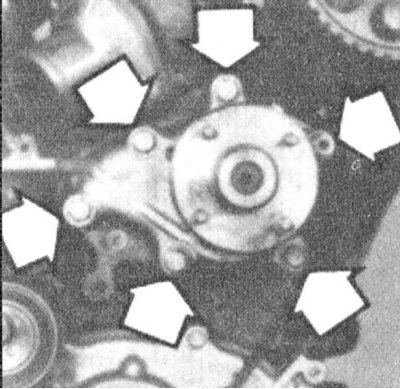
6. Remove the mounting bolts and remove the pump from the engine. Check the impeller blades on the back of the rotor for signs of corrosion or damage.
 |
 |
7. Clean the threads of the mounting bolts and bolt holes, completely removing traces of corrosion and old sealant and restoring damaged threads.
8. Make sure that the size characteristics of the new and old pumps are identical.
9. Scrape off any remaining old sealant from the mating surface of the engine block.
10. Thoroughly wipe the mating surfaces of the new pump with a rag soaked in acetone.
11. On SOHC engines, apply a thin coat of RTV sealant to the mating surface of the new pump, then gently press the new gasket into place. On DOHC engines, install the new O-ring onto the pump, then lightly lubricate it with heavy-duty grease to help seat the assembly into the engine block.
12. Carefully place the pump in its original place, screw in the mounting bolts and tighten them by hand.
Note: Before screwing in the bolts, coat the threads with RTV sealant. Make sure all the provided guide pins are in place.
13. In several stages (1/4 turn per set) tighten the fasteners to the specified torque. Remember that overtightening the bolts can damage the pump. On DOHC engines, rotate the crankshaft 20° clockwise to tighten the main chain on the pump sprocket, remove the locking pin from the tensioner and reinstall the tensioner and pump access covers.
Note: Caps should be installed with RTV sealant.
14. Reinstall all other components removed for access purposes.
15. Fill the cooling system and remove air locks from it (see Chapter Settings and ongoing maintenance). Start the engine and check for signs of coolant leaks.
Note: On DOHC engines, the valve train may initially produce increased noise until the high-pressure chamber is completely purged. To eliminate the noise, run the engine at 3,000 rpm for a while.