


Warning! The air conditioning system is under constant high pressure. Never disconnect refrigeration lines or remove any system components without first discharging the system. Discharging the air conditioning system must be done by an experienced technician in a car service workshop. Always wear safety glasses when disconnecting refrigeration lines!
When replacing air conditioning system components, a certain amount of replacement refrigeration oil will be required to fill the volume of the new unit. Use only oil suitable for use in R-134a systems (read the container label carefully).
Removal
Design of the NVR 140S compressor manufactured by ATSUGI
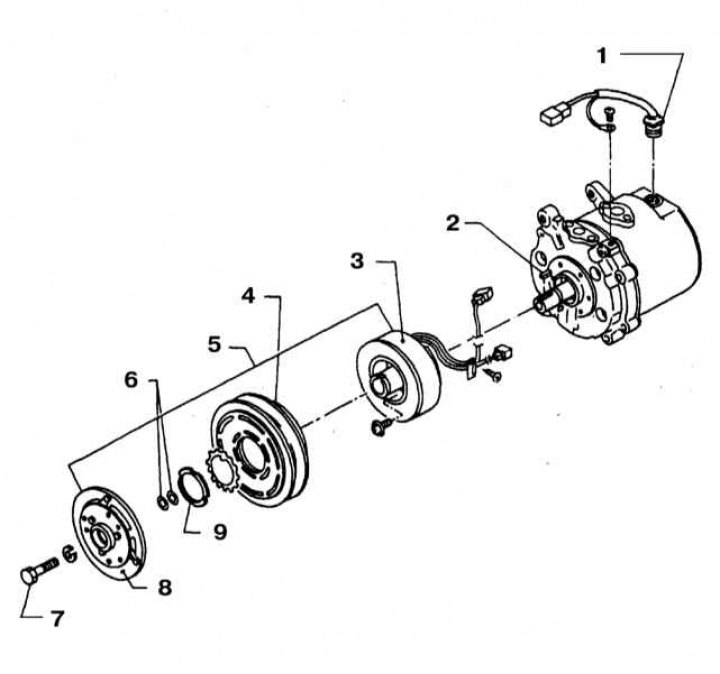
1 - Thermal fuse (10÷15 Nm); 2 - Key; 3 - Electromagnetic winding; 4 - Pulley; 5 - Clutch; 6 - Adjusting washers; 7 - Central bolt (9.1÷11.8 Nm); 8 - Clutch disc; 9 - Lock nut (29÷39 Nm)
The design of the V-6 compressor manufactured by CALSONIC
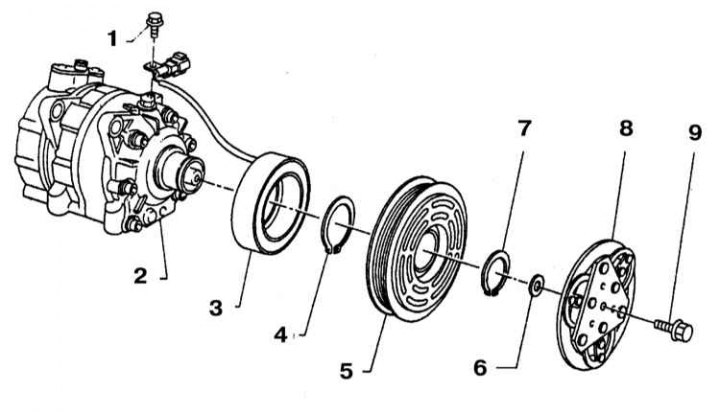
1 - Screw; 2 - Compressor block; 3 - Field winding; 4 - Thrust ring; 5 - Pulley; 6 - Gasket; 7 - Thrust ring; 8 - Clutch disc; 9 - Central bolt (14 Nm)
The design of the DKS-16H compressor manufactured by ZEXEL
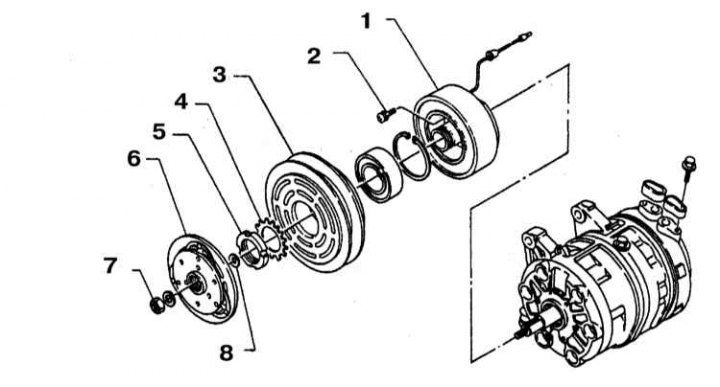
1 - Electromagnetic winding; 2 - Screw (5÷6 Nm); 3 - Pulley; 4 - lock washer; 5 - Lock nut (34÷39 Nm); 6 - Clutch disc; 7 - Shaft nut (14÷16 Nm); 8 - Adjusting washer
1. Discharge the air conditioning system in a specialized workshop.
2. Disconnect the negative cable from the battery.
Warning! If the car stereo system is equipped with a security code, make sure you have the correct combination to activate the audio system before disconnecting the battery!
3. Set the parking brake, support the rear wheels with wheel chocks, then jack up the front of the car and place it on supports.
4. Remove the compressor drive belt (see Chapter Settings and ongoing maintenance).
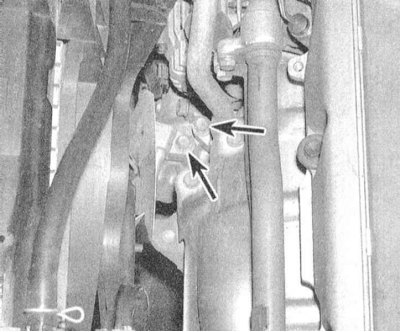
5. Disconnect the refrigeration lines from the compressor. Immediately plug the open ends of the tubes and fittings to prevent dirt and moisture from entering the system.
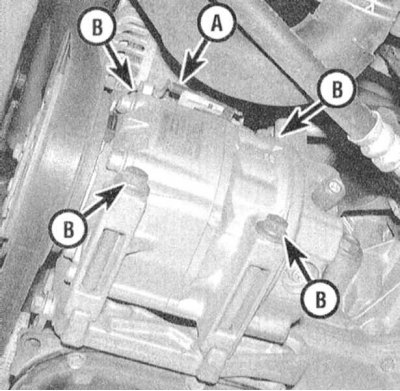
6. Disconnect the electrical wiring from the compressor, then loosen the mounting bolts and remove the assembly from the support bracket.
Note: The upper mounting bolts may not be fully removed and may remain in the compressor assembly until it is removed from the vehicle.
Service
The models of cars under consideration use one of three types of air conditioning compressors.
Compressor Clutch Replacement
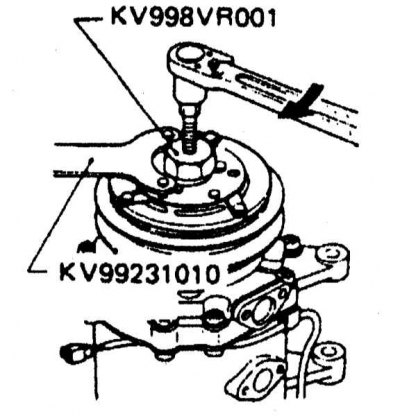
1. Unscrew the central bolt, locking the clutch disc with a wrench. The clutch can be removed using a special extractor.
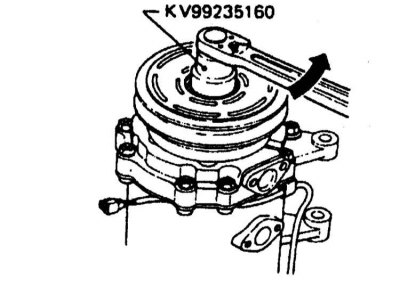
2. Bend the lock washer flag down, loosen the lock nut and remove the pulley.
3. If the mating surface shows signs of damage or traces of overheating, the clutch drive disc and pulley must be replaced.
4. Before installation, wipe the mating surface of the pulley with solvent.
5. Check the condition of the coil - pay attention to signs of loose contact and damage to the insulation.
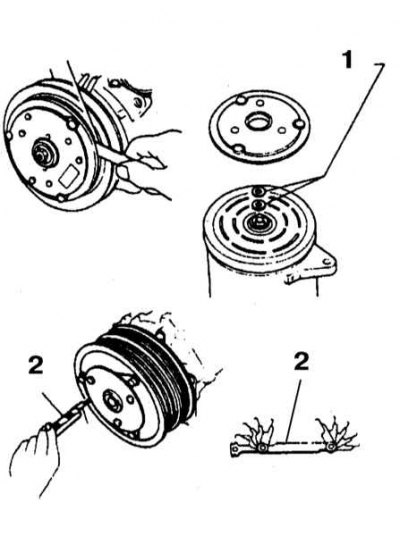
6. When installing, adjust the gap between the disk and the pulley by selecting adjusting washers - use a spark plug gap gauge.
7. When replacing the compressor clutch, do not forget to run it in - the compressor must be turned on at least 30 times.
8. During the running-in process, the clutch torque increases. Do not allow foreign materials to enter the compressor.
Installation
1. Don't forget to transfer the clutch from the old compressor to the new one.
2. Add the required amount of fresh refrigeration oil to the system based on the following data:
- a) Drain the refrigerant from the compressor removed from the vehicle and measure its volume;
- b) Drain the refrigerant present in the new assembly;
- c) If the amount of oil drained from the old block was 90÷150 ml, fill the new compressor with the same amount of fresh refrigerant;
- d) If less than 90 ml of oil was drained from the old compressor, add 90 ml to the new one;
- e) If the amount of oil drained from the old block exceeds 150 ml, 150 ml of refrigerant should be poured into the new assembly.
3. Installation is done in reverse order. Remember to replace the O-rings on the refrigeration line unions. Lubricate the O-rings with refrigeration oil before installing. Note: Remember to install the two upper mounting bolts into the compressor before installing the new assembly on the vehicle.
4. Charge the system and check it for leaks in a specialized workshop.