


Table of contents: Examination ↓ Replacement ↓
Warning! Do not open the radiator cap or remove the thermostat until the engine has cooled down completely! See also the warning at the beginning of the Section Antifreeze - general information.
Examination
1. Before you finally decide that the thermostat is out of order, check the coolant level in the system, the condition and tension of the drive belt (see Chapter Settings and ongoing maintenance), as well as the proper functioning of the temperature meter.
2. One of the possible reasons for the engine warming up too slowly (according to the meter readings) is the thermostat is stuck in the open position. Replace the thermostat with a new one.
3. If the engine overheats, feel the upper radiator hose with your hand. If the hose is not hot, the thermostat may be stuck in the closed position, blocking the circulation of coolant through the radiator. Replace the thermostat.
Warning! Never operate the vehicle with the thermostat removed! This may disrupt the on-board processor feedback, which will lead to increased toxicity of exhaust gases and excessive fuel consumption.
4. If the upper hose is hot, this means that the coolant is circulating properly through the radiator, i.e. the thermostat is open. Refer to the materials in the Section on diagnosing faults in the cooling system.
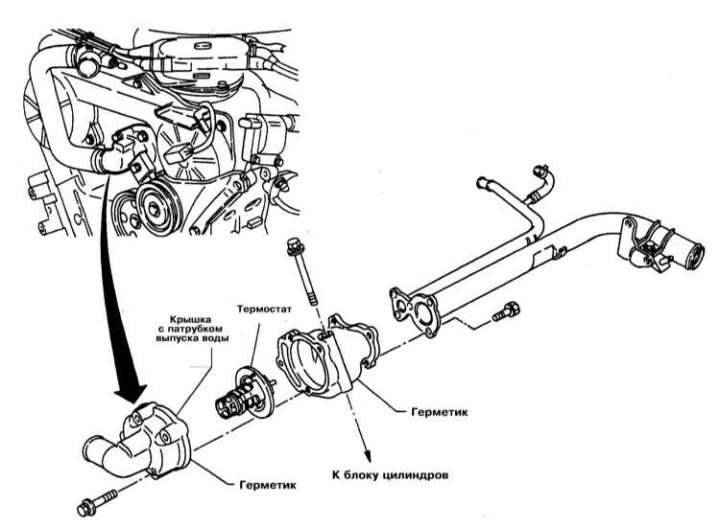
5. To perform a more detailed inspection, the thermostat must be removed from the engine. If the thermostat remains open at room temperature, it must be replaced.
6. Tie a piece of string to the thermostat assembly (the valve must be in the closed position) and place the latter in a heat-resistant container with cold water, and place a thermometer there.
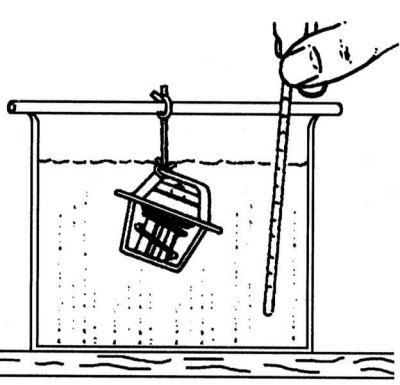
7. Place the container on the stove and begin to observe the behavior of the valve, while simultaneously monitoring the thermometer readings.
Attention! Neither the thermometer nor the thermostat should touch the walls of the container!
8. Record the thermometer reading at the moment of the beginning of opening and at the moment of full opening of the valve. Compare the measurement results with the requirements of the Specifications.
Note: The thermostat housing usually has the nominal value of the temperature at which the valve opens completely stamped on it. The data on the temperature at which the valve opens and the amount at which the valve opens may also be indicated.
9. Replace the faulty assembly.
Replacement
1. Disconnect the negative cable from the battery.
Warning! If the car stereo system is equipped with a security code, make sure you have the correct combination to activate the audio system before disconnecting the battery!
2. Drain the coolant from the radiator and engine block (see Chapter Settings and ongoing maintenance). If the mixture has been changed recently, save it for future use.
3. On SOHC engines, disconnect the upper radiator hose from the water outlet on the intake manifold and from the radiator, then release the intermediate retainer on the front timing cover and remove the hose. Disconnect the bypass hose from the thermostat cover.
4. On DOHC engines, remove the drive belts and idler pulley bracket. Also remove the lower radiator hose and remove the water pump drain plug from the front-facing side of the block.
5. Remove the thermostat cover - try to remember its installation position. Prepare to collect any spilled liquid.
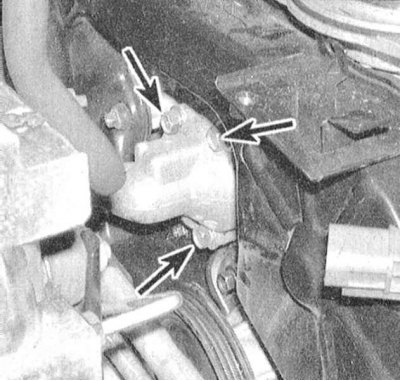
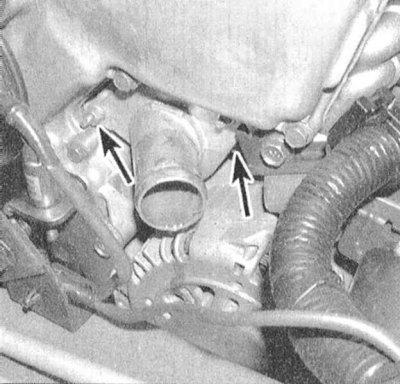
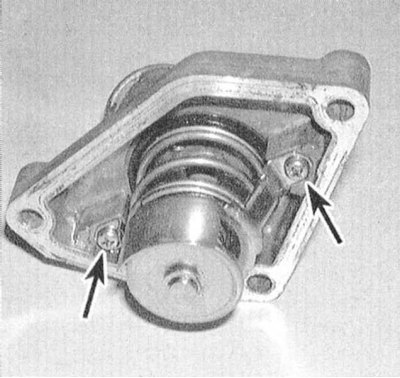
6. Remove the thermostat, remember its installation position.
7. Carefully clean the sealing surfaces of the thermostat cover and housing with a scraper, then wipe them with a rag soaked in solvent.
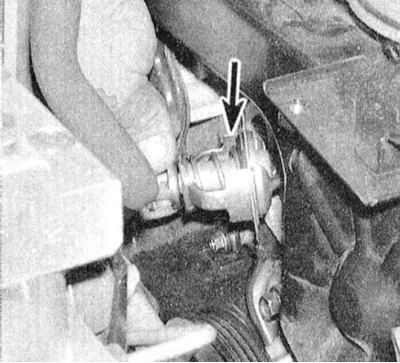
8. Apply a bead of RTV sealant around the perimeter of the mating surface of the cover. Rotate the thermostat so that the bleed valve plunger is at the top point, install it in its regular place in the cover/housing and within five minutes of applying the sealant, bolt the cover to the housing.
9. Further installation is carried out in the reverse order of dismantling the components. Make sure that all fasteners are tightened to the required force and that the hoses are connected correctly.
10. After allowing the sealant to harden for about half an hour, fill the cooling system and release any air locks from it (see Chapter Settings and ongoing maintenance). Start the engine and check for leaks and proper functioning of the thermostat.