


Table of contents: Steering repair ↓ Checking the tension of the V-belt…↓ Filling the steering system and…↓ Fluid replacement ↓
1. Raise the front of the vehicle and support it on jack stands.
2. Bend back the ends of the cotter pins on the steering rod joint nuts and remove them with side cutters.
3. Loosen the steering rod joint nuts.
4. Disconnect the hinges with a suitable puller, as already shown in illustrations.
5. Loosen the hydraulic hose clamp and disconnect the hose.
6. Unscrew the union nut of the pipeline on the steering gear, remove the pipeline and collect the leaking liquid in a container.
7. Loosen the four steering gear mounting bolts.
8. Disconnect the lower steering shaft joint from the steering gear.
9. Also remove the upper steering universal joint clamp bolt so that the joint can be removed completely later.
10. Release the cable harness from the mounting on the intermediate frame.
11. Completely remove the steering gear mounting bolts and remove the mounting bracket.
12. Place a jack with a wooden block under the power unit, lift it until it is well taut, unscrew the middle engine support and remove it. The rear engine mount should also be removed.
13. Now remove the steering gear. To do this, first move it to the left, then lower it and remove it from the right side of the car. The steering rods remain on the steering gear. When removing, the universal joint should disengage from the steering gear and the steering column.
14. The steering mechanism is installed in the reverse order, taking into account the following points:
15. Tighten the steering gear to 73-97 N·m.
16. Align the flattening on the gear with the threaded hole in the flange and carefully hammer in the clamping bolt without damaging the thread. Tighten the nut to 25-30 N·m.
17. Tighten both hydraulic lines on the steering gear, referring to the illustration. Tighten the low pressure line (1) with a torque of 20-25 N·m, the high pressure line (2) with a torque of 15-25 N·m.
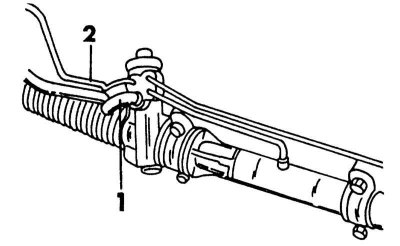
Two nipples on servo control
1 - low pressure pipeline
2 - high pressure pipeline
18. When connecting both steering rods, proceed as for a normal steering system (see also illustration).
19. Check that the steering wheel spokes are positioned correctly when the wheels are in the center position. It may be that the steering gear is turned one turn too far.
Steering repair
As already mentioned for the steering without power steering, it is not worth repairing. In case of significant damage, it makes sense to install a new steering mechanism.
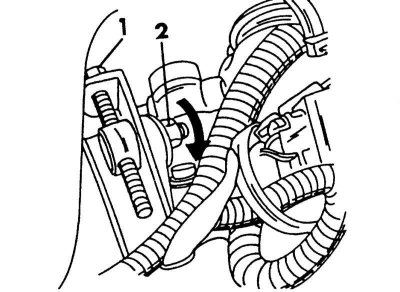
Individual elements for adjusting the tension of the power steering pump belt on a carburetor engine
1 - adjusting bolt
2 — lock nut
Checking the tension of the V-belt of the steering pump
The position of the power steering pump drive belts for both engine versions is shown in the illustrations below. Also in p. " The belt tension is checked... " the dimensions given are the ones to which the belts should be pressed when pressed with your thumb.
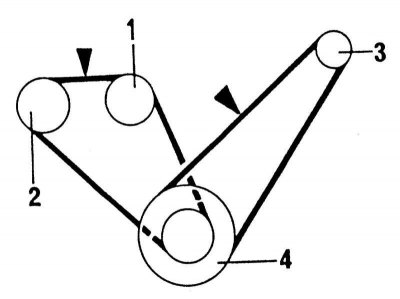
Location of drive belts on an injection engine. Check the tension at the points indicated by arrows
1 - water pump belt pulley; 2 - Power steering pump belt pulley; 3 - generator belt pulley; 4 - crankshaft belt pulley
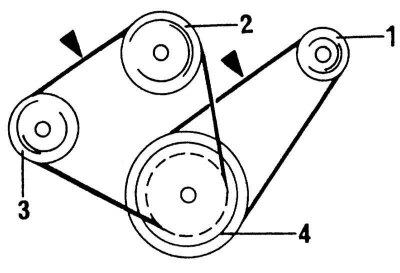
Location of drive belts on an injection engine. Check the tension at the points indicated by arrows.
Like the location, the adjustment of the belts differs on a carburetor and injection engine. Both belts have a tensioner device, which also looks different. If adjustment is necessary, perform the following work:
1. On an injection engine, referring to the illustration, loosen the bolt (2) and tighten the adjusting bolt (1) until the required tension is achieved. Then tighten the bolt (2) to a torque of 16-22 N·m. After adjustment, check the tension at the specified illustrations place and compare with the required value.
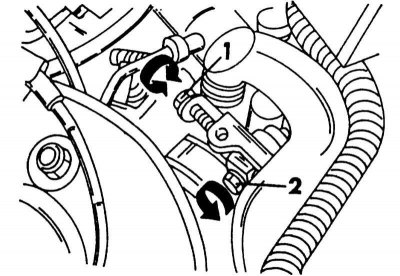
Elements for adjusting the tension of the power steering pump belt with an installed injection engine
1 - adjusting bolt
2 - lock bolt
2. On a carburettor engine, referring to the illustration, loosen the lock nut (2) on the inside of the tensioner and turn the adjusting bolt (1) until the required tension is achieved. Tighten the lock nut (2) to 6-9 N·m.
3. If the V-belt is too loose, the pump is unable to create the pressure required for steering. The result may be a slow response of the wheels to steering wheel turns.
Filling the steering system and bleeding air from the system
1. Place the vehicle on a level surface.
2. Warm up the engine.
3. Run the engine at 1000 rpm or less and turn the steering wheel from lock to lock to increase the hydraulic oil temperature.
4. Unscrew the cap of the power steering fluid reservoir and check that the oil level is between the two marks on the dipstick (illustration). If the check is carried out on cold liquid, the oil level is slightly lower on the rod.
5. Add fluid if necessary (which is used in automatic transmissions), and adjust the level.
6. Screw the lid back on.
7. If the system has been emptied, air should be removed from it:
8. Place the front of the vehicle on supports.
9. Turn the steering wheel from lock to lock two or three times.
10. If the fluid level drops, add fluid.
11. Check the fluid level in the reservoir as described above.
12. Start the engine and let it idle.
13. Turn the steering wheel from lock to lock two or three times.
14. Lower the vehicle back onto its wheels.
15. Let the engine run at 1000 rpm.
16. Turn the steering wheel from lock to lock several times.
17. Turn the steering wheel to the center position.
18. Unscrew the expansion tank cap and check the fluid level. Now start the engine and check whether the level in the tank increases. If the level increases by more than 5 mm, the air removal work should be repeated, since there is still air in the system.
19. Replace the cover.
Fluid replacement
If the fluid has been in use for a long time, the pump or steering gear has been removed, or the hydraulic oil has become mixed with air, the fluid should be replaced:
1. Place the front of the vehicle on supports.
2. Disconnect the return hose from the expansion tank and drain the liquid into a container provided.
3. Turn the steering wheel from lock to lock until all fluid is drained from the system.
4. Fill the system with fluid and bleed air as described in the previous step. Be sure to use the correct fluid. Dexron oil is usually used, but your Nissan center may recommend another.
5. Test drive the vehicle and check that the steering responds well to steering wheel movements both while moving and while stationary.