


Draining the coolant
Attention.
- To avoid burns, do not change the fluid on a hot engine.
- Wrap the radiator cap with a thick layer of rag and unscrew the cap. First, turn the cap a quarter turn to relieve the pressure in the system. Then turn it further and open the cap completely.
1. Disconnect the lower radiator hose and remove the expansion tank cap.
Note: When you need to drain the fluid from the system completely, unscrew the cooling system jacket plugs on the cylinder block.
Attention.
- Perform this step only on a cold engine.
- Do not allow coolant to come into contact with the drive belt.
2. If necessary, remove the expansion tank and drain the coolant. Clean the expansion tank before installation.
3. Check the drained coolant for signs of rust, corrosion or discoloration. If the fluid is contaminated, flush the cooling system.
Filling the coolant
1. If it was removed, install the expansion tank.
2. Connect the lower radiator hose.
Note: If the coolant jacket plugs on the cylinder block have been removed, tighten them to a tightening torque of 9.8 Nm.
3. Tighten all hose clamps securely.
4. Disconnect the heater hose (1) at the location indicated by the black arrow in the figure.
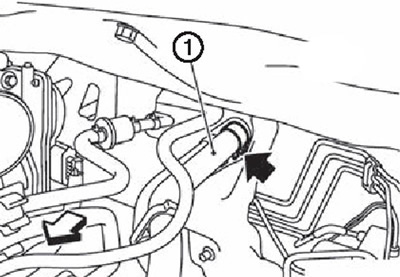
Versions with petrol engines
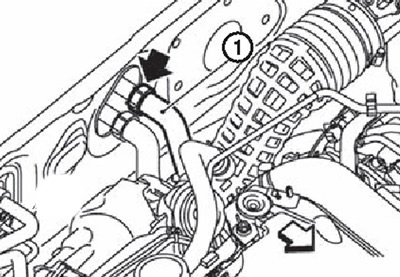
Versions with diesel engines
Note.
- The white arrow points towards the front of the car.
- Raise the heater hose as high as possible so that its edge is above the "MAX" mark on the expansion tank.
5. Fill the expansion tank to the specified level:
Add coolant slowly, no more than 2 liters per minute, to allow air to escape from the system.
When the coolant starts to flow out of the heater unit, connect the heater hose and continue filling the coolant up to the "MAX" mark on the expansion tank.
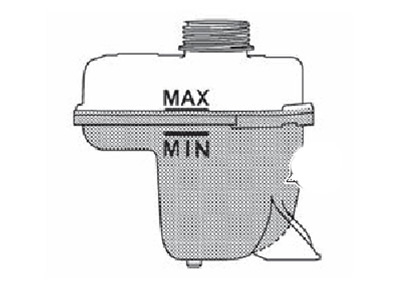
Start the engine without closing the expansion tank cap.
Maintaining the crankshaft speed at 1500 rpm for about 2-3 minutes, fill the expansion tank to the "MAX" mark, if necessary.
Note: Use genuine NISSAN Engine Coolant or equivalent antifreeze/water mixture (distilled or demineralized).
6. Install the expansion tank cap.
7. Warm up the engine until the thermostat opens. Typically, the engine warm-up time at 2000-2500 rpm is 10 minutes.
Note: The thermostat opening is indicated by the lower radiator hose heating up and hot coolant starting to flow through it.
Caution: To avoid engine overheating, it is necessary to monitor the coolant temperature gauge.
8. Stop the engine and let it cool down to approximately 50°C.
Note: To reduce cooling time, turn on the fan.
9. If necessary, add coolant to the expansion tank to the "MAX" level.
10. Repeat steps 6 through 9 two or more times with the coolant expansion tank cap installed until the coolant level in the expansion tank stops dropping.
11. With the engine running, check the cooling system for leaks.
12. Warm up the engine and check the sound of coolant flowing with the engine running, changing the crankshaft speed from idle to 3000 rpm and setting the heating temperature regulator to different positions between "COOL" and "WARM". The sound may be audible in the heater area.
13. Repeat step 12 three times.
14. If the sound is clearly audible, bleed the system by repeating steps 6 through 9 until the coolant level stops decreasing.
15. Make sure the expansion tank cap is securely tightened.
Flushing the cooling system
1. Install the expansion tank in place (if it was filmed) and tighten the radiator drain plug.
Caution: Clean the radiator drain plug thoroughly and install with a new sealing ring.
2. Disconnect the heater hose (1) at the location indicated by the black arrow in the figure.
Note.
- The white arrow points to the front of the car.
- Raise the heater hose as high as possible so that its edge is above the "MAX" mark on the expansion tank.
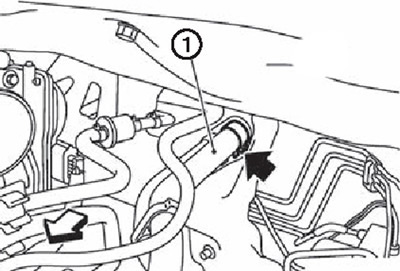
Versions with petrol engines
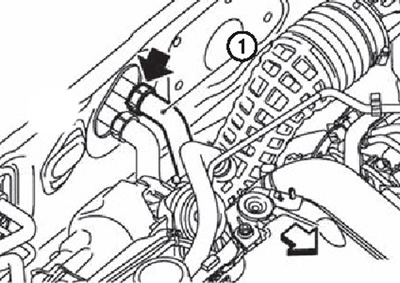
Versions with diesel engines
3. Fill the radiator and expansion tank with water and install the radiator cap.
Note: If water starts to leak out of the disconnected heater hose, reconnect it and continue adding water up to the "MAX" mark.
4. Install the air duct (between the air filter housing and the electronic throttle actuator).
5. Start and warm up the engine to normal operating temperature.
6. Accelerate the engine to high speed two or three times without load (on the spot).
7. Stop the engine and wait until it cools down.
[For more information, see the website: NissanBook]
8. Drain water from the cooling system.
9. Repeat steps 1 through 8 until clear water begins to flow from the radiator.
10. Make sure the expansion tank cap is securely tightened.