


1. Place rack in neutral position with no fluid in steering gear.
2. Screw in the adjusting screw, having previously applied a locking agent to its thread.
3. Lightly tighten the locknut.
4. Tighten the adjusting screw to 4.9-5.9 Nm.
5. Loosen the screw and tighten it again with a torque of 0.2 Nm.
6. Move the rack several times throughout the entire travel.
7. Measure the torque of the gear as it rotates±180°from neutral. Stop the rack at the point with the maximum moment.
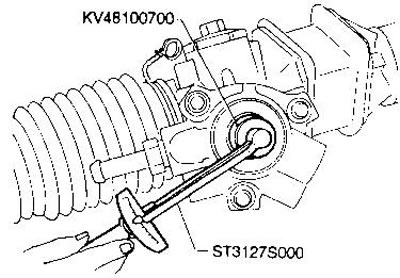
8. Loosen the adjusting screw n s'n'oia tighten it to a torque of 4.9 Nm.
9. Loosen the screw by 70 to 110°.
10. While holding the adjusting screw from turning, tighten the locknut to the specified torque.
11. Check up effort of shift of a lath on the car. To do this, install the steering mechanism, but do not attach the steering rods to the swing arms.
Connect all pipelines and fill in the working fluid.
Start the engine and bleed the air from the system. Disconnect from the steering mechanism the lower hinge of a steering shaft.
Warm up the idle fluid to normal operating temperature (60-80°С).
Slowly move the tie rod±11.5 mm from neutral at a speed of 3.5 mm/s. The shear resistance must lie within the following limits:
- Average rack shear force - 152-240 N (15.5-24.5 kgf)
- Maximum dispersion - 98 N (10 kgf)
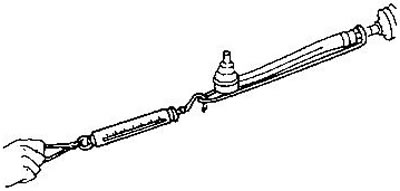
Check the shear force beyond and within the specified range at a rack speed of 40 mm/s.
- Maximum rack shear force - 294 N (30 kgf)
- Maximum dispersion - 147 N (15 kgf)
If the shear force is not within the specified limits, repeat the adjustment from the beginning.
If the adjustment fails to establish the desired force, it is necessary to replace the steering gear.