


Table of contents: Checks before adjustment ↓ Recommendations for adjustment ↓ Camber angle ↓ Angle of longitudinal inclination of…↓ Convergence ↓ Checking wheel alignment ↓
The steering wheel alignment angles ensure wheel stabilization, i.e. their ability to maintain the position they occupy during straight-line movement and automatically return to this position.
The installation angles are the angles of longitudinal inclination of the steering axis, as well as the camber and toe angles of the wheels.
A car with good wheel stability can move in a straight line for some time even if the driver lets go of the steering wheel. When the vehicle exits a turn with good stabilization, the steered wheels quickly return to their original position without driver intervention, which makes his work easier and reduces the risk of the vehicle colliding with obstacles, especially on sharp turns.
It is recommended to adjust the front suspension without load. It should be borne in mind that when the vehicle is loaded, the camber angle of the wheels changes significantly.
Checks before adjustment
If you notice that your car is behaving strangely, the first thing you should pay attention to is the tires. While excessive tire wear is often the result of improper wheel alignment, there can be other causes of this wear. Before checking or adjusting the front wheels, check the following:
- Is the tire pressure correct?.
- Is there excessive tire wear?.
- Runout (clearance) of front wheel bearings.
- Excessive play in ball joints, tie rods or control arms.
- Broken springs or damage in the steering mechanism.
- Damage to the upper shock absorber mount.
- Possible overloading of the vehicle. If this excessive load is carried by the vehicle on a regular basis, check the installation angles under this load.
- Reliability of equipment used for checking and installing angles. Follow the equipment manufacturer's instructions strictly.
If you haven't found the cause among the above, empty the trunk, remove the spare tire, adjust the tire pressure to the correct level, and take your tires to a mechanic for an adjustment. They'll do a better job at a mechanic's.
Caution: Wheel geometry may change due to a collision, vehicle overload, improper repairs, or the presence of deformed parts.
Recommendations for adjustment
Regardless of the type of equipment used, the vehicle must be installed on a site that is level both longitudinally and transversely.
Caution: Satisfactory vehicle operation can be achieved over a wide range of adjustments to the front suspension.
If the stated requirements cannot be met and the calculated technical characteristics cannot be obtained, check the vehicle for faulty suspension components. Make any necessary repairs or replacements.
If the adjustment fails to achieve the toe-in value within the established limits, the adjustment should be repeated.
To obtain the correct values for the installation angles for the front wheels, the following conditions must be met:
♦ The tread pattern on all tires must be uniform and the tires themselves must be in good condition;
♦ The air pressure in the tires must be within the norm;
♦ all rims must be checked and in satisfactory condition;
♦ The fuel tank should be half full;
♦ Rock the car several times to stabilize the springs (also stabilize the springs if the car was previously raised);
♦ When using installation equipment whose turntable does not capture lateral forces, the vehicle must first be rolled back one meter and then returned to its original position.
Wheel alignment methods vary depending on the equipment used. It is necessary to follow the instructions developed by the equipment manufacturer.
Camber angle
Camber is the deviation of the top of the tire from vertical when viewed from the front of the vehicle.
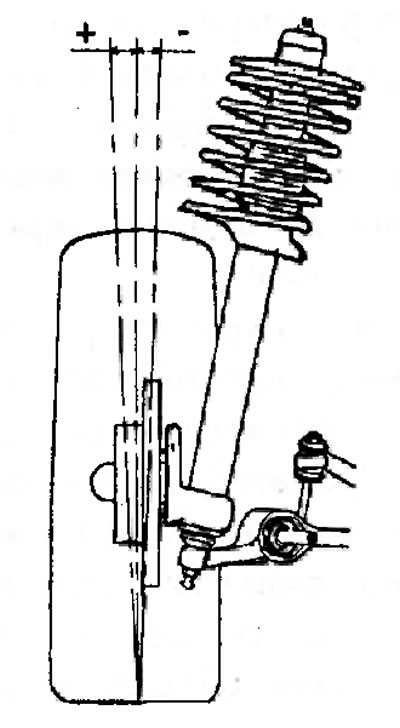
When the top of the tire is tilted outward from the vertical, this camber is called positive (+). When the tire is tilted inward, the camber is called negative (-). Camber is measured in degrees of deviation from the vertical and is characterized by the camber angle. The camber angle affects both road holding characteristics and tire wear. If a vehicle has too much positive camber, the outside shoulder of the tire will wear. Likewise, if the amount of negative camber is too great, the inner shoulder of the tire will wear out.
- The camber angle of the wheels is not adjustable.
- Control data: from -0°2' to +0°25'.
- If the actual camber angle differs from the reference value, the front suspension must be checked and any faulty parts must be replaced.
Angle of longitudinal inclination of the axis of rotation
Caster is the forward or backward deviation from the vertical line at the very top of the steering axis when viewed from the side of the vehicle. Rearward lean is called positive (+), forward lean is called negative (-). Steering axis lean affects road holding, but does not affect tire wear. The amount of tilt can be affected by weak springs and faulty upper shock absorber mounts, as well as overloading the vehicle.
If one wheel has more positive caster than the other wheel, this will cause that wheel to "pull" towards the center of the car. As a result, the car will pull towards the wheel with the less positive tilt. The tilt angle of the pivot axis is measured in degrees and is not adjustable.
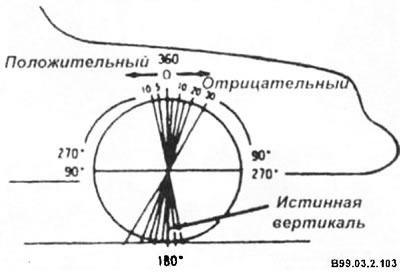
Attention: When installing the shock absorber strut, remember that it (the strut) has an asymmetrical mount and if installed incorrectly, the angle will be incorrect, +3° instead of the required +5°.
Convergence
Toe-in is the position of the front wheels when the distance between the side surfaces of the tires at the front is less than at the rear; while reverse toe-in is observed when this distance at the rear is less than at the front. The purpose of adjusting the toe is to ensure that the wheels rotate parallel.
Wheel alignment is used to compensate for small deviations that may occur in the wheel suspension system as the vehicle moves forward. The set wheel toe angle is a preliminary adjustment that allows the toe value to be equal to "0" when the vehicle is in motion. Incorrect wheel alignment or toe-in will cause premature tire wear and prevent you from achieving maximum fuel economy. As the vehicle's mileage increases, individual components of the steering and suspension system wear, additional wheel alignment may be required to compensate. When adjusting wheels, toe-in should always be adjusted last.
The wheel toe angle is small and difficult to measure. Therefore, in practice, wheel alignment is defined as the difference in distances between the side surfaces of the tires. (Y-X).
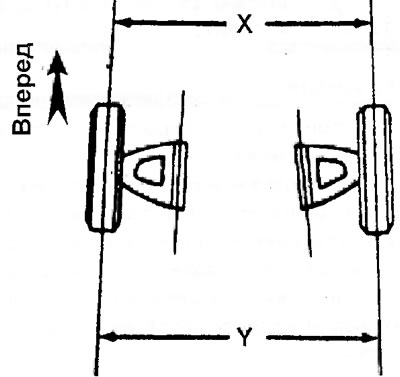
Checking wheel alignment
- Place the vehicle on a level horizontal surface and place a ruler (1) between the inner surfaces of the tires (rims) of the front wheels in front of the front axle so that the chains suspended at the ends of the ruler touch the surface of the surface. The pointer should be at the zero mark on the ruler scale.
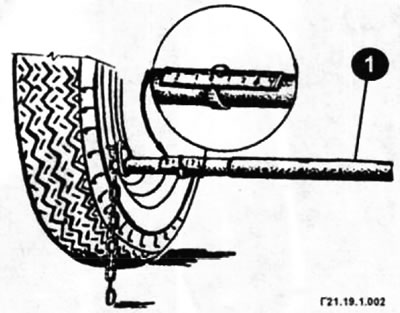
- Place a ruler behind the axle. Determine the wheel toe-in value and compare it with the data given in the table.
- You can also check wheel alignment in another way using the procedure described below.
Attention: The measurement procedure is carried out on a flat surface. Before pushing the car, make sure there is no one in front of the car.
- To stabilize the position of the car, rock its front end up and down several times.
- Roll the car forward about 5 m.
- Place marks (3) on the center line (2) of both tires (at the rear of the tire) so that they are at the same height (1) relative to the center of the wheel hub. The measurement is made at the specified locations.
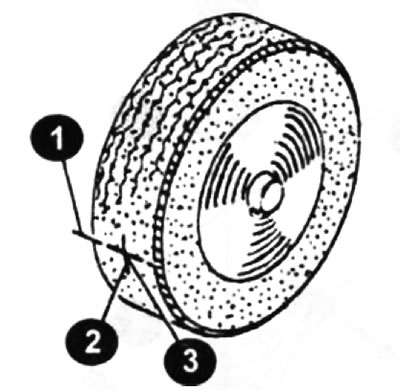
- Measure the distance "A" (from the back)
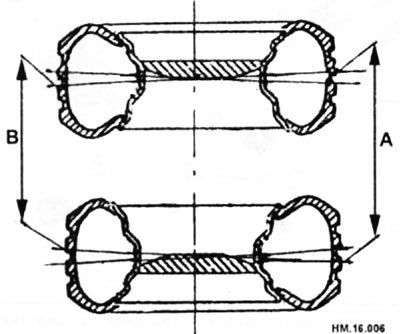
- Roll the car slowly forward until the wheels turn 180° (half a turn). If the wheels have turned more than 180° (half a turn), repeat the above procedure again from the beginning. Never roll the car backwards.
- Measure the distance "B" (from the front side). Wheel alignment (A-B): standard - 0.5 mm, maximum - 1.5 mm.
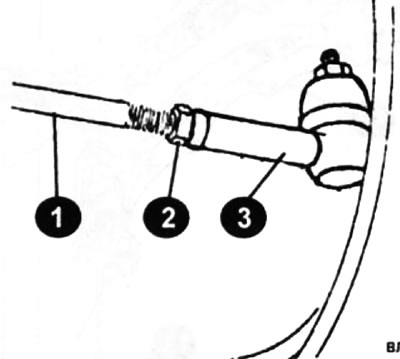
- If the measurement results differ from the required value, adjust the wheel toe-in by loosening the lock nut (2) on each of the tie rod ends (3) and turning the rod (1) until the correct toe-in value is achieved. When adjusting, you should achieve the same length of the right and left steering rod.
Caution: Before you begin adjusting (turning the steering rods) it is necessary to loosen the small clamp of the cover so as not to damage the cover.
Wheel alignment angle control values (unloaded vehicle)
| Wheel alignment angles | Meaning | |||
| minimum | nominal | maximum | ||
| Longitudinal tilt of the pivot axis | 1°50'(1,83°) | 2°35' (2,58°) | 3°20' (3,33°) | |
| Collapse | -1°05' (-1,08°) | -0°20' (-0,33°) | 0°25' (0,41°) | |
| Front wheel alignment | Distance (A-B) | -0.5 mm | 0.5 mm | 1.5 mm |
| Corner (left and right) | -1'(-0,02°) | 1'(0,02°) | 3'(0,05°) | |
| Angle of transverse inclination of the axis of rotation | 13°35'(13,58°) | 14°20'(14,33°) | 15°05'(15,08°) | |
Caution: The difference between the right and left sides when adjusting the caster angle and camber angle should not exceed 45' (0.75°).