

Removal
The anti-roll bar is attached at four points. Its ends are connected by struts to the lower suspension arms, and two clamps and separating rubber bushings hold the middle of the stabilizer on the body.
The anti-roll bar works like this: when the inside wheel is sprung during a turn, the anti-roll bar twists.
With the help of the spring force thus generated, the suspension of the outer (in relation to the turn) wheels and thus its spring is strengthened to a certain extent. Result: the car leans significantly less when turning. If the car springs, for example, when braking evenly at the front, then the stabilizer is not working.
- Remove the wheels.
- Remove the steering gear from the vehicle.
- Unscrew the lower nuts securing the anti-roll bar connecting rods and disconnect the connecting rods from the stabilizer.
- Loosen the bolts securing the stabilizer bar clamps.
- Remove the stabilizer from the car.
Examination
- Check the anti-roll bar, anti-roll bar connecting rods and anti-roll bar clamps for deformation, cracks and damage. Replace parts if necessary.
Installation
- Installation is carried out in the reverse order of removal.
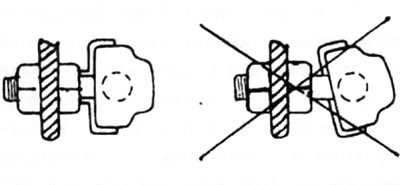
- Tighten the stabilizer bar clamp mounting bolts. They are tightened in the following sequence: front bolt of the left clamp, rear bolt of the right clamp, front bolt of the right clamp and rear bolt of the left clamp. The anti-roll bar uses connecting rods with ball joints that have bushings. Position the ball joints so that the housing with the liners is parallel to the stabilizer.