


The final drive ratio for all models except the Patrol ST and Ti with manual transmission, the 3.0L models, and the Maverick XLT is 4.111:1. The 3.0L models have a final drive ratio of 4.375:1, while the ST, XL, and Ti models have a final drive ratio of 3.900:1.
The driven gear assembly of the main transmission with the differential is mounted in two tapered roller bearings, and the radial play and preload are adjusted using special nuts.
The drive pinion is also installed in two tapered roller bearings, the preload of which is determined by selecting an adjusting washer of the required thickness installed between them. The seating depth of the drive pinion is adjusted by selecting an adjusting washer installed between the pinion and the cone of the inner bearing.
A limited-slip differential (LSD) transmits power to both rear wheels at all times, but torque is distributed to the wheel with the least amount of slip. When one side gear spins faster than the opposite side, the planetary axle rotates slightly, pushing the planetary housings apart, increasing the load on the friction plates and discs.
The differential locks permanently (being blocked) transmits rotation to both rear wheels evenly, regardless of the degree of their slippage, and is controlled by means of a switch that directs a vacuum through two electromagnetic valves into an actuator chamber fixed in the rear part of the axle housing.
When the differential lock is engaged, a vacuum is supplied to one side of the chamber. In this case, the shift fork and the selector clutch are displaced toward the differential assembly. The selector clutch slides along the splines toward the differential casing and, engaging with the rear part of the side gear, stops the rotation of the latter, thereby locking the differential. When the lock is disengaged, a vacuum is supplied to the opposite half of the chamber, returning the fork with the clutch to their original positions.
The differential lock should only be engaged when the rear wheels are stationary and the vehicle speed at the time of engagement does not exceed 7 km/h.
The procedures for removing and installing all final drive assemblies are identical, however, in the event of failure of the locking differential, the authors of this Manual recommend that the vehicle be taken to the manufacturer's dealer workshop for repairs.
The axle shafts on models with rear drum brakes are equipped with one conical roller bearing (each), on models with disc brakes - two conical roller bearings. The bearing of each axle shaft is enclosed in a casing secured at the end of the axle housing sleeve. The casing is secured to the axle shaft by means of a lock washer and nut. The axle shaft seals are located at the outer ends of the axle housing.
The rear suspension can be made either on leaf springs or on coil springs.
In the first case, the suspension consists of a driving rear axle suspended on semi-elliptical leaf springs (springs). Springs are mounted on rubber bushings. The front end of the spring is attached to the chassis frame by means of an anchor pin, the rear end is attached by a mounting earring.
The shock absorbers are mounted on rubber bushings. Their lower ends are secured to the spring U-bolt support plates, and the upper ends are attached to the chassis frame.
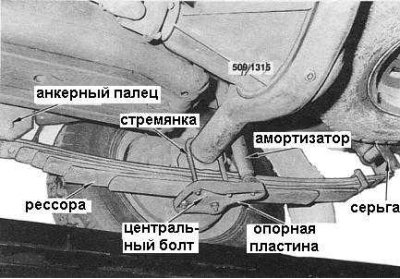
The rear axle is mounted on the springs by means of the central bolts of the latter, and is secured to them by U-bolts of the stirrups with nuts. The components of the rear suspension are shown in the accompanying illustration.

On vehicles with spring-type suspension, the leading rear axle is suspended by means of four longitudinal reaction rods and a transverse reaction rod (see accompanying illustration).
The long travel of the coil springs is controlled by double-acting hydraulic shock absorbers. The anti-roll bar is installed between the axle housing and the vehicle chassis to limit the rocking of the vehicle body during the execution. Some models are equipped with a remote cable drive for disabling the anti-roll bar to facilitate the movement of the vehicle in off-road conditions. The disabling mechanism ensures free movement of the right end of the anti-roll bar.
See the original on the resource NISSANBOOK.ru
The vehicle chassis is equipped with a rubber compression limiter, which serves to prevent direct contact between metal parts when the coil springs are fully compressed.
The use of maintenance-free rubber bushings at the pivot points of suspension components can significantly reduce the level of noise emitted by the suspension. Check the condition of the bushings from time to time.