


Table of contents: Replacing the pinion seal ↓ Removal ↓ Installation ↓ Disassembly ↓ Cleaning and checking the condition…↓ Assembly ↓
Note: The following special tools are required to perform the following procedures: Stillson wrench and pinion flange puller (to replace the pinion seal); the tools listed above, plus a bearing puller (for disassembly); press with support plates, sensitive low range torque wrench and dial gauge (for assembly).
Replacing the pinion seal
1. Jack up the rear of the car and place it on supports placed under the frame side members.
2. Unscrew the drain plug and drain the oil from the rear axle housing.
3. Mark the position of the rear propeller shaft in relation to the pinion flange, then disconnect the propeller shaft from the flange and tie it to the side of the frame member with a piece of wire.
4. Mark the position of the pinion gear in relation to its flange.
5. Hold the flange still with a large Stillson wrench and loosen the pinion nut.
6. Using a puller, remove the flange from the gear.
7. Using a sliding hammer or a suitable lever, remove the oil seal from the crankcase.
8. Clean the seat for installing the oil seal in the crankcase and check its walls for burrs and scratches.
9. Fill the space between the lips of the new seal with universal lithium-based grease. Lubricate the outer edge of the seal with special grease and seat the latter perpendicularly into the main gear housing flush with its end.
10. Using a soft-faced hammer, install the drive gear into place, making sure that the marks made during dismantling are aligned.
11. Seal the nut, fit the washer and tighten the nut with a force of 196-284 Nm -on Hardtop models and a station wagon (Station Wagon) and 167-245 Nm - on Utility and Mini-truck models (Cab Chassis).
12. Connect the cardan shaft to the flange (make sure that the marks applied during dismantling are aligned). Tighten the mounting bolts to 93÷108 Nm.
13. Fill the bridge housing with the required amount of oil of the required grade (see size and adjustment tables at the end of the Guide).
General view of the main gear assembly
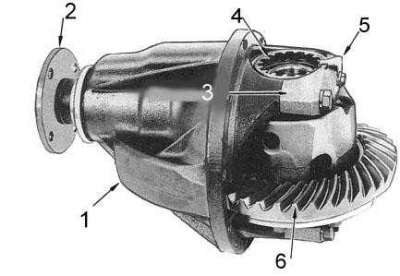
1 - crankcase; 2 - drive gear flange; 3 - bearing cap; 4 - adjusting nut; 5 - stop flag; 6 - driven gear
Removal
1. Remove the axle shafts.
2. Mark the position of the rear propeller shaft in relation to the flange of the main gear pinion, then disconnect the shaft from the flange. Tie the shaft to the side of the frame member with a piece of wire.
3. On models equipped with a rear anti-roll bar, loosen the mounting bolts and remove the stabilizer bar brackets. Raise the bar and tie it with wire.
4. Loosen the mounting nuts, remove the washers and disconnect the final drive assembly from the front axle housing. Remove the gasket from the assembly and discard it.
Note: The authors of this Manual recommend using an assistant to remove the final drive - the weight of the assembly is quite significant.
5. Check the axle housing for metal filings inside, the presence of which should be regarded as a sign of wear of the internal components of the main transmission. In this case, the assembly should be completely disassembled and defective or worn parts should be replaced.
6. Clean the mating surfaces of the axle housings and the final drive assembly. Make sure that no debris gets inside the housings.
Installation
Installation is carried out in reverse order.
1. Install a new gasket on the axle housing (on Hardtop and Estate models, ensure that the gasket is installed with the grey side facing the mating surface of the axle housing).
2. Install the final drive assembly, screw on the mounting nuts and tighten them to 54÷64 Nm on Hardtop and Station Wagon models and 27÷36 Nm on Utility (Van) and Mini-truck models.
3. Connect the cardan shaft. Make sure that the marks made during dismantling are aligned. Tighten the fasteners with a force of 93÷108 Nm.
4. Install the axle shafts. Fill the axle housing with the required amount of oil of the required grade (see size and adjustment tables at the end of the Guide).
Disassembly
1. Remove the final drive assembly. Clamp it in a vice.
2. Before disassembling the assembly, perform the following checks:
- Using a dial gauge placed against the mating surface of the housing assembly, check the runout of the final drive driven gear. If the measurement exceeds 0.08 mm, check for foreign particles between the gear and the differential case. If none are found, replace the differential case.
- Using a dial gauge, check the radial clearance of the driven gear at four points. The nominal clearance value is 0.15÷0.20 mm. If the measurement result exceeds the specified value at any of the points being checked, (at an acceptable runout value) be sure to replace the driven and driving gears, or the differential box (depending on the circumstances).
- On models equipped with a limited slip differential, clamp the differential assembly in a vice and insert it into the side gears of the axle shaft. Using a torque wrench with a suitable attachment, turn one of the axle shafts several times while holding the other one still and record the value of the turning resistance. The turning force of the axle shaft on Hardtop and Estate models should be 76-96 Nm, on Utility (Van) and Mini-truck models - 127-226 Nm. If the measurement results are outside the permissible limits, check the condition of the friction discs, as well as the friction and spring plates.
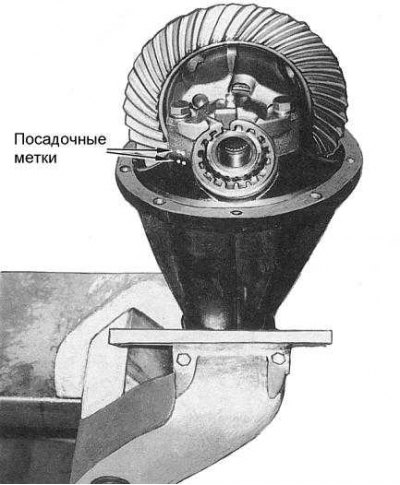
3. Apply alignment marks to the side bearing caps and the adjacent surfaces of the final drive housing (see accompanying illustration).
4. Remove the locking flags from the side bearing caps, loosen the mounting bolts and remove the caps and adjusting nuts.
5. Using a wooden lever, support the driven gear with the differential assembly, pushing them out of the main gear housing. Try not to mix up the side bearing races - to be sure, apply identification marks to them.
6. Mark the position of the axial assembly of the satellites relative to the flange of the pinion gear.
7. Secure the flange with a large Stillson wrench and loosen the drive gear nut, remove the washer.
8. Using a puller, remove the flange from the drive gear, then remove the gear itself, spacer sleeve and adjusting washers from the crankcase (if necessary, use a soft-faced hammer).
9. Using a sliding hammer or suitable lever, remove the oil seal from the crankcase, then remove the pinion outer bearing cone.
10. Mark the mounting position of the driven gear on the differential case.
11. Bend the locking plates (if any are provided) mounting bolts of the driven gear of the main transmission.
12. Where necessary, bend the tongues of the locking plates of the driven gear mounting bolts.
13. Loosen the driven gear mounting bolts in a diagonal order, remove and discard the locking plates (if any are provided).
14. Using a soft-faced hammer, carefully tap the driven gear around the perimeter to separate it from the differential case.
15. Mark the installation position of the differential case halves (lids and boxes themselves), then loosen the bolts that secure them to each other. On models with a limited slip differential, (the components of the H260 limited slip differential are shown in the accompanying illustration) while loosening the mounting screws, press on the main differential case.
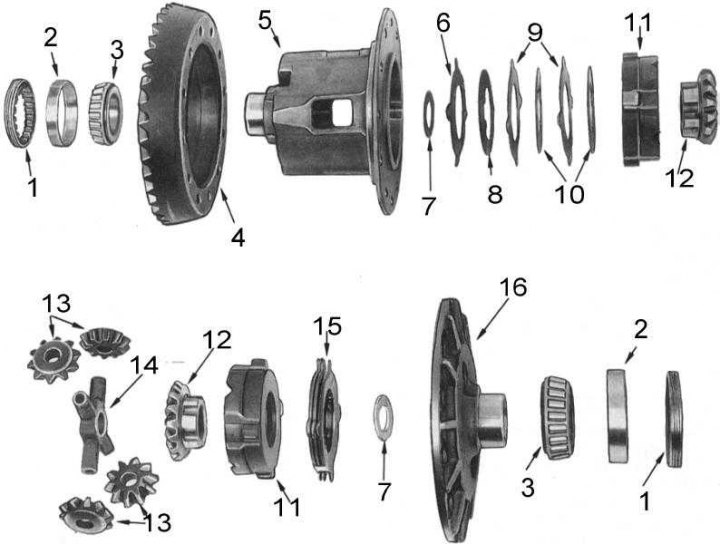
1 - adjusting nut; 2 - clip; 3 - cone; 4 - driven gear; 5 - differential box; 6 - spring plate; 7 - thrust washer; 8 - spring disc; 9 - friction plates; 10 - friction discs; 11 - planetary assembly housing; 12 - side gear; 13 - satellites; 14 - satellite axes; 15 - assembly of plates and disks; 16 - differential box cover
16. Split the differential case in half and remove the pinion shaft assembly, pinions, side gears and thrust washers. On models with a limited slip differential, store the removed pinions, discs and plates in an organized manner and mark the components with identification marks to ensure proper installation during reassembly.
Cleaning and checking the condition of components
1. Wash all components in solvent and dry them with compressed air.
2. Check the teeth of the driven and driving gears for signs of wear, chips and other damage.
3. Check the pinion gears, differential side gears, thrust washers and pinion shafts for signs of wear or damage.
4. Inspect the differential box for cracks and other damage.
5. Check the side bearings and their cups for signs of wear, discoloration, and other damage. If necessary, remove the bearing cones from the box using a puller.
6. Check the pinion bearings for signs of wear, discoloration, or other damage. Replace the bearings if necessary, as follows:
- Using a suitable puller, remove the inner bearing cone and spacer sleeve from the pinion gear (if such is installed).
- If necessary, fit a spacer sleeve onto the pinion gear. Make sure that the sleeve is installed with the beveled end facing the pinion gear. Using a press with support plates, install a new bearing cone. Remember that force should be applied only to the inner race of the bearing and until the spacer sleeve rests against the shoulders of the pinion gear.
- Using a brass drift, remove the bearing cups from the final drive housing.
- Carefully install the new cups into the crankcase until they rest firmly against the shoulders.
7. Check the seal contact surface of the pinion flange for scoring and signs of wear. Replace if necessary.
8. On models with a limited slip differential, perform the following checks:
- Check the condition of the components, remove any burrs or scratches found using a whetstone.
Note: If any defects are found on the surface of the planetary housing that contacts the friction disc, remove them with a whetstone, then polish the surface using a fine abrasive paste.
- Check the discs and plates for signs of wear, burrs and scoring, and replace if necessary. Burrs can be removed from the semi-circular protrusions using a whetstone.
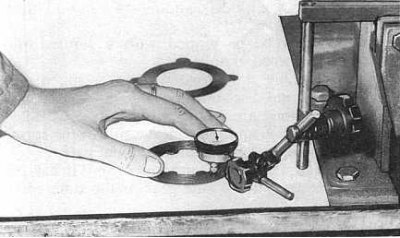
- Check the friction discs and plates for signs of deformation by laying them on a flat surface and measuring the amount of deformation with a dial gauge (see accompanying illustration). If the measurement result exceeds 0.08 mm, the defective disk/plate must be replaced.
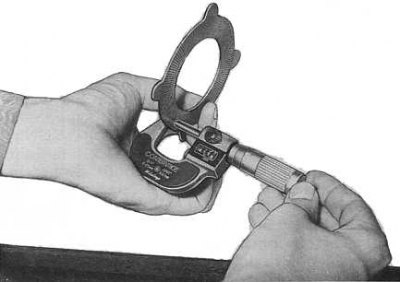
- Measure the friction surface thickness of each disc/plate at several points using a micrometer (see accompanying illustration). Compare the measurement results with the thickness of the semicircular protrusions near the measurement points. If the difference in thickness at any point exceeds 0.1 mm, replace the worn disc/plate.
Assembly
Assembly is carried out in the reverse order of disassembly.
1. Lubricate the components with the required grade of lubricant.
2. On Hardtop and Wagon models equipped with a limited slip differential, check the end play of the friction discs and plates (see accompanying illustration):
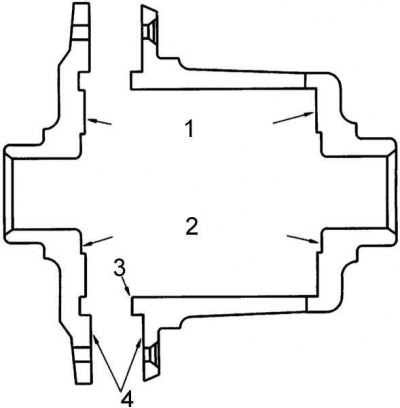
1 - surfaces in contact with spring plates; 2 - surfaces in contact with thrust washers; 3 - landing sponges; 4 - mating surfaces of flanges
- Using a vernier caliper, measure the distance between the seat jaws and the surface of the differential case that contacts the spring plate. Record the measurement result, then subtract the distance between the seat jaws and the mating surface of the flange from it. Designate the result of the subtraction as value C.
- Measure the distance between the surface in contact with the spring plate and the mating surface of the flange. Add the measurement result to the value C. Designate the sum as the value A.
Note: The value A can also be obtained by assembling the differential case halves and measuring the distance between the surfaces in contact with the spring plates with a micrometer.
- Place the planet axle assembly between the planetary gear housings, press the housings together and measure the assembly width with a micrometer. Record the measurement as F.
- Assemble the spring plates on each side and measure the thickness of both assemblies with a micrometer.
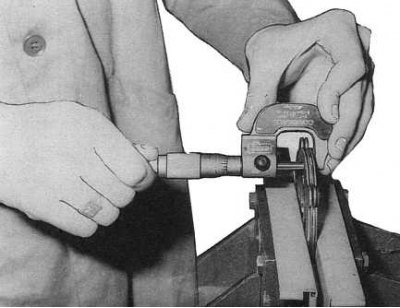
- Assemble the friction discs and plates on both sides and measure the thickness of both assemblies (see accompanying illustration).
- Add the results of the last two measurements and designate the sum as the value M.
- Then calculate the value of the axial play of the friction plate and disc assemblies using the formula: Axial play = A - F - M. If the obtained result is outside the range of 0.05÷0.20 mm, replace the friction plates with plates of the required thickness.
Note: Friction plates are available in 2.0 and 2.1 mm thickness.
- Install the thrust washers, planetary housings, side gears, planet axle assembly and planets into the main differential case. Do not install the plates or discs at this stage.
3. On models with a conventional differential, install the side gears, thrust washers, satellites and their axle assembly into the box.
4. On models equipped with a limited slip differential, except Utility (Van) and Mini Truck, perform the following procedures:
- Measure the distance between the differential case mating surface and the top of the side gear and thrust washer. Use a flatness gauge (steel ruler edge) and a vernier caliper. Record the measurement result, designating it as A.
- Press the flatness gauge against the mating surface of the differential case cover and use a vernier caliper to measure the distance between the contact surface of the side gear with the thrust washer and the edge of the gauge. Record the result, designating it as B.
- To determine the side gear thrust washer clearance, subtract value B from value A. If the calculation result is outside the range of 0.15÷0.20 mm, replace the thrust washers with new ones of the required thickness.
5. On models with a conventional differential, assemble the halves of the box together, making sure that the alignment marks applied during dismantling are correctly aligned. Tighten the mounting bolts with a force of 64÷74 Nm on Hardtop and Station Wagon models and 39÷54 Nm on Utility (Van) and Mini-truck models.
6. On models with limited slip differential:
- Install the side gears, thrust washers, spring and friction plates and discs into the main half of the case. Make sure to install the components in the correct order. The spring plates should be with the concave side facing the differential case.
- Align the plate assemblies with the discs and install the planetary gear housings and side gears into the box.
- Place the satellites and thrust washers on the satellite axle assembly, then insert the planetary assembly into the casing. Make sure that the satellites engage with the side gears. If necessary, install a thrust block.
- Install the remaining side gear, planetary housing, friction plates and discs, and thrust washers.
- Install the differential box cover, making sure that the mounting marks applied during dismantling are aligned. Press the box halves tightly together and tighten the fastening screws with a force of 8÷11 Nm.
- On Utility (Van) and Mini-truck models, measure the thrust washer clearance of each side gear by inserting the blades of a feeler gauge into the differential case hole at the base of each side bearing. If the clearance is outside the range of 0.05÷0.20 mm, replace the thrust washers with new ones of the required thickness.
- Clamp the differential assembly in a vice and insert it into the side gears of the axle shaft. Using a torque wrench with a suitable attachment, turn one of the axle shafts several times while holding the other one still. The turning force on Hardtop and Station Wagon models should be 76÷96 Nm, or 108÷137 Nm if new friction discs and plates are installed; on Utility (Van) and Mini-truck models - 127÷226 Nm or 157÷245 Nm, respectively. Otherwise, install friction plates of a different thickness.
7. Install the driven gear on the differential case, using a soft-faced hammer if necessary. Make sure that the mounting marks made during dismantling are aligned.
8. Lubricate the driven gear mounting bolts with a locking sealant, screw in the bolts, installing new locking plates under them (if any are provided).
9. Tighten the bolts diagonally to 132÷152 Nm on Hardtop and Estate models and 196÷226 Nm on Utility (Van) and Minitruck models, while tapping their heads lightly with a hammer. Bend the tabs of the locking plates where necessary using a center punch.
10. Lubricate the outer edge of the new pinion oil seal and the cone of the pinion front bearing with the required grade of grease. Fill the space between the lips of the oil seal with a lithium-based multi-purpose grease. Install the bearing and oil seal into the crankcase.
11. Lubricate the inner bearing of the pinion with the required grade of grease, then install the pinion, spacer sleeve and adjusting washer into the crankcase. Holding the pinion stationary, tap the flange onto it with a soft-faced hammer.
12. Make sure that the threads on the drive gear and the mounting nut are not contaminated with grease or oil, lubricate the threads of the nut with sealant.
13. Install the washer, then screw on the nut and tighten it to 196÷284 Nm on Hardtop and Station Wagon models and 167÷245 Nm on Utility (Van) and Mini Truck models.
14. Turn the pinion gear several times in both directions. Put a torque wrench on the fastening nut and determine the pinion bearing preload. If the preload value is outside the range of 1.3÷1.6 Nm on Hardtop and Station Wagon models and 1.5÷1.7 Nm on Utility (Van) and Mini-truck models, replace the bearing adjusting washer with another one of the corresponding thickness.
15. Install the cups on the side bearing cones and place the differential assembly with the driven gear into the final drive housing, making sure that the bearing cups are positioned correctly. If old side bearings are used, make sure that their cups are installed on the same sides as before disassembly.
16. Screw in the adjusting nuts of the side bearings, making sure that they are correctly seated in the threads in the main gear housing.
17. Align the seat marks on the side bearing caps and the main gear housing, install the bearing caps and tighten the bolts by hand. If the cap does not fit evenly when pressed by hand, the bearing adjusting nut is not correctly aligned with the cap.
18. Using a suitable tool, tighten the side bearing adjusting nuts until the bearing cups begin to rotate.
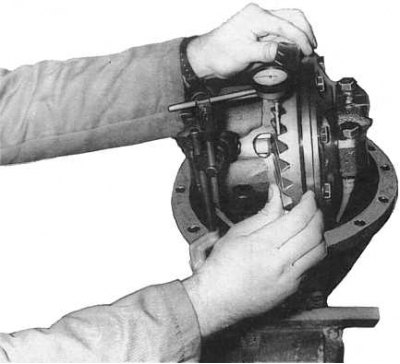
19. Using a dial gauge, check the radial play of the final drive driven gear (see accompanying illustration). If the measurement result exceeds 0.02 mm, loosen the adjusting nut on the drive gear side and tighten the opposite one by the same number of turns. If the clearance is less than 0.15 mm, perform the procedure in the reverse direction.
Note: If the amount of axial play varies at different points on the driven gear, check whether foreign particles have entered between the gear and the differential case. If such particles cannot be found, replace the drive and driven gear or the differential case.
20. Turn the drive pinion several times in both directions, then use a torque wrench on its mounting nut to check the overall differential preload. If the measurement result is outside the range of 1.8÷2.5 Nm for Hardtop and Station Wagon models and 1.7÷2.5 Nm for Utility (Van) and Mini-truck models, respectively, loosen or tighten both adjusting nuts. Having achieved the required differential preload, check the radial play of the driven pinion again.
21. Tighten the side bearing cap mounting bolts to 93÷103 Nm on Hardtop and Station Wagon models and 78÷98 Nm on Utility (Van) and Mini Truck models.
22. Install the locking flags and tighten their mounting bolts securely. Press the plunger of the dial gauge against the supporting surface and check the runout of the driven gear of the main gear. If the measurement result exceeds 0.8 mm, remove the gear from the differential case and check whether foreign particles have gotten between them.
23. Lubricate the surface of the teeth of the driven gear with Prussian blue or a mixture of red lead and oil, then, having fixed the flange of the driving gear, rotate the driven gear in both directions.
24. Inspect the surfaces of the driven gear teeth and compare the shape of the contact patch with the attached reference card. If the required shape of the contact patch cannot be achieved, both gears (driven and driven) must be replaced.
25. Install the main gear and axle shaft assembly. Fill the rear axle housing with the required amount of oil of the required grade (see size and adjustment tables at the end of the Guide).