


Checking the correct functioning
1. With the engine off, depress the clutch pedal several times to remove the vacuum from the servo unit.
2. Press the pedal lightly and hold it in this position.
3. Start the engine. The pedal should noticeably fall down, otherwise it is necessary to check the vacuum supply:
- Check the vacuum hoses for signs of material aging or other damage. Replace if necessary.
- Disconnect the vacuum hose from the servo unit and, with the engine idling, make sure that vacuum is reaching the unit by plugging the end of the hose with your thumb.
- Disconnect the vacuum hoses, release the retaining clamp and remove the check valve from the vehicle.
- Blow into the check valve from the servo unit side. Air should pass through the valve.
- Try to suck air through the valve (again from the servo side). The valve must be closed. If these conditions are not met, replace the valve.
Removal
1. Remove the clutch master cylinder.
2. Disconnect the vacuum hose from the servo unit.
3. In the passenger compartment, disconnect the servo pushrod from the clutch pedal. Loosen the mounting nuts and remove the servo side from the vehicle.
Installation
Installation is carried out in reverse order.
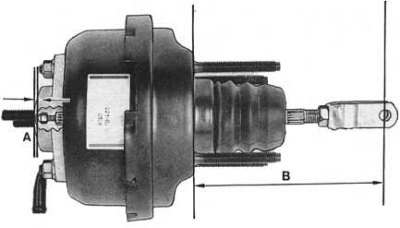
1. Check the installation of the servo unit push rod protrusion length, make the necessary adjustment (see accompanying illustration):
- On the removed servo unit, measure the distance from the supporting end surface of the unit to the center of the hole for installing the push rod mounting pin to the clutch pedal (In the illustration). The nominal value is B = 130 mm.
- If adjustment is required, loosen the locknut and move the pushrod tip in the desired direction, then retighten the locknut securely.
- Measure the distance from the bearing surface of the master cylinder to the outer edge of the front pushrod of the servo unit (And in the illustration). The nominal value is A = 1.30÷1.55 mm.
- To make adjustments, lock the pusher and move its tip in the appropriate direction.
Note: If the front pushrod requires adjustment greater than 0.5mm, the servo is faulty and must be replaced.
2. Tighten the servo unit mounting nuts to the required torque.
3. Check the height and free travel of the clutch pedal, make adjustments if necessary.