

Table of contents: When using a new cylinder block and…↓ When using a used cylinder block and…↓ Table for selection of main bearing…↓ Table for selection of main bearing…↓ Use of main bearings of size groups ↓
When using a new cylinder block and crankshaft
1. Determine the size group of the main bearing bed in the cylinder block using the mark located on the rear left side of the block (L) and use this value to select the line in the "Main Bearing Sealer Selection Table".
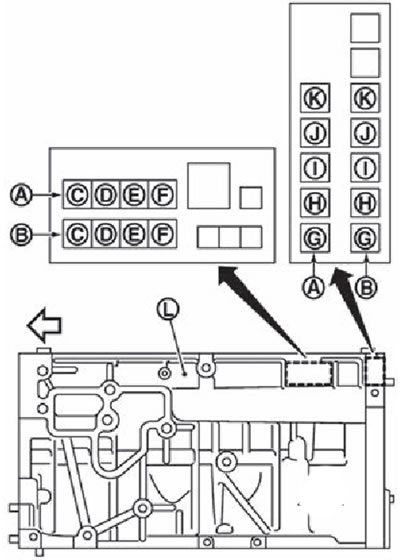
A. Correction stamp.
B. Standard stamp.
C. Dimensional group of the first cylinder bore.
D. Size group of the second cylinder bore.
E. Dimensional group of the third cylinder hole.
F. Dimensional group of the fourth cylinder bore.
G. Dimensional group of the main bearing bed of support No.1.
H. Dimensional group of the main bearing bed of support No.2.
I. Dimensional group of the main bearing bed of support No.3.
J. Dimensional group of the main bearing bed of support No.4.
K. Dimensional group of the main bearing bed of support No.5.
L. Arrangement of size groups.
The arrow points towards the front of the engine.
Note: If there is a correction stamp on the cylinder block, these values should be used as they are more in line with reality.
2. Determine the size group of the crankshaft main journal using the stamp on the front side of the crankshaft to select the column "Main Bearing Shell Selection Tables".
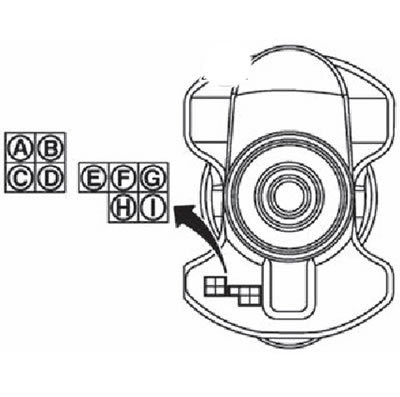
A. Crankpin size group No.1.
B. Size group of connecting rod journal No.2.
C. Size group of connecting rod journal No.3.
D. Connecting rod journal size group No.4.
E. Size group of the root neck No.1.
F. Size group of the root neck No.2.
G. Size group of the root neck No.3.
H. Size group of the root neck No.4.
I. Size group of the root neck No.5.
3. Determine the symbol at the intersection of the selected row and column in the "Main Bearing Shell Selection Table".
Attention.
- There are two tables for selecting main bearing shells. The first is for main bearing journals No.1, 4 and 5. The second is for main bearing journals No.2 and No.3. To select the shells, use the tables for the specified journals.
- Don't confuse the tables.
4. Using the received symbol, select the main bearings of the required thickness.
Note: Main bearing shells are supplied as a set consisting of an upper and lower shell.
When using a used cylinder block and crankshaft
1. Measure separately the diameters of the crankshaft main journal and the bed bore in the cylinder block.
2. Use the obtained results for the "Main Bearing Shell Selection Table".
3. Determine the symbol at the intersection of the selected row and column in the "Main Bearing Shell Selection Table".
Attention.
- There are two tables for selecting main bearing shells. The first is for main bearing journals No.1, 4 and 5. The second is for main bearing journals No.2 and No.3. To select the shells, use the tables for the specified journals.
- Don't confuse the tables.
4. Using the received symbol, select the main bearings of the required thickness.
Note: Main bearing shells are supplied as a set consisting of an upper and lower shell.
Table for selection of main bearing shells (journals No.1, 4 and 5)
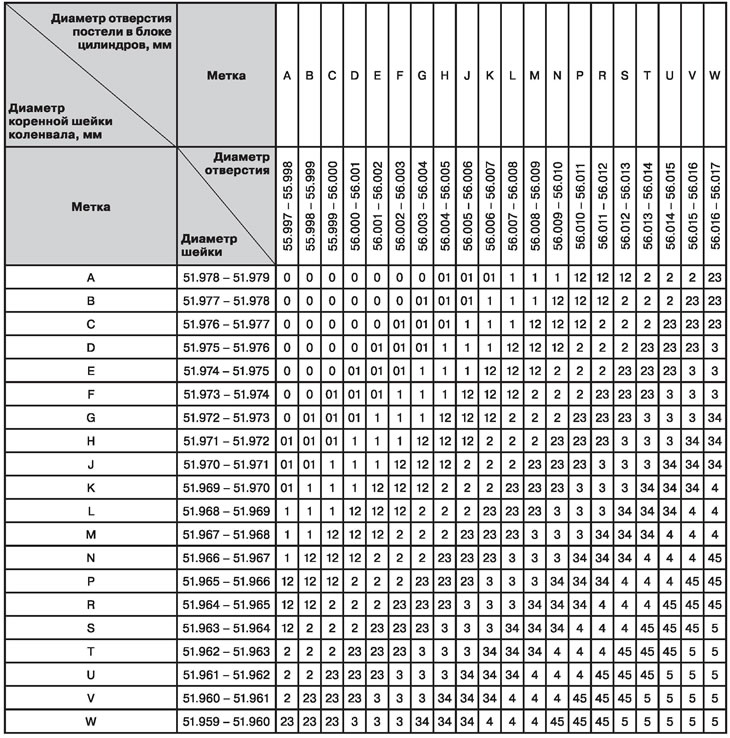
Table for selection of main bearing shells (journals No.2 and 3)
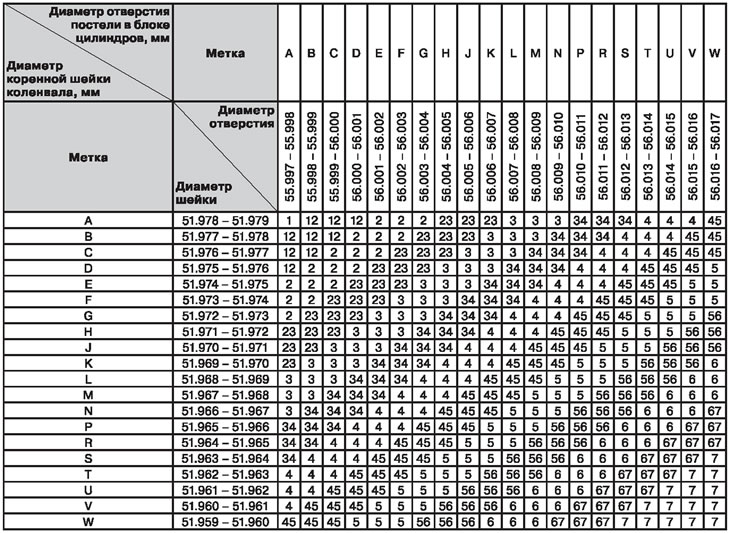
Note: See the Service Data and Specification section at the end of the chapter.
Use of main bearings of size groups
In cases where the specified oil clearance value is not ensured when using standard size group liners, repair size group liners should be used.
Measure the diameter of the main bearing bore in the cylinder block with the bearing shells installed and regrind the crankshaft main journal to ensure the required clearance.
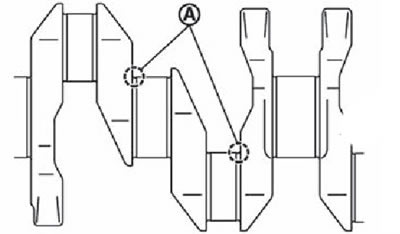
Attention. When grinding the neck for repair liners, it is necessary to ensure the radius of the fillets (A) equal to 1.5-1.7 mm.