


Table of contents: Checking the axial clearance of the…↓ Checking the connecting rod side…↓ Clearance between piston and piston…↓ Lateral clearance of piston rings ↓ Piston ring gap ↓ Bending and twisting of the…↓ Connecting rod lower head diameter ↓ Clearance in the upper connecting…↓ Non-flatness of the upper surface of…↓ Inner diameter of main bearing bed ↓ Clearance between piston and cylinder ↓ Crankshaft journal diameter ↓ Crankshaft journal diameter ↓ Ovality and taper of crankshaft…↓ Crankshaft runout ↓ Clearance in connecting rod bearings ↓ Main bearing clearance ↓ Main bearing shell protrusion height ↓ Connecting rod bearing protrusion…↓ Main bearing cap bolt outer diameter ↓ Outside diameter of connecting rod…↓ Clogged or damaged oil filter of the…↓ Flywheel deformation (modifications…↓ Flywheel play (modifications with…↓ Deformation of the drive disk…↓
Note: Standard values for all tests are given in the Service Data and Specification section at the end of the chapter.
Checking the axial clearance of the crankshaft
Using a dial indicator (A), measure the crankshaft end clearance by using a screwdriver to move the crankshaft forward and backward until it stops.
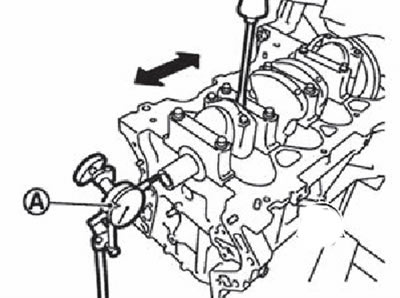
If the obtained value exceeds the maximum permissible value, replace the thrust half rings and measure again. If the axial clearance still exceeds the maximum permissible value, replace the crankshaft with a new one.
Checking the connecting rod side clearance
Measure the side clearance between the connecting rod and the crankshaft web using a set of flat feeler gauges (A).
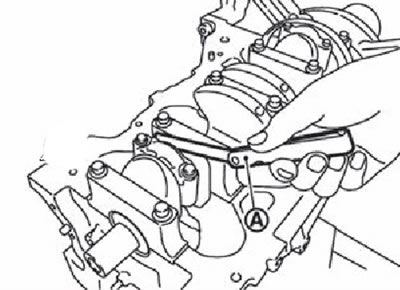
If the obtained value exceeds the maximum permissible value, replace the connecting rod and measure again. If the side clearance value still exceeds the maximum permissible value, replace the crankshaft.
Clearance between piston and piston pin
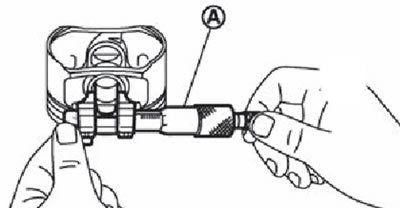
Piston pin bore diameter
Using a micrometer (A), measure the inside diameter of the piston pin bore.
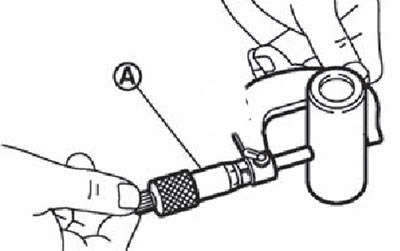
Piston pin outer diameter
Using a micrometer (A), measure the outside diameter of the piston pin.
Clearance between piston and piston pin
(Clearance between piston and piston pin) = (Piston bore diameter) - (Piston pin diameter)
If the obtained clearance value does not correspond to the norm, replace the piston and piston pin as a set.
Note.
- When replacing the piston with the pin assembly, follow the information on piston selection (see below).
- Only piston pins are differentiated by size groups (holes in the piston), selectively selected at the manufacturing plant. There are no size groups of piston pins supplied as spare parts (only the "zero" size group is supplied).
Lateral clearance of piston rings
Measure the side clearance between the piston rings and the piston grooves using a set of flat feeler gauges (A).
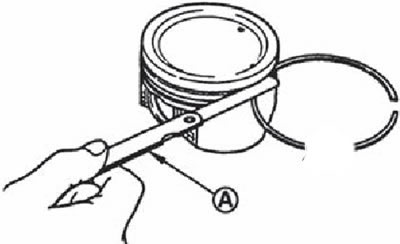
If the obtained value exceeds the maximum permissible value, replace the piston ring and measure again. If the clearance still exceeds the maximum permissible value, bore the cylinder and use a piston and piston rings of the repair size.
Piston ring gap
Ensure that the cylinder bore ID is within specification (see "Piston to Cylinder Clearance" below).
Lubricate the piston (1) and piston ring (2) with fresh engine oil, then use the piston to push the piston ring (A) to the middle of the cylinder (B), and measure the gap in the piston ring lock with a flat feeler gauge (C).
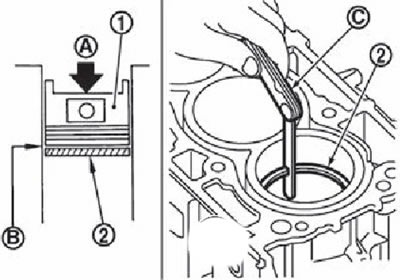
If the measured value exceeds the maximum allowable value, replace the piston ring and measure again. If the measurement result still exceeds the maximum allowable value, ream the cylinder bore and use pistons and piston rings of repair size.
Bending and twisting of the connecting rod
Check the geometric parameters of the connecting rod using a specially designed stand.
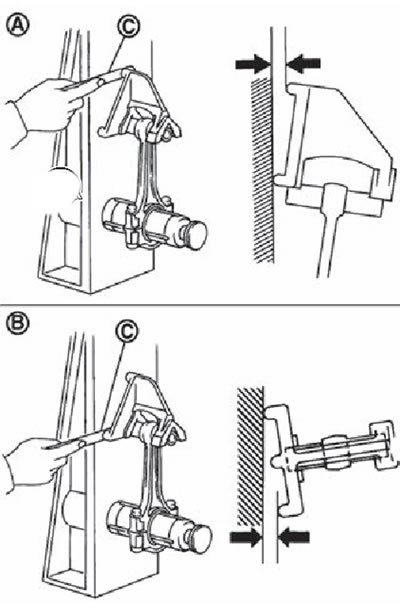
A. Bending.
B. Torsion.
C. Set of flat feeler gauges.
If the obtained parameters exceed the maximum permissible values, replace the connecting rod with a new one.
Connecting rod lower head diameter
Install the connecting rod cap (1) without the connecting rod bearing and tighten the connecting rod bolts to the specified tightening torque.
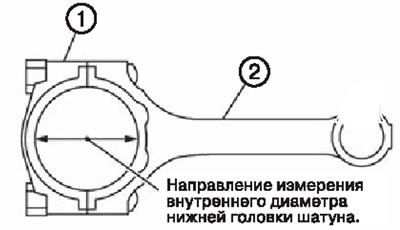
1. Connecting rod cover.
2. Connecting rod.
Measure the inside diameter of the connecting rod lower head using a bore gauge.
If the obtained value exceeds the maximum permissible value, replace the connecting rod assembly.
Clearance in the upper connecting rod head
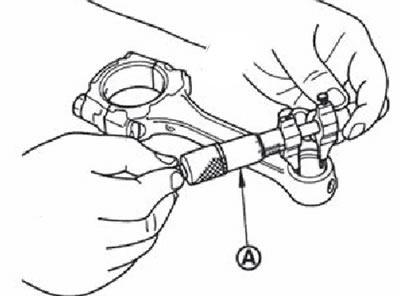
Connecting rod bushing inner diameter
Using a bore micrometer (A), measure the inside diameter of the connecting rod bushing.
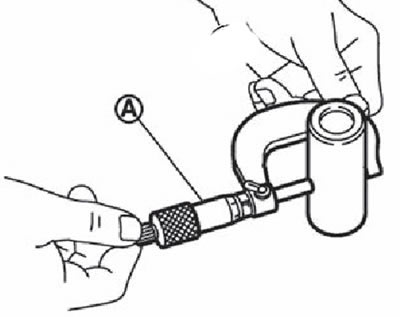
Piston pin outer diameter
Using a micrometer (A), measure the outside diameter of the piston pin.
Clearance in the upper connecting rod head
(Clearance in the upper connecting rod head) = (Inner diameter of connecting rod upper head bushing) - (Piston pin outer diameter)
If the obtained clearance value does not correspond to the standard, replace the connecting rod assembly and/or the piston and piston pin assembly.
When replacing the piston with the pin assembly, follow the information on piston selection (see below).
When replacing the connecting rod, follow the information on selecting connecting rod bearings (see below).
Non-flatness of the upper surface of the cylinder block
Using a scraper, remove any remaining gasket from the top surface of the cylinder block, and clean the surfaces of oil, carbon deposits and other contaminants.
Caution: Be careful not to allow gasket residue to enter the oil passages and coolant passages in the cylinder block.
Using a straight edge (A) and a set of flat feeler gauges (B), measure the non-flatness of the cylinder block surface at several points in six directions.
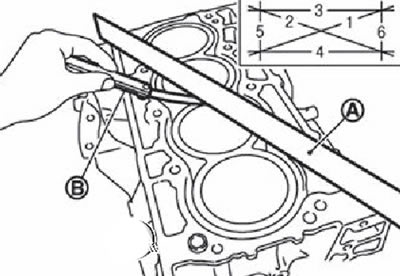
If the measured value is not within the norm, replace the cylinder head with a new one.
Inner diameter of main bearing bed
Install the main bearing caps without the liners and tighten the mounting bolts to the specified tightening torque.
Measure the inner diameter of the main bearing bed with a bore gauge.
The measurement should be taken in the plane indicated in the figure (5 mm from the leading edge of the main bearing bed) in two directions. For analysis, select the smallest of the two obtained diameter values.
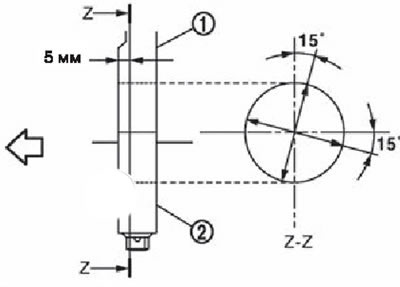
1. Cylinder block.
2. Main bearing cap.
The arrow points towards the front of the engine.
If the obtained value does not correspond to the norm, replace the cylinder block with the main bearing caps as an assembly.
Note: The main bearing caps cannot be replaced separately, as they are bored together with the cylinder block.
Clearance between piston and cylinder
Inner diameter of cylinder bore
Using a bore gauge (A), measure the cylinder bore diameters in various planes and directions to determine the amount of wear, ovality and taper of the cylinder (directions "X" and "Y" in planes "A", "B" and "C"; "Y" - longitudinal direction relative to the engine).
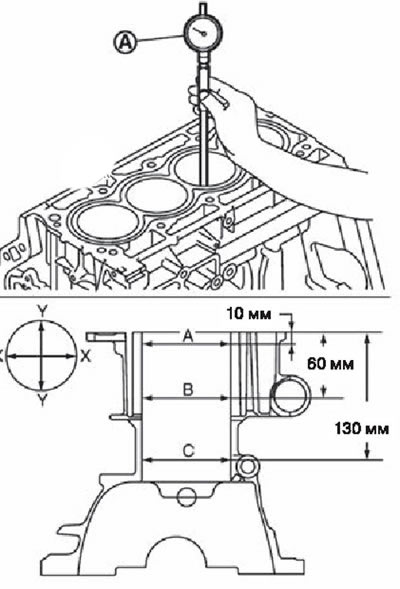
Note: To determine the cylinder bore size group, measure the cylinder diameter in the "X" direction in the "B" plane.
If the obtained values exceed the maximum permissible values, or if there are scratches and/or scoring on the cylinder mirror, replace the cylinder block with a new one.
Note: The use of pistons of repair sizes is not permitted.
Piston skirt diameter
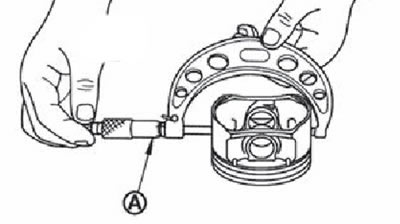
Using a micrometer (A), measure the outside diameter of the piston skirt.
Clearance between piston and cylinder
Using the measured values of the cylinder diameter and piston skirt, calculate the clearance value (direction "X", plane "B").
(Gap) = (Cylinder diameter) - (Piston skirt diameter).
If the obtained value exceeds the maximum permissible value, replace the piston with the piston pin assembly and/or the cylinder block.
Crankshaft journal diameter
Measure the outside diameter of the crankshaft journal with a micrometer (A).
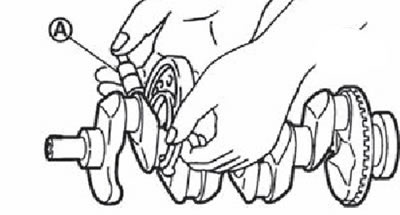
If the obtained value does not correspond to the norm, measure the clearance in the main bearing and use main bearing shells of the repair size.
Crankshaft journal diameter
Use a micrometer to measure the outside diameter of the crankshaft journal.
If the obtained value does not correspond to the norm, measure the clearance in the connecting rod bearing and use connecting rod bearings of the repair size.
Ovality and taper of crankshaft journals
Using a micrometer, measure the diameter of each main and connecting rod journal at four points on the crankshaft journal as shown in the figure.
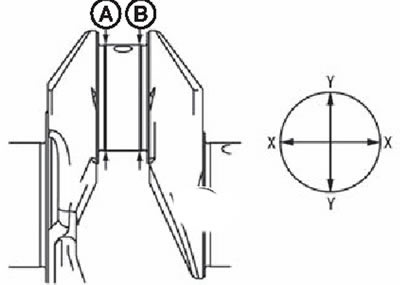
Ovality is defined as the difference in diameters between the "X" and "Y" directions in the "A" and "B" planes.
Taper is defined as the difference in diameters between planes "A" and "B" in the "X" and "Y" directions.
If the obtained values exceed the maximum permissible values, regrind or replace the crankshaft.
After regrinding, measure the clearances in the main and connecting rod bearings, and then select the main and/or connecting rod bearing shells.
Crankshaft runout
Place the prisms on the marking plate and place the crankshaft on the prisms.
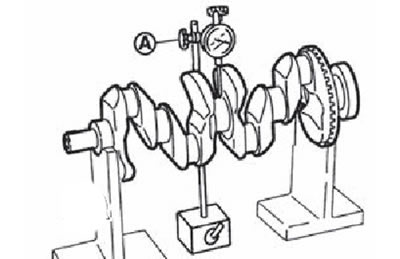
Install a dial indicator on the middle main journal (No. 3).
Rotate the crankshaft and measure the crankshaft runout at the center main journal (full amplitude of the arrow movement).
If the obtained value exceeds the maximum permissible value, replace the crankshaft with a new one.
Clearance in connecting rod bearings
Calculated definition of the gap
Install the connecting rod bearings (2) into the connecting rod (3) and connecting rod cap (1), then tighten the connecting rod bolts to the specified tightening torque.
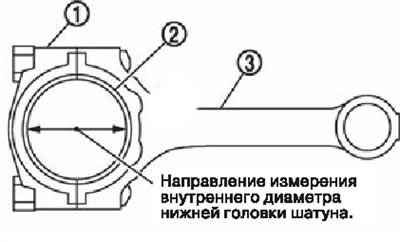
1. Connecting rod cover.
2. Connecting rod.
Using a micrometer with a bore gauge, measure the inside diameter of the hole in the lower connecting rod head.
(Gap) = (Connecting rod lower head bore diameter) - (Crankpin diameter)
If the clearance value exceeds the maximum permissible value, select suitable connecting rod bearings based on the diameter of the connecting rod lower head hole, the diameter of the connecting rod journal and the required oil clearance.
Measuring the gap using a calibrated wire
Thoroughly wipe the crankshaft journal and connecting rod bearings.
Measure and cut a length of Plastigage to just under the width of the bearing and install along the journal, but not on the oil hole.
Install the connecting rod bearings into the connecting rod and into the connecting rod cap, tighten the nuts to the specified torque.
Caution: Do not turn the crankshaft.
Remove the connecting rod cover with the liner and measure the width of the wire in the most flattened part, and then use the gauge scale to determine the value of the radial oil clearance.
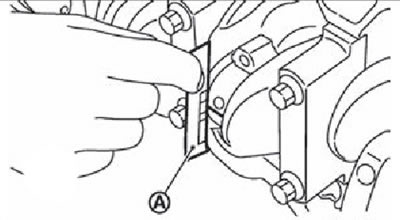
Note: If the gap is greater than the maximum, the measures taken are the same as in the case of the calculation method.
Main bearing clearance
Calculated definition of the gap
Install the main bearing shells (3) into the cylinder block (1) and the main bearing cap (2), then tighten the cap mounting bolts to the specified tightening torque.
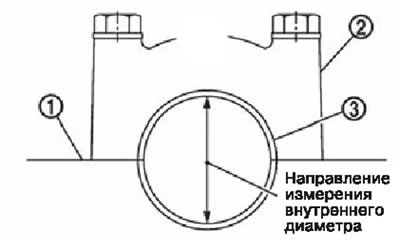
Measure the inner diameter of the main bearing with a bore gauge.
(Main bearing clearance) = (Main bearing inner diameter) - (Crankshaft journal diameter)
Data posted on the website nissanbook.ru
If the obtained value exceeds the maximum permissible value, select the appropriate diameter of the main bearing shells and crankshaft main journals to ensure the required clearance in the main bearings.
Measuring the gap using a calibrated wire
Thoroughly wipe the crankshaft main journal and main bearing shells.
Measure and cut a length of Plastigage to just under the width of the bearing and install along the journal, but not on the oil hole.
Install the main bearing shells into the cylinder block and main bearing cap, tighten the mounting bolts to the specified torque.
Caution: Do not turn the crankshaft.
Remove the main bearing cap with the liner and measure the width of the wire in the most flattened part, and then use the gauge scale to determine the value of the radial oil clearance.
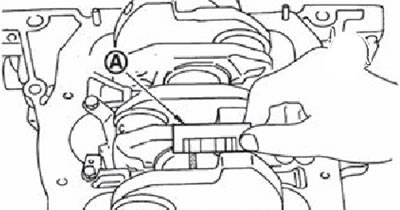
Note: If the gap is greater than the maximum, the measures taken are the same as in the case of the calculation method.
Main bearing shell protrusion height
After removing the main cover with the liner (1), the bolts of which were tightened to the specified torque, the end of the liner should protrude (B) above the bed connector.
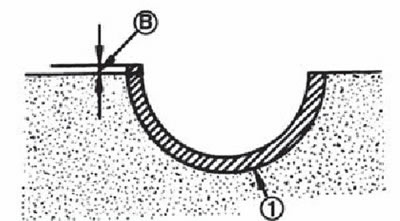
If there is no protrusion, replace the liners.
Connecting rod bearing protrusion height
After removing the connecting rod cap with the liner (1) (the connecting rod bolts were tightened to the specified torque) the end of the insert must protrude (B) above the bed connector.
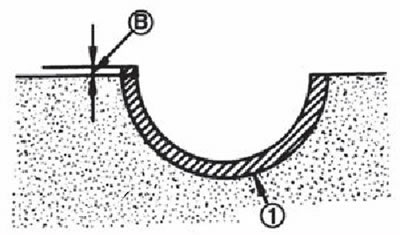
If there is no protrusion, replace the liners.
Main bearing cap bolt outer diameter
Measure the outside diameter ("d1", "d2") at two points as shown in the figure.
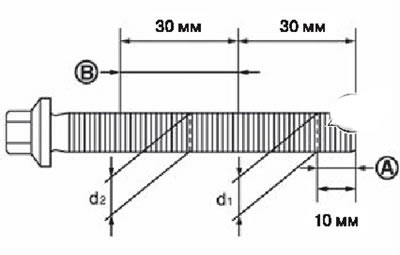
A: measuring point "d1".
B: fine dimension "d2".
If the thinning of the bolt occurs not at the point "d2" indicated in the figure, but at another point, then this point must be considered as "d2".
Note: Maximum permissible difference ("d1"-"d1"): 0.15 mm.
If the difference between the two diameters exceeds the maximum permissible value, replace the main bearing cap mounting bolt with a new one.
Outside diameter of connecting rod bolts
Measure the outside diameter "d" at the point indicated in the figure.
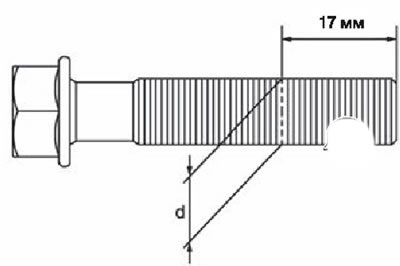
If the thinning of the bolt occurs not at the point "d1" indicated in the figure, but at another point, then this point must be considered as "d1".
Note: Maximum diameter: 7.75mm.
If the obtained value of the connecting rod bolt diameter exceeds the maximum permissible value (the bolt is too thin), replace the connecting rod bolt with a new one.
Clogged or damaged oil filter of the intake valve timing control system
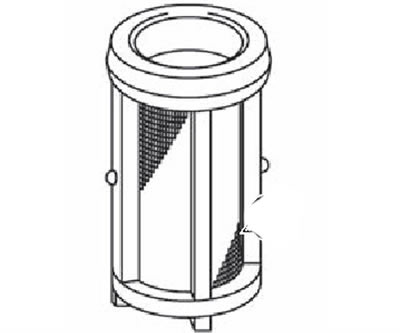
Make sure there is no foreign material on the oil filter and check it for clogging. Clean the filter if necessary.
Check the oil filter for damage. Replace if necessary.
Flywheel deformation (modifications with manual transmission)
Using a dial indicator (A), measure the amount of deformation of the flywheel contact surface (spin the flywheel).
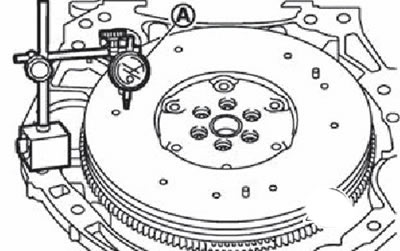
Note.
- Measurements should be taken at a diameter of 210 mm.
- Maximum permissible deformation of the flywheel contact surface: no more than 0.45 mm.
If the measured value is not within the norm, replace the flywheel.
If you find any signs of burning or discoloration on the surface, remove them with sandpaper.
Attention: When taking measurements, do not allow the magnate to be in close proximity (on a dial indicator stand) with a pulse disk on the rear of the crankshaft.
Flywheel play (modifications with manual transmission)
Caution: Do not disassemble the flywheel with paired masses.
Flywheel play in axial direction (back and forth)
Measure the amount of axial play (back and forth) when applying a force of 100 N (10.2 kg) in the area of a radius of 125 mm from the center of the flywheel.
Note: Standard value of axial clearance: no more than 1.8 mm.
If the obtained value does not correspond to the norm, replace the flywheel with a new one.
Play around the circumference (twisting)
Check the amount of play around the circumference:
1. Insert the clutch pressure plate mounting bolt (1) into the mounting hole and place the torque wrench (A) along the flywheel centerline (2).
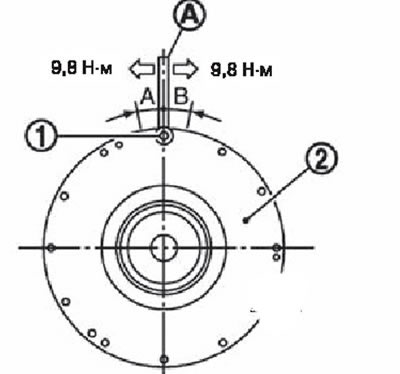
Note: Tighten the bolt to 9.8 Nm to prevent it from loosening spontaneously.
2. Apply alignment marks around the circumference of the two flywheel masses without applying load.
3. Apply a force of 9.8 Nm in each direction and note the value relative to the mass displacement on the gearbox side.
4. Measure the value of the relative displacement "A" and "B" along the circumference of the flywheel from the gearbox side.
Note: The maximum permissible value is no more than 33.2 mm.
If the measured value is not within the norm, replace the flywheel with a new one.
Deformation of the drive disk (modifications to the variator)
Measure the amount of deformation of the contact surface of the drive disk using a dial indicator (A) (rotate the drive disk).
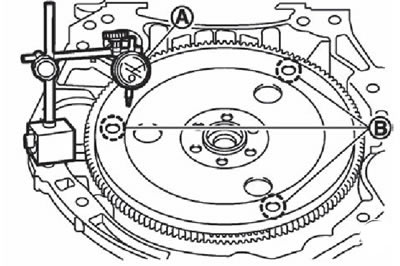
Note.
- The measurement is carried out in an area limited by a diameter of 12.4 mm and 20.0 mm around the hole (B).
- Maximum permissible deformation value: no more than 0.35 mm.
If the measured value is not within the norm, replace the drive disk with a new one.