


Caution: Use safety glasses to protect your eyes.
2. Install all plugs into the cylinder block as shown in the figure.
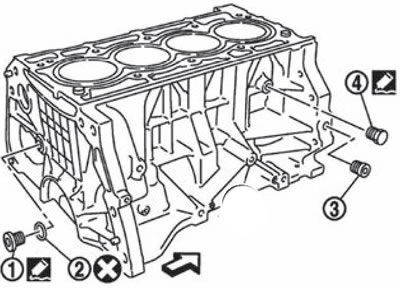
The arrow points towards the front of the engine
1. Plug of the rear part of the block.
2. Washer.
3. Plug of the front part of the cylinder block.
4. Drain hole plug.
Note.
: replace the part with a new one after each removal.
: places where sealant is applied.
- Apply sealant to the threads of the drain plug (4). Use the original sealant or equivalent.
- Apply sealant to the threads of the plug (1). Use thread locking compound or equivalent.
- Apply sealant to the plug (3).
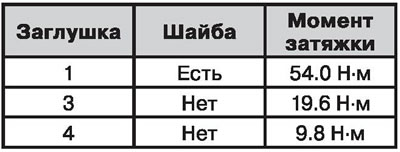
- Tighten the plugs to the specified tightening torques shown in the table below.
3. Install the main bearing shells and thrust half rings:
Remove dust, dirt and engine oil from the surface of the cylinder block seats and main bearing caps.
Install thrust half rings on both sides of the main bearing seat No.3 (B) in the cylinder block.
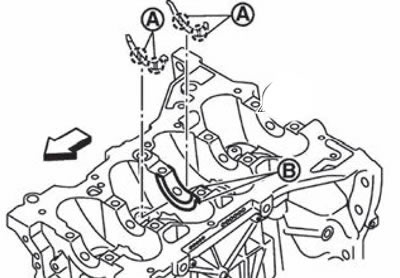
The arrow indicates the front side of the cylinder block
Note: Install the thrust washers so that the oil grooves (A) face outward.
Install the main bearing shells, paying particular attention to the direction of their installation.
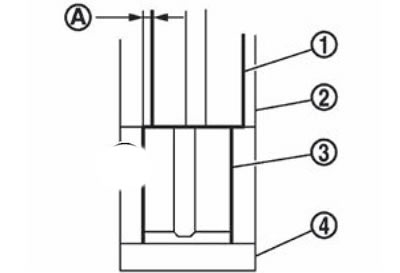
1. Main bearing shell.
2. Cylinder block.
3. Lower main bearing shell.
4. Main bearing cap.
Note.
- Before installing the main bearing shells, apply fresh engine oil to the inner surface of the shell. Do not apply oil to the back surface, but clean it thoroughly.
- When installing, place the main bearing shell strictly in the center of the socket in the cylinder block or bearing cap.
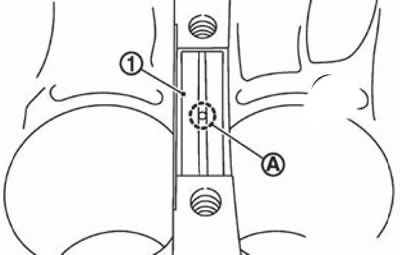
- The offset (A) relative to the upper (1) and lower (3) main bearing shells must not exceed 0.85 mm.
- Make sure that the oil holes (A) in the cylinder block and in the bearing shell (1) are aligned.
4. If removed, install the pulse disk on the crankshaft:
Install the pulse disk with the flange facing the front of the engine onto the rear of the crankshaft.
Apply fresh engine oil to the threads and seating surfaces of the mounting bolts.
Install the pulse disk (1) on the crankshaft (2), using the hole (A) for the mounting pin as a guide, then tighten the mounting bolts in the sequence shown in the figure using a TORX socket.
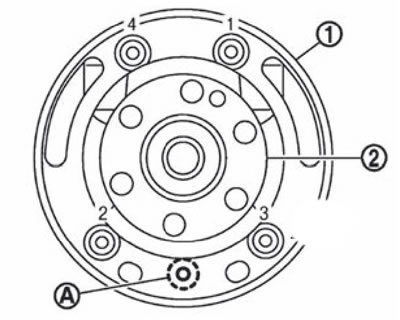
Note: Crankshaft and pulse disk dowel pin is supplied as a spare part with each of them.
Tighten the mounting bolts in the sequence shown in the figure.
Remove the locating pin.
Caution: Make sure the locating pin is removed.
5. Install the crankshaft into the cylinder block.
Note: Make sure the crankshaft rotates freely by hand.
6. Install the main bearing caps:
Install the main bearing caps, using the number stamp (A) and the front part mark (B) as a guide.
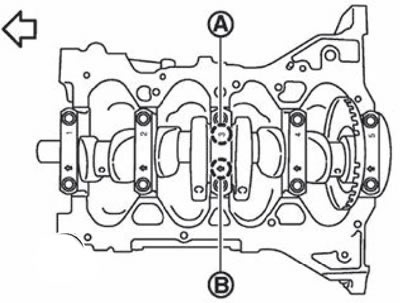
The arrow points towards the front of the engine
Note: Main bearing caps are not replaceable as separate spare parts as they are bored together with the cylinder block.
Tighten the main bearing cap bolts in the sequence shown in the figure in several stages:
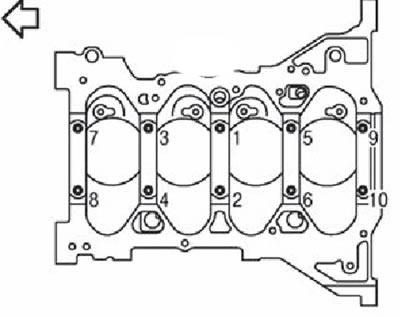
The arrow indicates the front side of the engine
1) Apply fresh engine oil to the threads and seating surfaces of the mounting bolts.
2) Tighten the main bearing cap bolts to 34.3 Nm.
3) Tighten the main bearing cap bolts 60° clockwise (corner tightening) in the sequence shown in the figure.
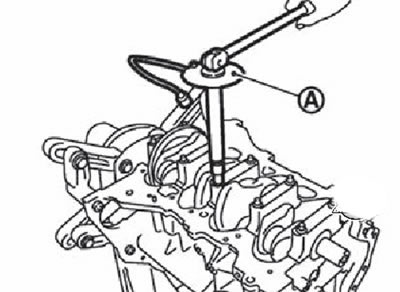
Attention. The tightening to the corner must be done using a corner brace (KV10112100) (A) Do not tighten the bolts "by eye".
Note.
- After tightening the main bearing cap bolts, make sure that the crankshaft still rotates freely.
- Check the crankshaft axial clearance.
7. Connect the pistons to the connecting rods:
Using the special tool, install the new snap ring into the groove at the rear of the piston.
Note: Make sure the snap ring is fully seated in the piston groove.
Install the piston onto the connecting rod.
Using an industrial hair dryer, heat the piston to approximately 60-70°C so that the piston pin can be easily inserted by hand. Insert the piston pin into the piston with the connecting rod through the front hole in the piston.
Make sure that the front mark (A) on the piston crown and the oil hole (B) and the cylinder number (D) on the connecting rod are in the position shown in the illustration.
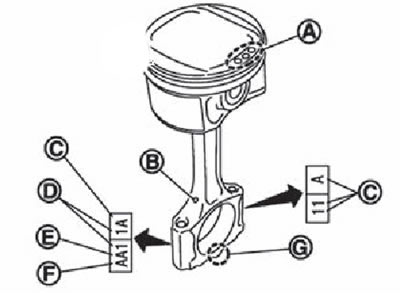
A. Front mark.
B. Oil hole.
C. Factory code.
D. Cylinder number.
E. Dimensional group of the diameter of the lower head of the connecting rod.
F. Dimensional group of the diameter of the upper head of the connecting rod.
G. Front mark of connecting rod cap.
Install a new snap ring into the groove on the front side of the piston.
Note.
- Make sure the snap ring is fully seated in the piston groove.
- After installation, make sure that the connecting rod moves freely.
8. Using a piston ring remover, install the piston rings.
Attention.
- Be careful not to damage the piston.
- Be careful not to damage the piston rings by over-stretching them.
Note: Install the piston rings so that their ring ends are in the position shown in the figure.
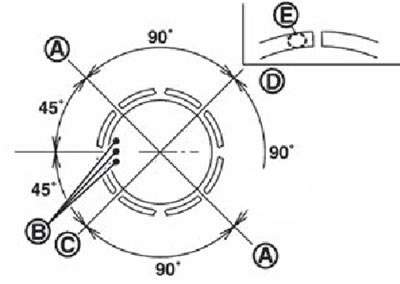
A. Upper or lower oil scraper disc lock.
B. Front mark.
C. Lock of the second compression and expansion oil scraper rings.
D. Upper compression ring lock.
E. Stamp.
Caution: Do not align the gap in the oil scraper disc lock of the oil scraper ring with the piston oil groove.
Note: Install the second compression ring with the stamped surface (E) facing upward.
9. Install the upper (2) and lower (3) connecting rod bearings into the connecting rod (1) and connecting rod cap (4).
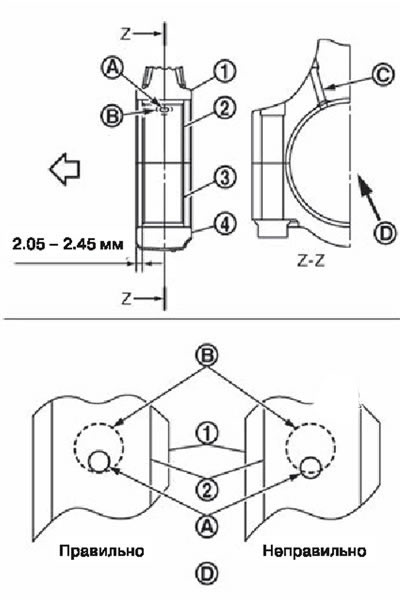
A. Oil hole.
B. Cone of the oil hole in the connecting rod.
C. Oil hole in the connecting rod.
D. View from the arrow side.
The arrow points towards the front of the engine.
Install the connecting rod bearings as shown in the figure.
Make sure that the oil hole (A) is completely located in the cone (D) of the connecting rod oil hole.
When installing the connecting rod bearings, apply fresh engine oil to the inner surfaces. Do not apply engine oil to the back surfaces of the bearings, but clean them thoroughly.
Note.
- The connecting rod bearings do not have positioning protrusions.
- The connecting rod bearings must be installed in the center of the connecting rod and connecting rod cap, as shown in the figure. For service operations, the central position can be determined visually.
10. Install the piston with connecting rod assembly onto the crankshaft.
Set the corresponding crankshaft journal to the bottom dead center position.
Apply a sufficient amount of fresh engine oil to the cylinder bore, piston and crankshaft journal.
Establish the correspondence between the piston and connecting rod to a particular cylinder using the number mark (D) on the connecting rod.
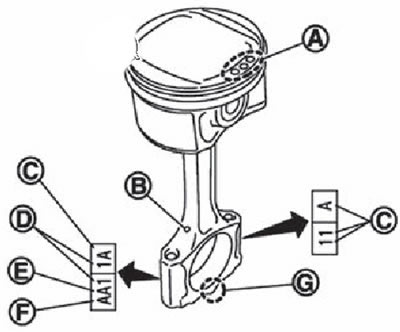
A. Front mark.
B. Oil hole.
C. Factory code.
D. Cylinder number.
E. Dimensional group of the diameter of the lower head of the connecting rod.
F. Dimensional group of the diameter of the upper head of the connecting rod.
G. Front mark of connecting rod cap.
Position the piston with the connecting rod so that the front mark (A) but the bottom of the piston is directed towards the front of the engine.
Using the piston ring compressor (A) (EM03470000) or a suitable tool, insert the piston with the connecting rod into the cylinder bore.
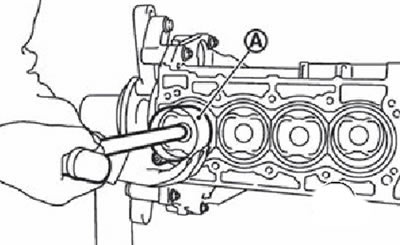
Caution: Be careful not to damage the cylinder bore and crankshaft journal with the lower part of the connecting rod.
11. Install the appropriate connecting rod cap, using the cylinder number mark as a guide.
12. Tighten the connecting rod bolts.
Caution. Make sure that there are no protrusions on the thrust surface of the joint (A) between the connecting rod (1) and the connecting rod cap (2), and that the connecting rod bearings are installed correctly. Then tighten the connecting rod bolts.
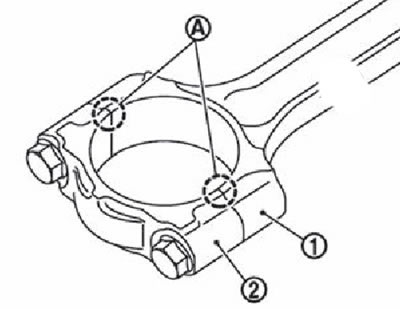
Caution: If connecting rod bolts are reused, measure their diameter (see "Checking after disassembly").
Apply fresh engine oil to the threads and seating surfaces of the connecting rod bolts.
Tighten the bolts to 27.4 Nm.
Loosen the bolts completely.
Retighten the connecting rod bolts to 19.6 Nm.
Tighten the bolts 60° clockwise (tightening but angle).

Attention: Use a special corner wrench to tighten the corner (KV10112100). Do not tighten the bolts "by eye".
Note.
- After tightening the connecting rod bolts, make sure that the crankshaft rotates freely.
- Check the connecting rod side clearance.
13. Install oil pans (upper and lower).
Note: After installing the upper oil pan, the rear oil seal must be installed.
14. Install the rear oil seal.
15. Install the drive disk (1) (modifications with variator!) or flywheel (modifications with manual transmission).
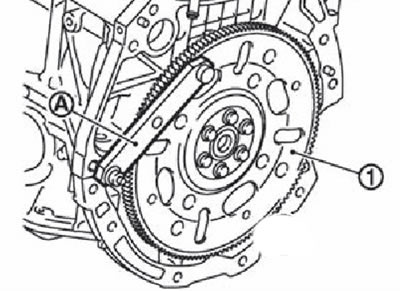
Note: Secure the crankshaft with a lock plate (KV11105210) (A), then tighten the mounting bolts in several steps in a crosswise pattern.
Note: Drive disc. Install the drive disc (1), reinforcing disc (2) and guide sleeve. Using a 33 mm diameter drift, press the guide sleeve into the end of the crankshaft until it stops.
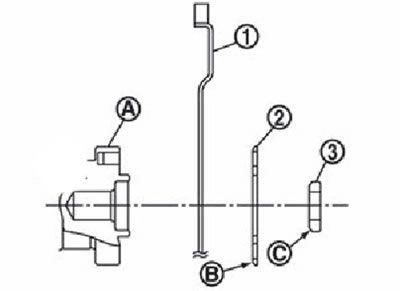
A. Rear of the crankshaft.
B. Rounding.
S. Faska.
Note: Manual transmission models do not have a guide bushing and reinforcement disc.
16. Install the knock sensor.
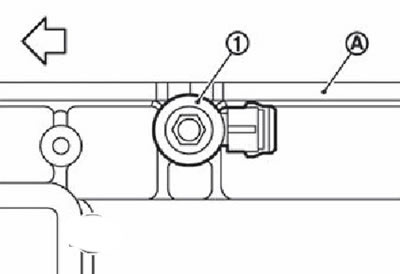
A. Left side of the cylinder block. Arrow points toward the front of the engine
Note: Install the knock sensor (1) with the wire connector facing toward the rear of the engine.
Attention.
- Do not tighten the sprinkling bolt while holding the sensor by the wire connector.
- If the sensor has been dropped or impacted, it must be replaced with a new one.
Note.
- Make sure there is no foreign material on the cylinder block mounting surface and the rear surface of the knock sensor.
- Make sure the knock sensor does not touch other parts.
17. Install the crankshaft position sensor (P0S) and sensor cover.
Attention.
- Handle the sensor with care and do not allow it to fall or be hit.
- Do not disassemble the sensor.
- Avoid exposing the crankshaft position sensor to electromagnetic fields.
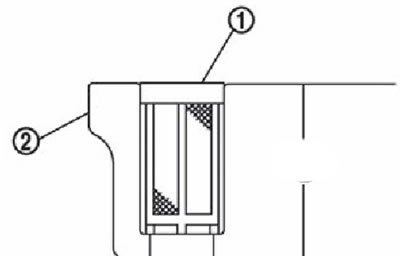
18. Install the oil filter of the intake valve timing control system (1) in the position shown in the figure.
Note: After installation, make sure that the oil filter does not protrude above the top surface of the cylinder block (2).
19. Further assembly is carried out in the reverse order of disassembly.