


Table of contents: Selection of new main bearing liners ↓ Checking clearances in main bearings ↓ Final installation of the crankshaft ↓
Selection of new main bearing liners
Attention! The description concerns only standard size main bearings. Repair liners are not divided into size groups. New main bearings are selected in accordance with the identification codes applied to the crankshaft and cylinder block.
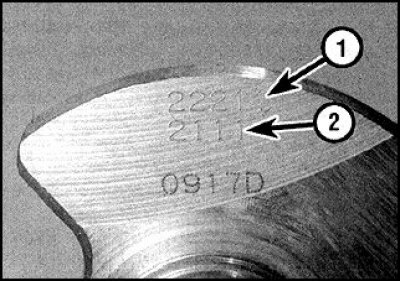
On the crankshaft, the codes are applied to the cheek of the neck of the 1st cylinder (from the chain cover side). The five-digit code refers to the main bearing diameters – the first digit is the code for the 1st crankshaft main journal, and the fifth is the code for the 5th journal.
Please note! Some engines also have four-digit codes on the crankshaft cheek that indicate the size group of the connecting rod bearings (see subsection 3.2.2.10.2).
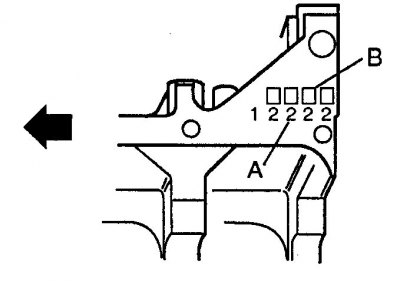
On the cylinder block, the size codes are stamped on the base on the flywheel side.
To select main bearing shells, you need to find out the size group for boring under the shell, stamped on the cylinder block, and the size group code of the corresponding main journal, which is applied to the crankshaft, and then, using the attached table, determine the required shell, focusing on the color marking, which is applied in the form of a dot on its side surface.
| Code on the crankshaft | Code on the cylinder block | Main Bearing Marking |
| 0 | 0 | black |
| 0 | 1 | brown |
| 0 | 2 | green |
| 1 | 0 | brown |
| 1 | 1 | green |
| 1 | 2 | yellow |
| 2 | 0 | green |
| 2 | 1 | yellow |
| 2 | 2 | blue |
Checking clearances in main bearings
1. Clean the outer surface of the new main bearings, the surfaces of the bearing bores in the cylinder block and in the main bearing caps.
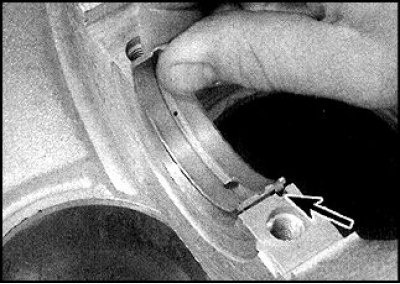
2. Install the upper bearing shells by aligning the protrusions with the recesses in the cylinder block (arrow).
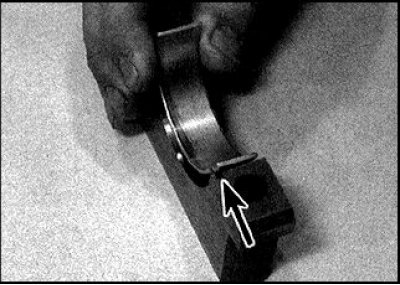
3. Install the lower inserts into the covers, also aligning the protrusion with the recess (indicated by the arrow).
4. Do not touch the working surface of the liners with your fingers. Keep in mind that all upper main liners have a lubrication groove and an oil supply hole. The lower liners are solid. If the clearance is checked on old liners, make sure that they are installed in their original places.
5. The gap can be checked in two ways.
6. When determining the gap, install the covers using the first method (or the frame of the lids) main bearings together with liners on the cylinder block, tighten the bolts to the specified torque and measure the inner diameter of each assembled pair of liners. The clearance in the main bearings is determined as the difference between this diameter and the diameter of the crankshaft main journals.
7. The second way (more accurate) consists of using plastic calibration wire.
8. After installing the main bearings, carefully install the crankshaft. The main journals must be dry and clean.
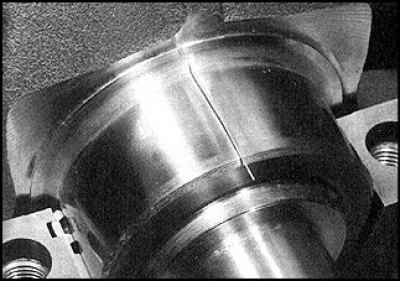
9. Prepare several lengths of Plastigage plastic gauging wire, slightly shorter than the width of the main bearings, and place one length on each crankshaft main journal parallel to its axis.
10. Install the lids with the lower inserts without disturbing their orientation.
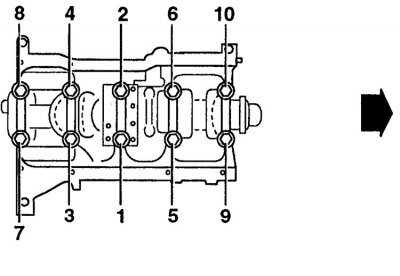
11. Tighten the bolts to the specified torque, in the specified sequence. Tighten the bolts with the same, constantly increasing force. During tightening, the position of the wire section should not change, turning the crankshaft is not allowed.
12. In the reverse order to that shown, unscrew the cover bolts, unscrewing one turn at a time.
13. Remove the lids (or frame), without disturbing the position of the flattened wires and without allowing the crankshaft to turn.
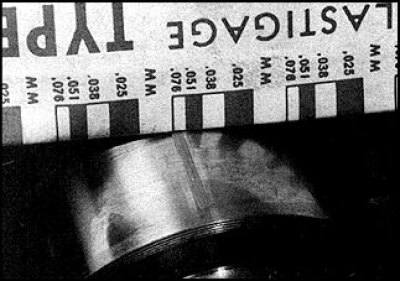
14. Compare the width of the crushed wires with the scale on the package and determine the clearance in the main bearing. Compare with the standard value.
15. If the gap differs from the standard, the reason may be the incorrect selection of liners (or their increased wear, if the liners tested were previously in use).
16. Before deciding whether the bearings need to be replaced, make sure that there was no dirt or oil between the covers or cylinder block and the bearing when measuring.
17. If the width of the flattened wire is greater at one end, this indicates that the neck is tapered.
18. If the gap differs from the norm when measured with old liners, repeat the measurements with new liners.
19. If the gap exceeds the norm even with new liners, you should consult a car service. It may be necessary to regrind the crankshaft journals and replace the liners with repair ones.
20. If necessary, purchase liners of the appropriate size group and repeat the procedure for measuring the clearance in the main bearings.
21. When finished, scrape off any remaining calibration wire from the crankshaft journals without damaging the surface.
Final installation of the crankshaft
1. Carefully remove the crankshaft from the cylinder block.
2. Install the main bearing shells into place.
3. If new liners are installed, wash them thoroughly in kerosene.
4. Wipe the bearings and connecting rods dry.
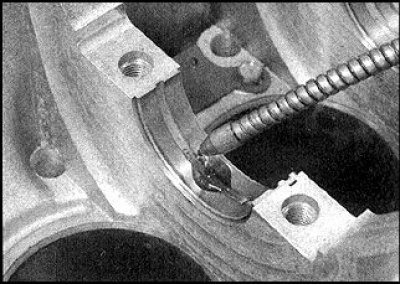
5. Generously lubricate the bearing surfaces installed in the cylinder block with fresh engine oil.
6. Apply a thin layer of grease to the thrust washers and attach them to both sides of the 3rd main bearing.
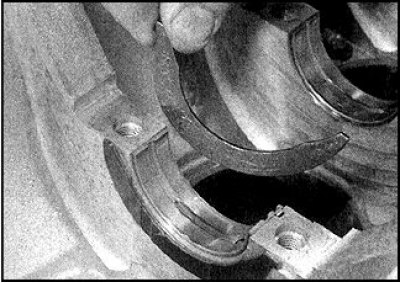
7. Make sure that the oil grooves on both half rings are facing away from the cylinder block.
8. Install the crankshaft into the cylinder block and check the axial clearance.
9. Carefully clean the separating surfaces of the main bearing caps and cylinder block from grease.
10. Lubricate the lower bearing surfaces with fresh engine oil. Make sure the locating tabs on the bearings fit into the recesses in the caps.
11. Install the covers back in their original places, using the marks as a guide.
12. Tighten the bolts by hand.
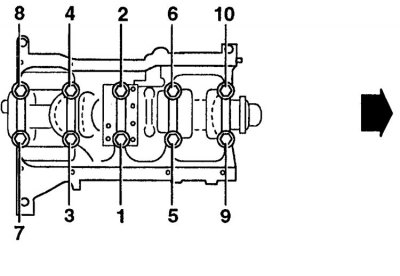
13. Tighten the cover bolts in the sequence shown to approximately half the specified torque. Then repeat the procedure to tighten the bolts to the specified torque.
14. Check the freedom of rotation of the crankshaft.
15. Install the connecting rods with pistons.
16. Make a mark indicating the depth of the seal in the holder and remove the seal by prying it up with a screwdriver.
17. Press in the new seal using light hammer blows to a depth that corresponds to the mark applied.
18. Apply a bead of sealant to the seal retainer split surface and install onto the cylinder block.
19. Tighten the bolts to the specified torque.
20. Install the flywheel, camshaft timing chains and oil pan.