


Table of contents: Checking the clearance in connecting…↓ Installation of connecting rod and…↓
Attention! The description concerns only connecting rod bearings of standard size. Repair connecting rod bearings are not divided into size groups.
New connecting rod bearings are selected according to the size group codes marked on the crankshaft.
Dimension group codes are applied to the 1st or 4th crankshaft cheeks.
To select connecting rod bearing liners, you need to find out the size group of the crankshaft connecting rod journal for a given cylinder, and then use the attached table to determine the required liners, focusing on the color marking, which is applied as a dot on the side surface of the liners.
| Code on the crankshaft | Color marking of the insert size group |
| 0 | white (or missing) |
| 1 | brown |
| 2 | green |
Checking the clearance in connecting rod bearings
1. Clean the outer surface of the connecting rod bearings and the surfaces of the bearing bores in the connecting rods and in the connecting rod caps.
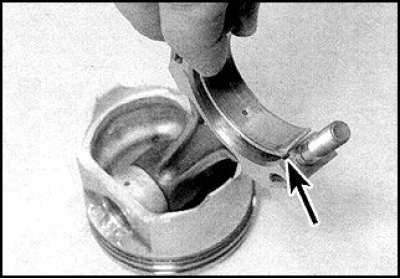
2. Insert into the bearing shells and make sure that the projections on the bearing shells fit into the recesses in the connecting rod (arrow) and in the connecting rod cap.
3. When installing the bearings, do not touch the working surface. Make sure that the oil hole in the upper connecting rod bearing is precisely aligned with the hole in the connecting rod.
4. If the clearance check is to be performed with the old bearings, then insert these bearings into their original positions.
5. There are two ways to check the clearance in connecting rod bearings.
6. When determining the clearance using the first method, assemble the caps with the connecting rods and connecting rod bearings, ensuring that these parts are correctly oriented relative to each other.
7. Tighten the cap nuts to the specified torque and measure the inside diameter of each assembled pair of bearings. The clearance is defined as the difference between the inside diameter of the assembled connecting rod bearings and the diameter of the connecting rod journal.
8. The second way (more accurate) consists of using plastic calibration wire.
9. Install the connecting rod bearings, orienting them correctly. Place a piece of calibration wire on each connecting rod journal of the crankshaft.
10. Clean the surfaces of the connecting rod bearings and install the connecting rods on the corresponding crankshaft journals. Install the connecting rod bearing caps, orienting them according to the existing marks or marks applied during disassembly.
11. Tighten the cap nuts. When tightening, the wire position must not change, and the crankshaft must not turn.
12. Remove the connecting rod caps, being careful not to turn the crankshaft or move the gauge wire. Compare the width of the flattened wire with the scale on the package and determine the clearance in the main bearings.
13. If the clearance differs from the standard, the reason may be the incorrect selection of connecting rod bearings (or their increased wear if the liners tested were previously in use).
14. Before deciding whether the bearings need to be replaced, make sure that there is no dirt or oil between the surfaces of the caps or connecting rods and the bearing when measuring.
15. If the width of the flattened wire on one edge is greater, this indicates the taper of the crank journal.
16. If the gap differs from the norm when measured with old liners, repeat the measurements with new liners.
17. If the clearance exceeds the norm even with new liners, you should consult a car service. It may be necessary to regrind the crankshaft journals and replace the liners with repair ones.
18. If necessary, purchase liners of the appropriate size group and repeat the procedure for measuring the clearance in the connecting rod bearings.
19. When finished, carefully remove any remaining wire.
Installation of connecting rod and piston group
The following description is given on the assumption that the crankshaft is already installed.
1. Make sure the connecting rod bearings are installed correctly.
2. If new bearings are to be installed, wash them in kerosene.
3. Wipe the connecting rods and bearings dry.
4. Lubricate the cylinders, pistons and rings, then lay out the pistons and connecting rods in the order in which these parts will be installed on the engine.
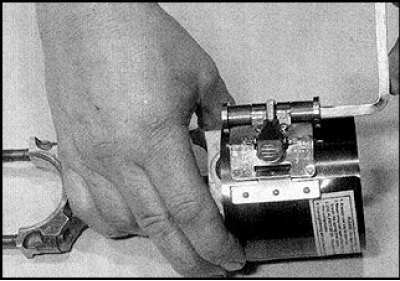
5. Start assembly with cylinder 1. Make sure the piston ring joints are correctly positioned (see Fig. subsection 3.1.2.13) and squeeze the rings with a special device.
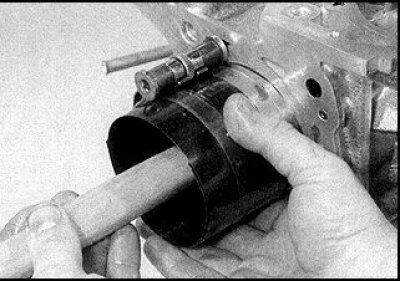
6. Insert the piston assembly with the connecting rod into the first cylinder. Orient the piston so that the mark on the piston bottom (in the form of an arrow or a line) was facing the front cover. Lightly tap the piston with a hammer handle or a wooden block so that the piston enters the cylinder and the piston bottom is aligned with the split plane of the cylinder block.
7. Make sure the connecting rod bearings are installed correctly and generously lubricate the bearings and crankshaft journal.
The article was obtained from the portal nissanbook.ru
8. Be careful not to damage the cylinder surface and pull the connecting rod toward the crankshaft journal.
9. Put the connecting rod cap on with the bearing shell and tighten the nuts by hand. Keep in mind that the planes on the connecting rod and on the connecting rod cap, on which the marks are applied, must be aligned (this means that the mounting lugs of the connecting rod bearings are located opposite each other).
10. Tighten the connecting rod cap nuts to the Stage 1 torque using a torque wrench and socket head. Then tighten the nuts to the Stage 2 torque angle, or tighten to Stage 2 torque.
11. Check the crankshaft for freedom of rotation. If new parts are installed, there should be a noticeable, constant resistance to crankshaft rotation, but the crankshaft should turn smoothly without jamming.
12. Install the remaining pistons and connecting rods in the same manner.
13. Install the cylinder head, camshaft chains and oil pan.