


Table of contents: Checking axial play ↓ Checking the status ↓
Checking axial play
1. Axial clearance is checked before the crankshaft is removed from the engine and can rotate freely in the main bearings.
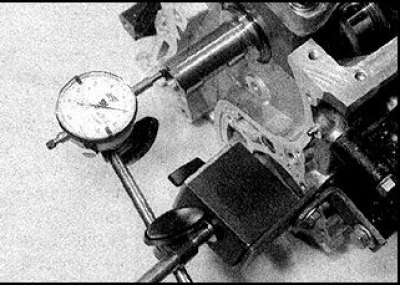
2. Axial clearance is checked using a dial indicator. Move the crankshaft to the stop to the side and set the indicator scale to zero. Move the crankshaft to the opposite side and read the indicator reading. Compare the result with the standard. If the clearance exceeds the standard, then the thrust half rings will need to be replaced.
3. If there is no indicator, the axial play can be checked with a feeler gauge. Move the crankshaft as far as it will go toward the flywheel, then measure the play by inserting feeler gauges into the gap between the crankshaft cheek near the 4th crankpin and the thrust half ring near the 3rd main bearing.
Checking the status
1. Wash the crankshaft with solvent and dry it. Thoroughly clean the oil passages inside the crankshaft.
2. Check for signs of uneven wear, cracks, scuff marks, and pitting (pits) on the connecting rod necks.
3. Wear of the connecting rod journal is accompanied by a distinct metallic knock when the engine is running (it is especially noticeable when you press the throttle pedal while driving at low speeds) and a noticeable drop in oil pressure.
4. Wear of the main bearings is accompanied by strong engine vibration and a dull rumbling sound that increases with increasing engine speed, as well as a noticeable drop in oil pressure.
5. Check the crankshaft journals for roughness by running your finger over them. Any roughness (which appears simultaneously with obvious signs of wear of the main and connecting rod bearings) indicates the need for regrinding of the crankshaft journals or its replacement.
6. Check the crankshaft runout in the central part by installing the crankshaft in prismatic bearings. If the runout exceeds the norm, the crankshaft must be replaced.
7. If the crankshaft journals have been reground, remove any burrs around the lubrication holes.
8. Measure the diameter of the main and connecting rod journals and compare the results with the standard. Determine the ovality of the journals by measuring the diameter at several points along the circumference of the journal. Check the taper by measuring the diameter near the opposite cheeks of the journals. Compare the results with the standard.
9. Check the condition of the crankshaft journals. If these journals have a deep groove formed in the place of the working edges of the seal, then consult a specialist, as either repair or replacement of the crankshaft will be required.
[The original is posted on the portal: NissanBook.ru]
10. There are two repair sizes for main bearings (with a diameter reduction of 0.25 and 0.5 mm) and three repair sizes for connecting rod bearings (0.08, 0.12 and 0.25 mm). If repair bearings are available for sale, and the wear of the crankshaft journals exceeds the standard so much that further repair is impossible, then it is advisable to purchase a repaired crankshaft and install repair bearings. Consult with a car service or a specialist about what actions to take next.