


2. Lay out the pistons assembled with the connecting rods and the new piston rings in such a way that the set of rings corresponds to the cylinder in which the clearance will be measured and in which the rings being checked will be installed.
3. Insert the top ring into the first cylinder and push it inward with the piston bottom so that the ring inside the cylinder becomes perpendicular to its axis. Push the ring to such a depth that the edge of the piston skirt is aligned with the split plane of the cylinder block, then remove the piston.
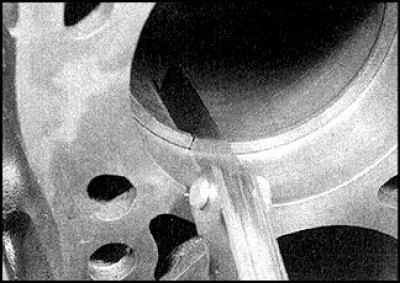
4. Measure the gap with a feeler gauge and compare the result with the standard.
5. If the gap is too small, carefully file the ends of the ring with a thin file.
6. If the gap is higher than normal, make sure that the ring matches the engine and cylinder size group.
7. Repeat the procedure for each ring of the first cylinder, as well as for the rings of the remaining cylinders. Keep rings and pistons corresponding to the same cylinder together.
8. After selecting the rings, measuring and adjusting the clearance, the rings can be installed on the pistons.
[The article was obtained from the portal: nissanbook.ru]
Caution! Always follow the ring manufacturer's instructions, as different manufacturers recommend different procedures for installing rings on the piston. Do not confuse the upper and lower compression rings, which have different profiles.
9. The oil scraper ring is installed first.
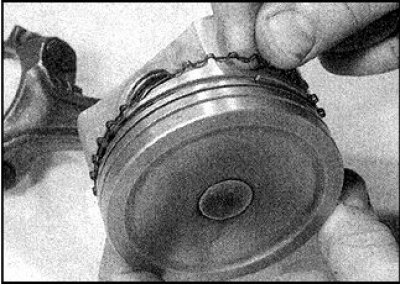
10. Install the expander into the groove.
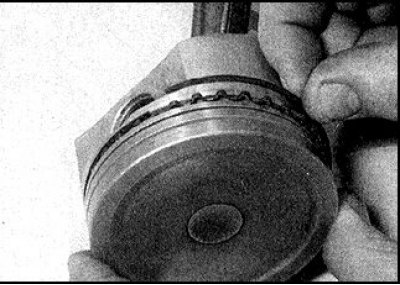
11. Then install the upper and lower discs of the oil scraper ring in order between the expander and the piston groove areas.
12. Install the lower compression ring.
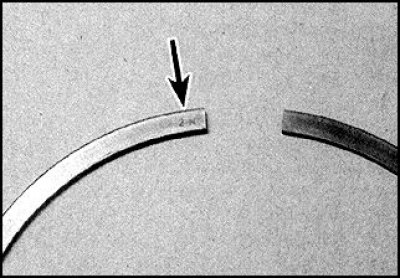
13. Install the upper compression ring, orienting it correctly. If the ring has a symmetrical cross-section, position it so that the identification mark faces upward.
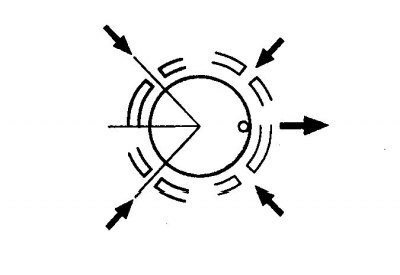
14. Arrange the joints in accordance.
15. Install the rings on the remaining pistons.