


Dismantling
Attention! The engine can be removed from the vehicle only as part of the power unit (i.e. assembled with the transmission). The power unit is lowered and removed from under the car. In order to freely remove the engine in this way, the car must be raised to a height of at least 75 cm (from the floor to the front bumper) and place on stands.
1. Place the car on a firm, level surface. Block the rear wheels and apply the handbrake. Raise the front of the car and place it on stands.
2. Remove the front wheels.
3. Loosen the screws and remove all engine shields.
4. Remove the hood (see subsection 13.7).
5. Drain the coolant.
6. Drain the oil from the gearbox, screw in and tighten both plugs.
7. Drain the oil and remove the oil filter, clean and tighten the drain plug.
8. Remove the battery.
9. Remove the expansion tank with the bracket.
10. Remove the belts.
11. Remove the generator.
12. On vehicles equipped with air conditioning, unscrew the compressor bolts, move the compressor to the side and secure it. Do not disconnect the hoses from the air conditioning.
13. Remove the power steering pump (see subsection 12.15).
14. Remove the brake calipers, set them aside and secure them without disconnecting the hoses.
15. Disconnect the CV joints from the hubs.
16. Disconnect the axle shafts (see subsection 10.2).
17. Disconnect the gear shift rods and clutch cable from the gearbox.
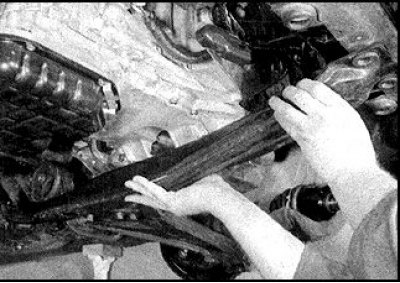
18. Remove the side member.
19. Disconnect the exhaust pipe.
20. Remove the radiator with hoses and fans.
21. Disconnect the anti-roll bar (see subsection 12.6).
22. On carburetor engines, remove or disconnect the following parts and assemblies:
- air filter;
- fuel hoses;
- throttle cable;
- carburetor wires;
- vacuum booster hose, cooling system and other sensor and valve hoses;
- suction manifold stand;
- exhaust gas sensor connector.
23. On injection engines, follow these steps:
- remove the air filter duct;
- perform fuel system decompression procedures, disconnect fuel hoses from throttle body;
- disconnect the throttle cable;
- disconnect the wiring connectors;
- move the wiring away from the engine.
24. Disconnect all hoses from the intake manifold.
25. Remove the intake manifold stand.
26. Identify and disconnect the heater hoses and coolant hoses from the engine.
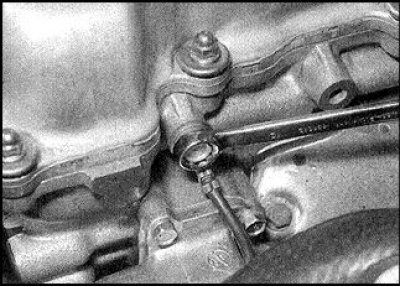
27. Disconnect the wiring connectors from the ignition distributor, ignition coil and transistor power supply. Release the wiring sleeve from the clamps on the cylinder head and move it to the side. Unscrew the bolts and remove all ground wires on the cylinder head and on the intake manifold.
28. Disconnect the speedometer cable and wires from the gearbox.
29. Attach the lifting hoist to the cylinder head eyes and tighten the hoist so that it supports the weight of the power unit.
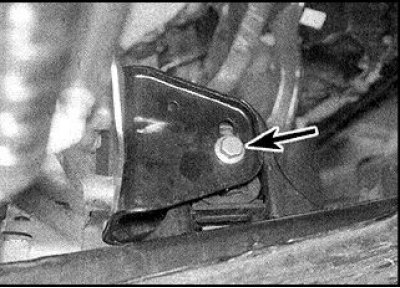
30. Mark the position of the tie bolt (indicated by the arrow) on the front support bracket of the power unit, unscrew the nut of the tie bolt and remove the bolt.
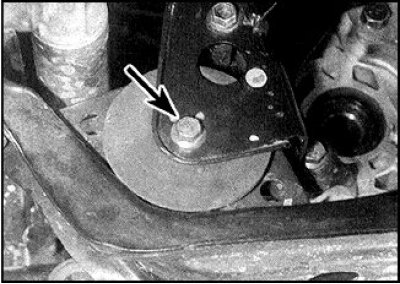
31. Loosen the nut and remove the rear support tie bolt (indicated by the arrow). Remove the front support and bracket.
32. Remove the right support and rubber cushions.
33. Remove the left support and rubber cushions.
34. Make sure all parts, wires and hoses that may interfere with disassembly are disconnected, removed and set aside.
35. Roll a trolley under the engine and carefully lower the power unit. It is advisable to perform this operation with an assistant, since you will need to tilt the engine slightly so as not to touch the body.
36. Roll the power unit out from under the vehicle.
Removal the gearbox
1. Secure the removed power unit with wooden blocks, placing it on a clean, level surface.
2. Loosen the bolts and remove the starter.
3. Remove the gearbox mounting bolts, marking the location of each bolt.
4. Carefully separate the gearbox from the engine, ensuring that the weight of the gearbox is not supported by the input shaft as it exits the clutch driven disc.
5. Remove the gearbox mounting pins if they are loose.
Installation
1. If the gearbox was removed from the engine, then perform the operations described below in paragraphs 3–7. If the gearbox was not removed, then perform the installation, following paragraph 8 and further.
2. Apply a thin layer of high-melting grease to the splines of the gearbox input shaft.
3. Install the pins (if they were filmed), make sure the release bearing is securely mounted on the clutch release fork.
4. Carefully install the gearbox onto the engine using the guide pins. During installation, the weight of the gearbox should not be supported by the input shaft.
5. Replace the gearbox housing mounting bolts in their original places and tighten to the specified torque.
6. Install the starter.
7. Place the power unit under the vehicle and attach the hoist.
8. Working with an assistant, carefully lift the power unit into the engine compartment.
9. Install the rubber cushions on the left support bracket, making sure that the cushion pins enter the bracket holes. Install the support and tighten the bolts to the specified torque. Tighten the tie bolt nut by hand.
10. Install the cushions on the right side bracket of the body. Install the support and tighten the bolts to the specified torque. Tighten the tie bolt nut by hand.
11. Insert the rear support pinch bolt and tighten the nut by hand.
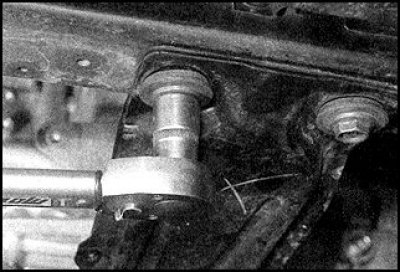
12. Install the side member and tighten the bolts.
13. Install the front support bracket and tighten the bolts. Insert the tie bolt. Orient the engine so that the support tie bolt is precisely aligned with the mark made before disassembly, tighten the bolt nut to the specified torque. The distance between the centers of the support bolts and the bracket should be 55 (±1.0) mm.
14. Rock the power unit and tighten the remaining tie bolts to the specified torque.
15. Next, the installation of the power unit is carried out in the reverse order.
16. Make sure the wiring is routed as it was originally, secured with clamps and staples, and that all connectors are connected.
17. Replace the axle shaft seals and install the axle shafts on the gearbox.
18. Connect all cooling system hoses.
19. Adjust the throttle cable (see subsection 6.1.7).
20. Connect and adjust the clutch cable (see subsection 8.3).
21. Install and adjust drive belts.
22. Change the oil in the engine and gearbox.
23. Fill with coolant.
24. Start the engine and check for leaks.