


- Signs of a malfunction in these systems include: excessive play in the steering wheel before the front wheels begin to turn, excessive vehicle rocking when turning, body vibrations on road surfaces, or bending in certain places when turning the steering wheel.
- The steering linkage and suspension components must be checked periodically. Worn or damaged suspension components can cause excessive and abnormal tire wear, poor handling and increased fuel consumption.
- Periodically, it is necessary to raise the front of the car, secure it on stands and visually inspect the wear of the steering and suspension parts.
- Check the wheel bearings by rocking them back and forth. Listen for any unusual noises and ensure the wheel rotates smoothly and without wobbling. Grasp the top and bottom of the wheel and rock it. Any movement indicates that the wheel bearings are weakening.
- From underneath the vehicle, check for loose bolts, broken or disconnected components, and intact rubber bushings on all steering and suspension components, including shock absorber struts. Check for signs of fluid leaks in the steering system.
- Have an assistant turn the steering wheel from side to side and check the steering components for ease of movement, bending, and binding. If the steering wheel is not responding well to steering wheel movements, try to determine the cause.
- Check the ball joints for grease leaks. If the ball joint boot is cracked or otherwise damaged, replace the ball joint assembly.
- Check the ball joint free play as follows:
- Raise the front of the vehicle.
- Check and adjust the front wheel bearings.
- Attach a dial indicator to the wheel guard and rest the indicator leg against the end of the lower arm or the bottom of the axle fork.
- Make sure the front wheels are in a straight-ahead position and the brake pedal is released.
- Insert a tire lever between the end of the lower control arm or between the bottom of the axle fork and the steering knuckle (next to the indicator leg).
- Move the blade and observe the indicator readings. The maximum movement should be 0.8 mm. Otherwise, replace the ball joint.
- Reposition the indicator and check the axial alignment (vertical) displacement of the steering knuckle. The displacement should be practically zero.
- If there is vertical free play, replace the ball joints.
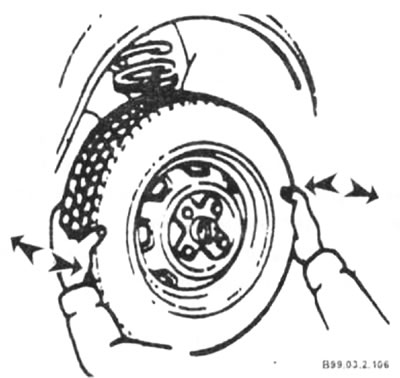
- Grasp the front wheel on the left and right and push it forward, pull it back at the bottom and determine the clearance in the steering rod and lever system. If even the slightest play is detected, check the steering gear mounts and steering rod ball joints to see if they are loose. If they are loose, tighten them. If the steering rods are loose, the ball joints may be loose (check if the nuts are tightened).