


Table of contents: Operating principle ↓ Service ↓
Operating principle
The operating principle of the positive crankcase ventilation (PCV) system is shown in the accompanying illustration.
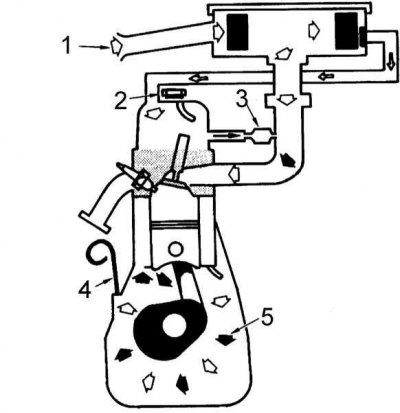
1 - intake air; 2 - oil filler cap (hermetically sealed); 3 - PCV valve; 4 - measuring probe (hermetically sealed); 5 - crankcase evaporation
Crankcase fumes, which include gases that have broken through from the combustion chambers bypassing the piston rings, enter the oil separator unit located in the cylinder head cover. The oil returns to the engine through the drain holes, and clean air is supplied to the oil separator through a hose from the air cleaner. The air mixes with crankcase gases and enters the intake manifold through the ventilation control valve (PCV), and from there - into the combustion chambers.
The system functions most effectively at high engine speeds, when a small vacuum in the intake manifold ensures full opening of the PCV valve. Accordingly, with closed throttle valves, when a deep vacuum is formed in the intake manifold, the efficiency of crankcase ventilation is minimal.
In a heavily worn engine, when the level of gases breaking through into the crankcase from the combustion chambers is significant, some of the crankcase vapors get back into the air cleaner regardless of the position of the throttle valves.
Service
Note: The system is subject to regular maintenance. Particular attention should be paid to the following points.
1. Check the patency and condition of the rubber hoses of the system. Replace defective ones.
2. Check the condition of the engine oil filler neck seals and dipstick. Replace defective and/or suspicious seals.
3. Check the proper functioning of the PCV valve.
Checking the operation of the PCV valve
1. Disconnect the PCV hose from the cylinder head cover.
Material borrowed from the website www.NissanBook.ru
2. Start the engine and let it idle.
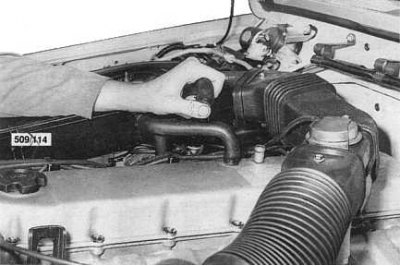
3. Press your finger against the open end of the hose (see accompanying illustration). A vacuum should be felt, otherwise the PCV valve is not flowing properly. Clean the valve or replace it.
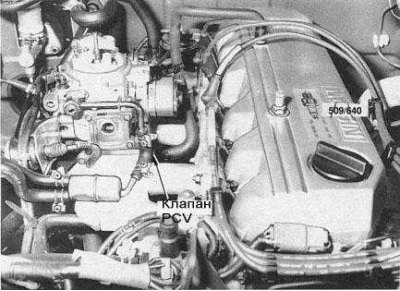
Note: The location of the PCV valve on 3.0L engines is shown in the accompanying illustration.