


Note. To perform the diagnostic procedures described below, you will need a hand-held vacuum pump with a vacuum gauge.
Operating principle
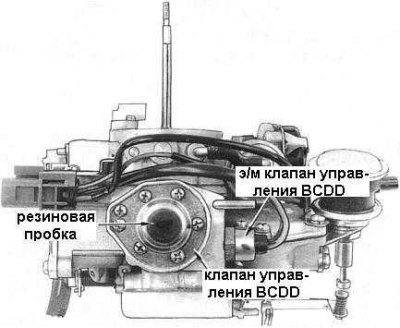
Deep vacuum in the intake manifold when the engine speed is reduced (deseleration) leads to the release into the atmosphere of unburned combustible gases and oils, an increase in the emission of hydrocarbon compounds. In order to reduce the level of emission of hydrocarbon compounds, the carburetor is equipped with a lean mixture during deceleration (BCDD) (see accompanying illustration).
When the depth of depression in the intake pipeline reaches a certain value, the BCDD control valve opens the air bypass, resulting in a reduction in the amount of fuel injected into the carburetor through the cast jet. This increases the completeness of combustion of the mixture, which leads to a reduction in the emission of hydrocarbon compounds.
To prevent engine knock after a final stop, manual transmission models are equipped with a BCDD solenoid valve that blocks the operation of the BCDD control valve.
Checking the BCDD control valve
Note. Under normal conditions, the BCDD control valve does not need to be checked and adjusted, however, if adjustment is necessary, proceed as described below.
1. On models with a manual transmission, disconnect the carburetor electrical connector.
Note. Disconnecting the carburetor connector de-energizes the BCDD and fuel cut solenoid valves (shut-off), preventing them from operating, which may cause the engine to not idle during this test.
2. Fully loosen the fast idle damper (if provided).
3. Remove the air cleaner top cover and connect a vacuum gauge to the intake manifold.
4. Raise the engine speed to 3000÷4000 per minute, then release the gas pedal. When the gas is released, the frequency of the sound emitted by the carburetor neck should change. This change in frequency indicates actuation of the BCDD control valve.
5. Repeat the test of the last paragraph, observing the readings of the vacuum gauge while changing the frequency of the sound. On 4.2 L models, the instrument should register a vacuum depth of 570±50 mmHg. Art., on models 3.0 l - 580±50 mm Hg. Art.
6. If there is no change in sound frequency, or the depth of depression is greater than the nominal value, remove the rubber plug from the BCDD control valve and turn the adjusting screw clockwise. If the frequency still does not change, remove the BCDD valve from the carburetor and verify that its plunger operates when vacuum is applied. Replace BCDD valve if necessary.
Attention! Do not press on the adjusting screw!
7. If the frequency change occurs at a depth of vacuum below the nominal depth, remove the plug and turn the adjusting screw counterclockwise until the desired result is obtained.
8. Adjust the fast idle damper.
BCDD Control Solenoid Check
1. Disconnect the carburetor electrical connector.
2. Apply battery voltage to the solenoid terminals in the carburettor connector (see accompanying illustration).
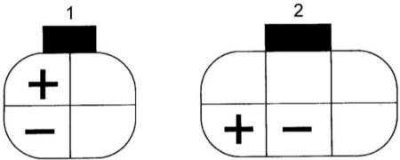
1 - 4.2 l
2 - 3.0 l
3. You should hear a click from the solenoid valve in the carburetor. Otherwise, replace the valve.