


2. Remove the glow plugs.
3. Disconnect the high pressure fuel pump wire connector to prevent fuel supply during the inspection process.
4. Connect the hose with the compression test gauge adapter (KV113BO400 (Mot. 1592)) (A) to the glow plug hole.
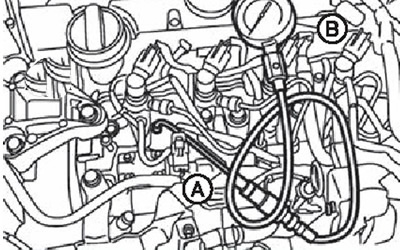
5. Connect the pressure gauge (B) to the hose with adapter (A).
6. Turn the ignition switch to the "START" position to rotate the crankshaft with the starter and check the compression value in the cylinder.
7. Perform the same procedure for other cylinders.
If the comparison of the nominal value of the SIZH is minimally acceptable, check the valve clearances and the condition of the elements associated with the combustion chamber (valves, valve seats, pistons, piston rings, cylinder walls, cylinder head, cylinder head gasket). After checking the relevant parts, measure the compression in the cylinders again.
If one of the engine cylinders has a low compression value, pour a small amount of engine oil into the spark plug hole and then repeat the measurements.
If the compression improves after adding oil, this indicates wear or damage to the piston rings. Check the condition of the piston rings and replace them if necessary.
If the compression remains low after adding oil, this indicates a malfunction in the valves. Check the valves for damage. If necessary, replace the corresponding valve or valve seat.
If the diameters of adjacent cylinders have a low compression value, which does not change after adding engine oil, this indicates damage to the cylinder head gasket, it is necessary to replace it with a new one.
8. Disconnect the pressure gauge (B) and the hose with adapter (A).
9. After checking, install the removed parts.
10. Start the engine and make sure it runs smoothly.
11. Perform fault diagnostics. If fault codes are issued, delete them.