


Oil level and contamination
Before starting the engine, check the oil level with the car level. If you have already started the engine, turn it off and wait 10 minutes before checking.
Make sure the oil level is within the range shown in the illustration.
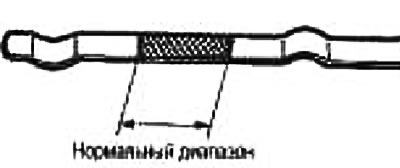
If it is outside this range, bring it up to normal.
Check the oil for white cloudiness or significant contamination.
If the oil becomes cloudy and white, it is very likely that engine coolant has entered it. Find the cause and fix it.
By inserting the dipstick into the guide, apply oil to the rubber seal of the handle.
Oil leak
Check for oil leaks around the following areas:
- Oil pan (upper and lower);
- Oil sump drain plug;
- Low Oil Pressure Warning Light Switch;
- Oil filter;
- Intake valve timing control solenoid valve;
- The contact surface between the cylinder block and the cylinder head;
- Contact surface between the cylinder head and the valve cover;
- Crankshaft seals (front and back);
- Oil filter (for the solenoid valve of the intake valve timing mechanism).
Checking oil pressure
Attention:
- Avoid burning yourself with hot engine oil.
- The oil pressure should be checked in neutral. Securely apply the parking brake.
1. Check the oil level. See "Oil level and contamination" above.
2. Unscrew the oil filter. See section "Oil filter".
3. Disconnect the connector from the low oil pressure indicator light switch and unscrew it using a long head (suitable special tool).
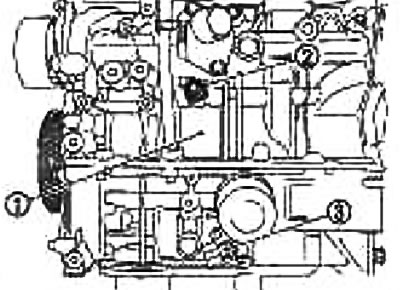
1. Cylinder block
2. Low oil pressure warning light switch
3. Oil level sensor
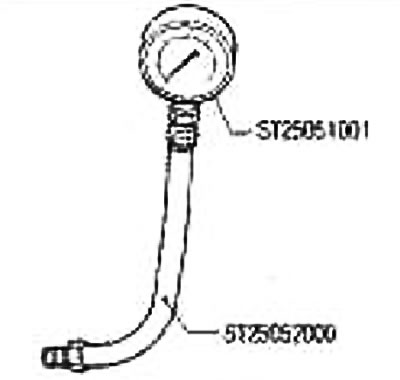
4. Connect the oil pressure gauge and hose (special tool).
5. Screw in the oil filter. See section "Oil filter".
6. Check the oil level. See "Oil level and contamination" above.
7. Start the engine and warm it up to normal operating temperature.
8. Check the oil pressure with the engine running without load.
Note: When the engine oil temperature is low, the oil pressure increases.
Engine oil pressure (oil temperature 80°C)
| Engine speed (rpm) | Approximate outlet pressure, kPa (kg/cm²) |
| Idle speed. | More than 60 (0.61) |
| 2000 | More than 275 (2.8) |
(The text was copied from the portal: www.nissanbook.ru)
If the pressure differs significantly from the specified value, check for oil leaks in the engine oil passage and oil pump.
9. After completing the check, screw the low oil pressure indicator light switch back into place as follows:
- a. Remove the oil filter. See section "Oil filter".
- b. Remove the old sealant from the switch and from the mounting hole on the motor.
- c. Apply sealant and tighten the switch to the required torque.
Use brand name sealant or equivalent.
Tightening torque: 19.6 Nm (2.0 kg·m)
- d. Screw in the oil filter. See section "Oil filter".
- e. Check the oil level. See "Oil Level and Contamination" above.
- f. Warm up the engine and check for oil leaks while the engine is running.