


Table of contents: Battery information plate ↓ Starting the engine from an external…↓
Keep the battery surface clean and dry. Any traces of corrosion should be removed with a sodium bicarbonate solution.
Make sure that the terminal posts are always clean and that the conductors that go to them are tightly screwed in.
If the vehicle is stored for more than 30 days, the negative cable must be disconnected from the battery to prevent it from discharging.
CAUTION! Keep the battery away from flames and sparks. The detonating gas produced by the battery is explosive. Do not allow battery fluid to come into contact with your skin, eyes, clothing or vehicle paint. Do not rub your eyes with your hands when handling the battery. Wash your hands thoroughly after servicing the battery. If electrolyte comes into contact with your eyes, skin or clothing, immediately rinse the affected area with plenty of water for at least 15 minutes and then consult a doctor.
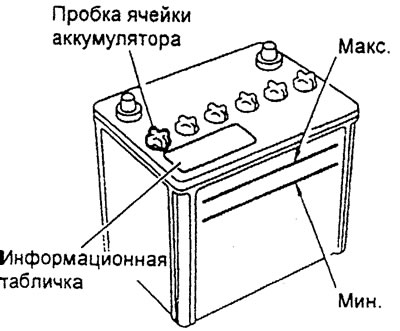
Check the electrolyte level in each battery cell. It should be between the MAX and MIN marks.
If there is not enough liquid, add only distilled water to each of the holes.
1. Unscrew the plugs of all elements using suitable tools.
2. Add distilled water up to the MAX mark.
3. If the side of the battery is hidden from view, the electrolyte level can be checked in each of the holes as shown in the figure.
4. Tighten the plugs.
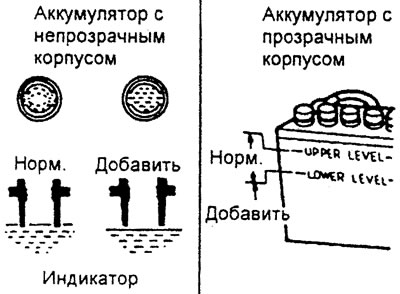
CAUTION! Do not add more water to each hole than necessary. Excessive electrolyte may leak out of the battery during the charging process and damage the vehicle's paintwork.
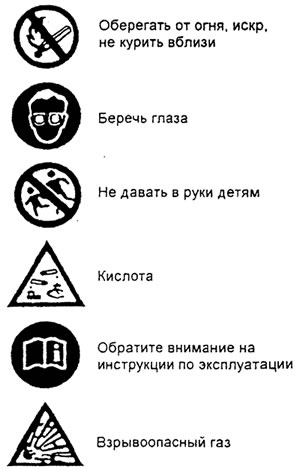
Battery information plate
The following warning symbols may be indicated on the plate:
Starting the engine from an external battery
Starting the engine using a second battery is described in the article "Starting the engine from an external battery". If the engine does not start even when using a booster battery, the battery may need to be replaced. It is recommended that you contact a Nissan dealer in such cases.