


The oil supply to the steering gear is provided by a pump continuously. Under normal conditions, very little pressure is required to maintain the oil flow, which ensures minimal engine power take-off. When the car is parked or turning, a rotary valve built into the worm shaft closes the free oil flow, providing an almost instantaneous increase in pressure.
The design of the steering drive is quite simple. It consists of a transverse steering rod, a connecting rod and a steering damper. It is possible to lubricate the ball joints - just unscrew the plugs and install special nipples for connecting a grease gun instead.
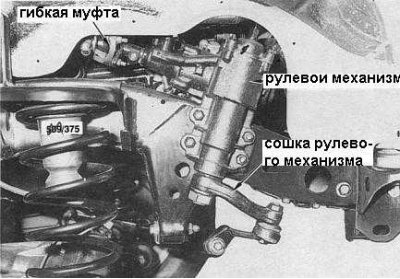
The steering gear worm shaft is connected to the steering column shaft via a flexible coupling (the location of the steering gear on the vehicle is shown in the accompanying illustration).
The steering gear and steering pump components do not require lubrication. If the power steering system fails, the steering continues to function normally, but the effort required to turn the steering wheel increases. Since the internal components of the steering gear and pump are lubricated by hydraulic fluid, if the power steering system loses power, the source of the fluid leak should be identified and corrected immediately to prevent wear and tear of the mechanical components.
Late model years (since 1992) with Utility and Mini-truck bodies (Cab-Chassis) as an additional configuration, they can be equipped with a helical spring suspension. In this case, the steering drive is used in the same design as on models with Hardtop bodies and a station wagon (Station Wagon). All procedures are carried out in the same way as described in the text of the relevant Sections below.
The steering gear on later model years has been modified. The order of all procedures remains the same as that described in the relevant Section of this Part of the Chapter Front and rear axles, chassis and steering, taking into account the points specified in the text of the Section.