


Note: Even if the driven shaft bearing has not been replaced, it should still be supplied with a new snap ring.
2. Install the bearing retainer onto the carrier plate and tighten the bolts to the required torque.
3. Using a press, press the bearing onto the input shaft (the outer race should be facing the snap ring groove away from the pinion. Do not install the snap ring into the outer race at this stage. The front end components of the transmission are shown in the accompanying illustration.
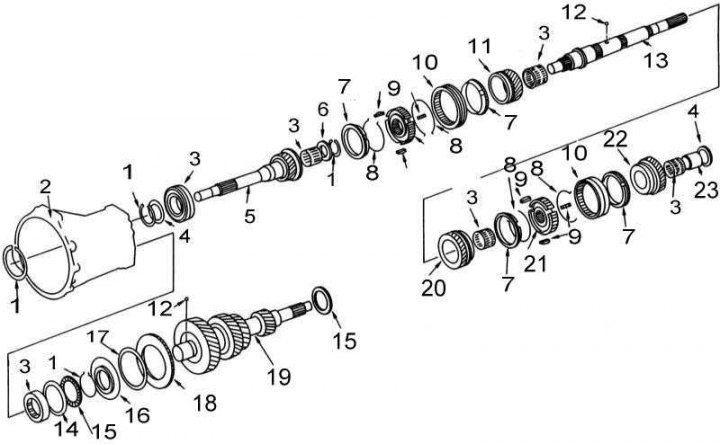
1 - retaining ring; 2 - clutch dome; 3 - bearing; 4 - washer; 5 - primary shaft; 6 - distance ring; 7 - synchronizer locking ring; 8 - spring; 9 - Sliding keys; 10 - synchronizer clutch; 11 - 3rd gear driven gear; 12 - ball; 13 - driven shaft; 14 - adjusting washer; 15 - thrust bearing; 16 - bushing; 17 - conical spring; 18 - toothed ring; 19 - intermediate shaft; 20 - 2nd gear driven gear; 21 - synchronizer hub; 22 - 1st gear driven gear; 23 - bearing sleeve
4. Install the washer on the input shaft and measure the lateral clearance between the retaining ring and the groove. Compare the measurement result with the standard requirements (see size and adjustment tables at the end of the Manual) and select a new retaining ring of the required thickness.
5. Lubricate the ball with lithium-based multi-purpose grease and install it into the intermediate shaft. Install the toothed ring, conical spring and bushing onto the intermediate shaft. Make sure that the concave side of the conical spring faces the gear.
6. Install the retaining ring on the intermediate shaft and tap it into place using a suitable sized drift placed on the end of the shaft.
7. Using a brass drift and a hammer, install the thrust bearing on the intermediate shaft. Observe the bearing seating direction noted during dismantling.
8. Assemble the 1/2 and 3/4 gear synchronizer assemblies in the same order. Make sure that the ends of the springs are not caught on the same sliding keys.
9. Lubricate the third gear roller bearing and install it on the driven shaft.
10. Install the 3/4 synchronizer unit with the locking ring on the third gear pinion. Place the assembly on the driven shaft using a press. Make sure that the hub and synchronizer sleeve are turned with the conical side forward.
11. Measure the lateral clearance between the retaining ring and the groove. Compare the measurement result with the standard data (see size and adjustment tables at the end of the Manual) and select a new retaining ring of the required thickness.
12. Lubricate the second gear roller bearing and install it on the opposite side of the driven shaft.
13. Install the 1/2 gear synchronizer unit with the locking ring on the second gear pinion and place the assembly on the driven shaft using a press, supporting the second gear pinion with the press's support plates.
14. Place the first gear roller bearing coupling and washer on the driven shaft and seat the coupling using a press, supporting the washer with the press plates. Remove the washer from the driven shaft.
15. Lubricate the first gear pinion roller bearing and install the bearing and pinion assembly onto the driven shaft.
16. Lubricate the steel ball and washer with universal lithium-based grease and install them into the driven shaft.
17. If the transmission housing components, intermediate shaft, thrust bearing, toothed ring have been replaced, or the intermediate shaft itself has been replaced, check the axial clearance of the latter:
- Install the intermediate shaft into the carrier plate and place a thrust bearing on its front end.
- Turn the clutch dome over and install the carrier plate with the intermediate shaft into it, achieving tight contact of the mating surfaces. Do not install the intermediate shaft front bearing adjusting washers at this stage.
- Screw in and tighten the two mounting bolts.
- Attach the dial gauge to the carrier plate so that its plunger is pressed against the end of the intermediate shaft. Move the shaft up and down and read the reading.
- Compare the measurement result with the standard values of axial play (see table below) to determine the required thickness of the adjusting washer:
| Axial clearance, mm | Required washer thickness, mm |
| 0.93÷1.02 | 0.88 |
| 1.03÷1.12 | 0.96 |
| 1.13÷1.22 | 1.04 |
| 1.23÷1.32 | 1.12 |
| 1.33÷1.42 | 1.28 |
| 1.43÷1.52 | 1.36 |
| 1.53÷1.62 | 1.44 |
18. If the extension housing, reverse idler gear, shaft or thrust washer has been replaced, check the reverse idler gear axial play:
- Install the reverse intermediate gear thrust washer into the extension housing (as noted during the dismantling process).
- Place the front pinion thrust washer, roller bearings and pinion onto the reverse intermediate shaft and install the assembly into the extension housing, making sure the washer is seated in the correct direction.
- Attach the dial gauge to the extension housing, pressing its plunger against the end of the reverse intermediate shaft.
- Place the flatness gauge (steel ruler edge) across the mating surface of the extension housing and press it against the end of the intermediate shaft of the reverse gear. Raise the shaft until it stops against the edge of the flatness gauge and read the indicator reading. If the axial clearance value is outside the permissible limits, it is necessary to select a new rear thrust washer of the shaft of the required thickness.
Note: Rear thrust washers are available in two sizes - 1.97mm and 2.07mm.
19. Clamp the carrier plate in a soft jaw vice and lubricate the intermediate and driven shaft bearings with a general purpose lithium based grease.
20. Tuck the rear end of the driven shaft into the carrier plate by tapping the bearing retainer with a soft-faced hammer. To allow the intermediate shaft to be installed later, do not seat the driven shaft all the way.
21. Using thick grease, seat the 4th gear synchronizer locking ring onto the 3/4 gear synchronizer hub and slide the assembly onto the driven shaft. Make sure the grooves in the locking ring align with the sliding keys.
22. Lubricate the roller bearing and place it together with the spacer ring on the primary shaft. Place the primary shaft on the driven shaft. Holding the primary shaft, position the intermediate shaft so that the teeth of the spring-loaded ring are aligned with its teeth. This is necessary to engage the gears of both shafts. Install the intermediate shaft in the carrier plate, holding the upper bearing roller with a screwdriver.
23. Finally seat the intermediate and driven shafts into the carrier plate by pressing down on the driven shaft while tapping the back of the plate with a soft-faced hammer.
24. Support the front end of the intermediate shaft and, using a suitable drift, fit the fifth gear roller bearing sleeve onto its rear end.
25. Using a drift, fit the fifth gear onto the driven shaft (just as it was installed before disassembly).
26. Install the carrier plate assembly with shafts into the clutch dome.
27. Lubricate the fifth gear roller bearing and install it on the intermediate shaft.
28. Install the reverse intermediate shaft and fifth gear pinion at the same time. Make sure that the shaft mounting pin fits into the recess.
29. Place the reverse gear synchronizer cone on the intermediate shaft and the reverse gear pinion roller bearing sleeve on the driven shaft (use a suitable mandrel).
(The article is located on the website: «NissanBook.ru»)
30. Install the reverse synchronizer locking ring assembly with sliding keys onto the fifth gear synchronizer sleeve (how they were installed before disassembly). Install the assembly on the intermediate shaft, making sure that the coupling is turned with the beveled side away from the carrier plate. Install the fifth gear synchronizer locking ring.
31. Using a suitable drift, fit the reverse gear pinion onto the intermediate shaft.
32. Install the front thrust washer of the reverse intermediate gear onto the gear shaft in the same direction as it was before disassembly.
33. Lubricate the driven shaft reverse gear pinion and the reverse gear intermediate shaft roller bearings and fit the components onto their shafts.
34. Place the intermediate gear thrust plate of the reverse gear onto your shaft (how it stood before dismantling).
35. Using a suitable drift, fit the reverse synchronizer hub and spacer ring onto the driven shaft. Make sure that the hub is facing the recess towards the carrier plate.
36. Place the rear bearings on the intermediate shaft (use the mandrel).
37. Remove the carrier plate assembly with shafts from the clutch dome and clamp the plate in a vice with soft jaws.
38. Using a blade-type feeler gauge, measure the lateral clearance between the C-shaped retaining half rings and the groove in the driven shaft. If the clearance exceeds 0.1 mm, install new half rings of the required thickness.
39. Using a brass drift, install the half rings and the holder, then seat the retaining ring.
40. Install the spacer ring on the rear end of the intermediate shaft and measure the lateral clearance between the retaining ring and the groove. Compare the measurement result with the standard requirements (see size and adjustment tables at the end of the Manual) and select a new retaining ring of the required thickness.
41. Install the reverse gear coupling onto the reverse gear hub, ensuring that the coupling is facing the beveled side towards the hub.
42. Using a blade-type feeler gauge, measure the axial clearance of the first, second, third and reverse gears of the driven shaft and the fifth gear of the intermediate shaft. If the clearance value is outside the permissible limits (see size and adjustment tables at the end of the manual), disassemble the transmission and carefully inspect the relevant gears and associated components for wear. Replace any defective parts.
43. Install the fifth gear fork onto the fifth gear synchronizer sleeve. Insert the shift rod through the fork into the carrier plate. Insert a new roller pin.
44. Install the reverse gear fork onto the reverse gear coupling, insert the shift rod through the fork into the carrier plate.
45. Install the 1/2 shift fork, impact lever with lock and 3/4 shift fork as they were installed before disassembly and insert the shift rod.
46. Install a new cylindrical pin into the striker arm and check the smooth operation of the shift rod.
47. Install the reverse/fifth gear shift rod, lubricate the threads of the mounting bolt with locking sealant and tighten the latter to the required torque.
48. Lubricate the intermediate shaft front bearing adjusting washer with multi-purpose lithium-based grease and install the washer into the clutch dome.
49. Lubricate with sealant 587 (or equivalent) the mating surface of the clutch dome and install the bearing plate with the shafts, ensuring that the mating surfaces fit tightly.
50. Install a new sealing ring and the check spring and ball into the retainer sleeve (lubricate components with a general-purpose lithium-based grease). Install the coupling and tighten the mounting bolt to the required torque.
51. Apply sealant to the threads of the retainer plug and tighten the plug to the required torque.
52. Place the washer on the front end of the shift rod and install new retaining rings on the shift rod and the outer race of the input shaft bearing.
53. Lubricate the lips of the new seal with a multi-purpose lithium-based grease and install the seal into the front cover.
54. Using a new gasket, install the front cover onto the clutch dome and screw in the mounting bolts (the threads of the lower three located next to the hole of the clutch release lever must be lubricated with sealant).
55. Lubricate the lips of the new seal with a general-purpose lithium-based grease and install the seal into the extension housing.
56. Lubricate with Loctite 587 sealant (or equivalent) mating surface of the carrier plate. Press the extension housing down, guiding the selector bracket onto the shift rod. Make sure the mating surfaces fit tightly. Tighten the mounting screws to the required torque.
57. Using a drift, seat the new cylindrical pin into the selector bracket.
58. Install the release lever and clutch release bearing.
59. Install the transmission on the vehicle.