


Note: Use a lithium-based, general-purpose grease to lubricate components unless another type of grease is specifically specified in the procedure description.
1. Before assembly, lubricate all components with the recommended grade of grease.

2. Assemble the 1/2 gear synchronizer unit in accordance with the marks made during disassembly. Make sure that the sliding keys are correctly aligned with the three V-shaped grooves in the splines of the clutch. The spring locks should not be opposite (see accompanying illustration).
3. Assemble the 3/4 gear synchronizer unit (taking into account the marks). Make sure the keys are aligned with the grooves. Install the springs (with locks in different directions). The hooks on the ends of the springs must fit into the corresponding hole in the synchronizer hub.
4. Assemble the reverse gear synchronizer unit using the marks. Make sure that the narrow end of the coupling faces the rear side of the hub and that the spring locks face in different directions. Using a mandrel, press the holder plate onto the hub flush with the end surface of the latter.
5. Install the locking ring, reverse gear pinion and roller bearing onto the reverse synchronizer assembly (observe the installation direction of the parts). Place the assembly in the press, supporting the synchronizer hub with support plates and install the driven shaft.
6. Place the driven shaft in the press, supporting the reverse gear with support plates, and place the first gear gear, bearing and synchronizer locking ring on the shaft.
Note: The first and second gear locking rings are not interchangeable. The first gear ring is distinguished by having three gaps in the teeth (see accompanying illustration).
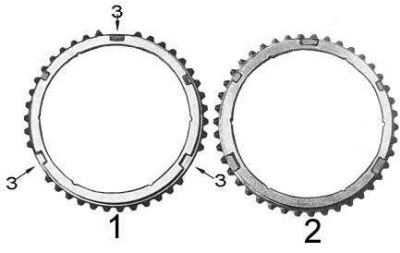
1 — 1st gear synchronizer locking ring
2 — 2nd gear synchronizer locking ring
3 - pass
7. Place the 1/2 gear synchronizer hub onto the driven shaft (use a press and a suitable mandrel). Make sure that the grooves in the hub surface are facing away from the first gear pinion (see accompanying illustration).
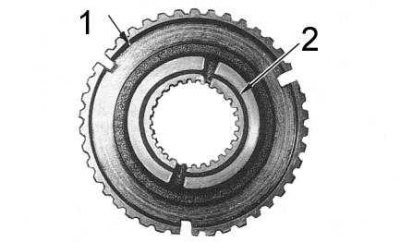
1 — hub
2 - groove
8. Measure the side clearance between the retaining ring and the synchronizer hub. Compare the measurement result with the standard requirements (see size and adjustment tables at the end of the Manual). Select a new retaining ring of the required thickness.
9. Place the second gear synchronizer locking ring and the second gear pinion on the driven shaft. Install the third gear pinion bearing sleeve (use a press and a suitable mandrel). Make sure that the coupling flange is facing the second gear.
10. Place the bearing, third gear pinion and synchronizer locking ring on the driven shaft. Install the shaft in the press, supporting its end with support plates.
11. Press the 3/4 synchronizer assembly onto the shaft. Make sure that the oil grooves in the hub are facing the third gear pinion.
13. Check the axial play.
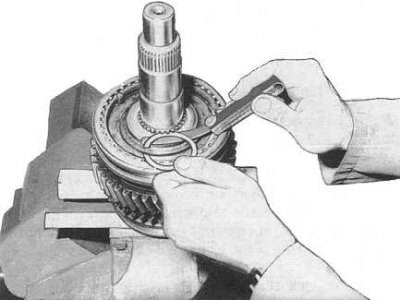
12. Measure the side clearance between the retaining ring and the synchronizer hub (see accompanying illustration). Compare the result with the data size and adjustment tables and select a new ring of the required thickness.
14. Place the bearing on the primary shaft, making sure that the groove for the retaining ring in the outer race is turned away from the primary shaft gear, then, supporting the bearing with support plates, press the shaft into it.
15. Place the spacer sleeve on the input shaft and measure the lateral clearance between the retaining ring and the sleeve. Compare the measurement result with the standard requirements (see size and adjustment charts at the end of the manual), select a new retaining ring of the required thickness.
16. Install the toothed ring holder on the intermediate shaft and measure the lateral clearance between the retaining ring and the holder. Select a new ring of the required thickness. Remove the holder from the intermediate shaft.
17. Apply grease to the steel ball and install the ball, toothed ring, disc spring and retainer onto the front of the intermediate shaft. Make sure that the concave side of the spring faces the toothed ring.
18. Install a new retaining ring of the required thickness on the intermediate shaft so that it is pressed against the holder. Use a suitable mandrel and press the retaining ring onto the intermediate shaft until it fits into the groove. Remove the mandrel and check that the ring is seated correctly.
19. Press the inner races of the front and rear bearings onto the intermediate shaft (use a suitable mandrel). Install the narrow clip back.
20. Install the reverse intermediate gear with thrust washers into the transmission housing. Make sure that the tongues of the washers are in the grooves and the stepped side of the gear is facing forward (as before disassembly). Install the reverse intermediate shaft and locking tab. Tighten the mounting bolt to the specified torque. The components of the reverse intermediate shaft are shown in the accompanying illustration.
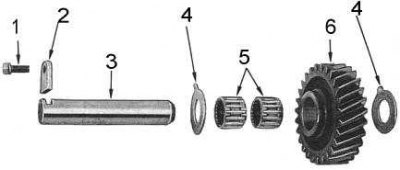
1 - bolt; 2 - locking plate; 3 - shaft; 4 - thrust washer; 5 - bearings; 6 - gear
21. Install the intermediate and driven shafts into the transmission housing. Turn the intermediate shaft so that its aligned segment and ring teeth are opposite the driven shaft.
(Data posted on the website NissanBook)
22. Install the synchronizer locking ring and the driven shaft guide bearing (use thick grease), then hold the shaft and align the flat segment of the input shaft synchronizer gear with the hole in the top cover, then install the input shaft using a soft-faced hammer.
23. Center the intermediate shaft and install the outer race of the front bearing using a soft-faced hammer. Make sure that the bearing is turned with the flared part of the roller separator towards the intermediate shaft.
24. Support the intermediate shaft and install the outer race of the rear bearing (use the soft-faced hammer again).
25. Press a piece of hard board against the front of the intermediate shaft and rotate the transmission so that the board rests against a hard support. Seat the thrust washer with thick grease (chamfer back along the shaft), then fit the reverse gear bearing sleeve onto the intermediate shaft using a suitable drift. Make sure that the thrust washer is not pinched between the sleeve and the bearing cage.
26. Lubricate the lips of the new seal and install it into the front cover. Using a new gasket, install the front cover onto the transmission and tighten the bolts to the required torque.
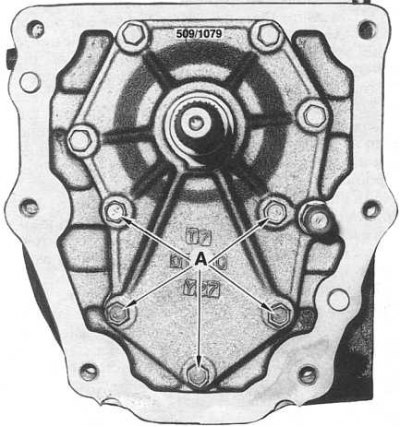
Note: Manufacturers insist that new bolts with a locking coating be installed at the points shown in the accompanying illustration (A), but old bolts can also be used with Loctite 242 thread sealant applied to the threads (or equivalent).
27. Install the clutch dome, release lever and release bearing. Tighten the mounting bolts to the required torque.
28. Pull the driven shaft slightly out of the rear of the transmission and tuck a suitable length of board in front of the second gear pinion (see accompanying illustration), to prevent the load from being transferred to the input shaft when the driven bearings and fifth gear are mounted.
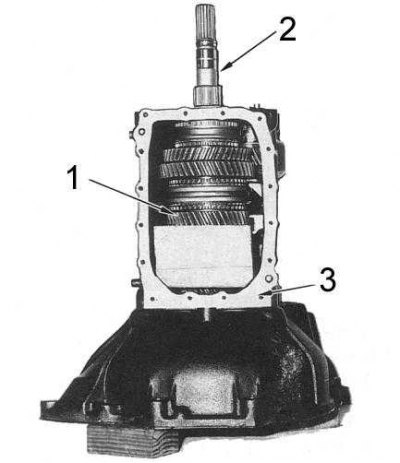
1 - 2nd gear pinion
2 — driven shaft
3 — crankcase
29. Place the transmission vertically, supporting the clutch dome on wooden blocks.
30. Remove the retaining ring from the driven shaft bearing and, using a suitable drift, seat the bearing and fifth gear on the shaft (the components of the rear part of the driven shaft are shown in the accompanying illustration). Make sure that the bearing is installed with the groove for installing the retaining ring facing backwards. The protruding part of the gear should rest against the bearing. Install the retaining ring on the bearing.
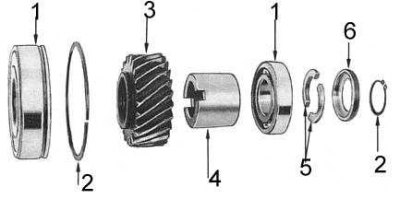
1 - bearing; 2 - retaining ring; 3 - 5th gear pinion; 4 - spacer sleeve; 5 - C-shaped retaining half rings; 6 - holder
31. Using a suitable mandrel, install the spacer sleeve and rear bearing on the driven shaft. Make sure that the sleeve is turned with the grooves towards the fifth gear pinion, remove the piece of board from the transmission.
32. Measure the side clearance between one of the C-shaped half rings and the bearing. Compare the result with the standard requirements. Select two half rings of the required thickness and install the holder and a new retaining ring on the driven shaft.
33. Install the bearing retainer and pre-tighten the countersunk head bolts, temporarily securing the retainer. Tighten all mounting bolts to the required torque. Use a center punch to mark the countersunk head of each bolt at two points.
34. Place the synchronizer sleeve on the intermediate shaft fifth gear (flat side to the gear). The narrow marks drawn on the inside of the coupling must be aligned with the grooves of the sliding keys.
35. Install the sliding keys and springs. The long ends of the keys and the spring hooks must face the pinion, and the springs must engage the keys correctly. To prevent the sliding keys and their springs from jumping out, install a synchronizer locking ring on the fifth gear assembly.
36. Install the intermediate shaft fifth gear pinion and the shift fork with the rod, making sure that the end of the rod equipped with a locking ring is turned towards the transmission housing. Using a suitable mandrel, seat the synchronizer cone on the intermediate shaft.
37. Install a washer on the intermediate shaft and measure the lateral clearance between the retaining ring and the washer. Compare the result with the standard requirements (see size and adjustment tables at the end of the Manual) and select a new ring of the required thickness.
38. Check the axial play of the intermediate shaft fifth gear.
39. Lubricate the lips of the new seal and, using a suitable drift, seat the seal into the transmission extension housing.
40. After replacing the gasket, install the extension housing onto the transmission and tighten the mounting bolts to the required torque.
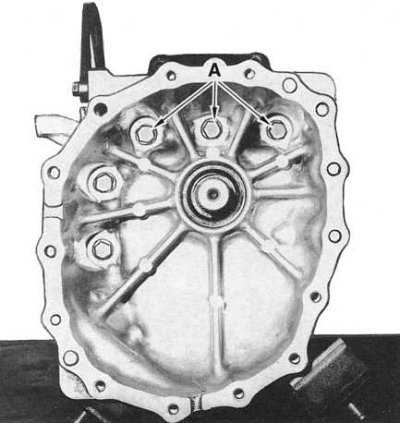
Note: Manufacturers insist that new bolts with a locking coating be installed at the points shown in the accompanying illustration (A), but old bolts can also be used with Loctite 242 thread sealant applied to the threads (or equivalent).
41. Assemble the top cover (see accompanying illustration):
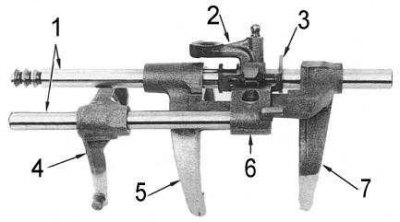
1 - rods; 2 - impact lever; 3 - impact lock; 4 - reverse gear engagement fork; 5 - 1/2 gear shift fork; 6 - reverse gear engagement lever; 7 - 3/4 gear shift fork
- Install the reverse gear control assembly and seat the mounting pin into the housing using a hammer and drift.
- Install the 1/2 shift fork, impact lever and 3/4 shift fork into the top cover (follow the order of installation of components that you remembered during dismantling). Insert the shift rod.
- Install the reverse gear engagement fork and the engagement lever into the top cover (follow the correct order of installing components).
- Align the notches in the shift forks, reverse gear lever, striker pin and striker arm. Make sure the striker pin is located between the ribs in the housing (see accompanying illustration), then install the new mounting pins.
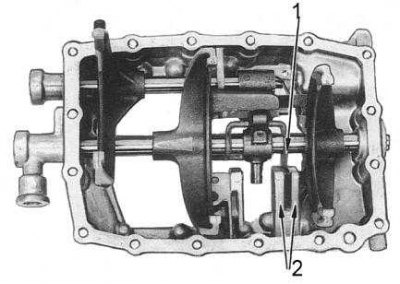
1 - impact lock
2 - ribs
- Lubricate the end plugs of the shift rods with Loctite 587 (or equivalent) and install the plugs into the casing.
- Lubricate the locking ball and guide and install the latter in its place, insert the ball and spring into the casing of the upper cover. Lubricate the plug and thread of the reverse light switch sensor with sealant and screw them firmly into the casing.
- Install the selector bracket and lever into the selector housing, insert the selector rod. Fit new cylindrical pins into the selector bracket and lever. Lubricate with Loctite 587 sealant (or equivalent) new plugs and install them into the selector housing.
- Install the guide plate, making sure that it is turned with the circular groove forward on the selector housing (as was noted during dismantling). Tighten the mounting bolts securely.
- Lubricate the locking plungers and balls and install them together with the springs into the selector housing in accordance with the instructions compiled during dismantling). Lubricate with Loctite 587 sealant (or equivalent)plugs and tighten them securely.
- Install the selector housing onto the top cover (don't forget to replace the gasket) and tighten the mounting bolts to the required torque.
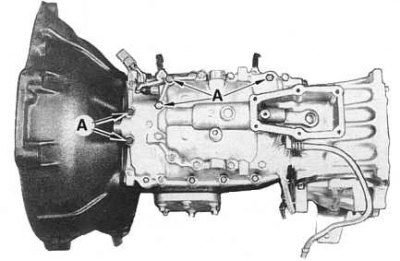
Note: Manufacturers insist that new bolts with a locking coating be installed at the points shown in the accompanying illustration (A), but old bolts can also be used with Loctite 242 thread sealant applied to the threads (or equivalent).
- After replacing the gasket, install the upper cover assembly onto the transmission and tighten the mounting bolts to the required torque.
42. Assemble the gear shift lever control housing:
- Install the rubber seat on the lever;
- Pack grease into the socket and bushing at the end of the shift lever and insert the lever into the socket, securing it with a new snap ring.
- Install the spring and lever into the housing and secure with a new retaining ring.
- Slide the protective rubber cover onto the casing (with the F mark forward along the casing). Install the mounting clamps.
43. Temporarily install the gearshift lever on the transmission and, by turning the input shaft, make sure that the transmission rotates freely in any position of the lever.
44. When assembling the transmission of 4.2 models, take into account the differences that exist in it (see sections Disassembly and General information).