


Table of contents: Models 4.2L ↓ 3.0L models ↓
Models 4.2L
1. Wash all components in solvent and dry them with compressed air.
2. Assess the degree of wear of the components. Check them for damage and deformation, paying particular attention to the condition of the shafts and gears.
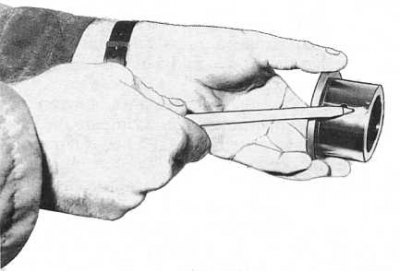
3. Check bearings and couplings for signs of wear, cracks and cavities (see accompanying illustration), evaluate how freely the bearings rotate.
Note: If the bearing is equipped with a separator and its condition cannot be determined visually, thoroughly wash the bearing in solvent, lightly lubricate with oil and rotate it slowly by hand, checking for jerks and sticking points.
4. Label all components of each synchronizer assembly. Slowly remove the synchronizer sleeve from the hub, noting the installation position of the sliding keys and springs. The sliding keys are spring-loaded - make sure that they do not jump out when removing the sleeve. Store the components of each assembly separately so as to avoid any confusion during assembly.
Note: To remove the sliding keys and rear spring from the reverse synchronizer hub, first remove the retainer plate with a puller and loosen the two bolts, after plugging the center of the hub with a plug.
5. Check the hubs and synchronizer couplings for signs of wear and damage, paying particular attention to the condition of the splines and grooves for installing the sliding keys (the components of the fifth gear synchronizer assembly are shown in the accompanying illustration).
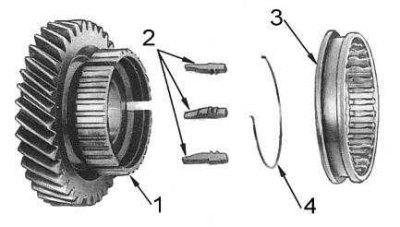
1 - gear; 2 - sliding keys; 3 - coupling; 4 - spring
6. Assess the condition of the sliding keys. Check the springs for signs of damage, deformation and loss of force.
The article was obtained from the portal nissanbook.ru
7. Check the synchronizer locking rings for cracks and signs of deformation. Place the rings on the corresponding gears until they are fully seated and measure the clearances between the rings and gears using a blade-type feeler gauge (see accompanying illustration). If the gaps exceed the permissible values, replace the corresponding rings.
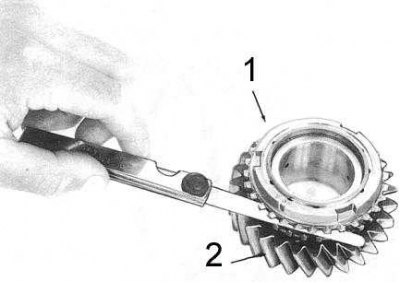
1 - gear
2 - synchronizer
8. Check the condition of the top cover components, paying particular attention to the shift rods and forks. Replace any worn, deformed or damaged parts.
9. Inspect the gearshift lever cover, selector and control housings for signs of wear or damage.
10. Check the transmission case, extension housing and clutch dome for cracks or other damage.
11. Replace components that cannot be restored.
Note: It makes sense to restore the threads in the holes of the aluminum housings. This work is best entrusted to specialists at a service station.
Note: If the transmission is disassembled for a major overhaul, it is a good idea to replace the bearings. All snap rings and roll pins must be replaced. Snap rings come in a variety of thicknesses. Measure the required ring thickness when removing them from the transmission components.
3.0L models
1. Wash all components in solvent and dry them with compressed air.
2. Assess the degree of wear of the components. Check them for damage and deformation, paying particular attention to the condition of the shafts and gears.
3. Check the condition and freedom of rotation of the bearings.
4. Label all components of each synchronizer assembly. Slowly remove the synchronizer sleeve from the hub, noting the installation position of the sliding keys and springs. The sliding keys are spring-loaded - make sure that they do not jump out when removing the sleeve. Store the components of each assembly separately so as to avoid any confusion during assembly.
5. Check the hubs and synchronizer couplings for signs of wear and damage, paying particular attention to the condition of the splines and grooves for installing the sliding keys.
6. Assess the condition of the sliding keys. Check the springs for signs of damage, deformation and loss of force.
7. Check the synchronizer locking rings for cracks and signs of deformation. Put on all the rings one by one (except for the reverse gear synchronizer locking ring) onto the corresponding gears until they are fully seated and use a blade-type feeler gauge to measure the clearances between the rings and the gears. If the clearances exceed the permissible values, replace the corresponding rings.
8. Place the reverse gear cone on a flat surface and press the synchronizer ring onto it. Using a dial gauge, measure the distance between the rear surface of the cone and the locking ring. If the measurement is greater than 0.7 mm, replace the ring.
9. Assess the condition of the shift rods and forks. Also check the impact lever and lock for signs of wear and damage.
10. Inspect the carrier plate, clutch dome and extension housing for cracks or other damage.
11. Replace components that cannot be restored.
Note: All retaining and sealing rings, as well as cylindrical pins, must be replaced without fail. Remember that retaining rings vary in thickness - measure them when removing. The authors of this Manual also recommend replacing bearings and seals.