


Table of contents: Position of seats and headrests ↓ Folding the rear seats ↓
Position of seats and headrests
The design of car seats ensures maximum comfort for the person sitting in them, while simultaneously providing conditions for the most effective performance of their functions by seat belts and airbags. The choice of seat position also affects the safety of the person sitting in it. For example, if the front seat is moved too far forward, the risk of injury to the occupant increases when the airbag is triggered, as well as the risk of being thrown through the windshield in a frontal collision.
Increasing the angle of the seat back will worsen the fixation of the body by the seat belt - the more the seat back is tilted back, the higher the probability of the occupant's body sliding under the lap section of the belt in the event of a strong frontal impact, and the more severe the injuries may be.
Fix the front seat in the position that is as far away from the steering wheel/dashboard as possible, while still being comfortable for driving the car, and bring the backrest to an upright position.
Headrests prevent injury to the cervical spine and head in the event of a rear impact. The headrest should be adjusted in height so that its upper edge is level with the upper edge of the occupant's ear.
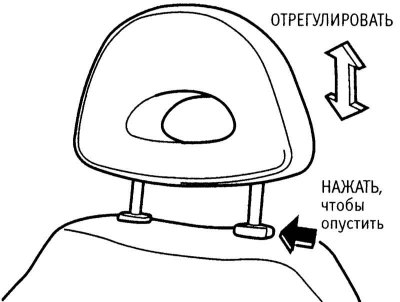
To increase the height of the headrest, simply pull it in the appropriate direction. To decrease the height, press the locking button and lower the headrest.
The head restraints on the rear seat should also be adjusted to one of the fixed positions. The lowest position of the rear seat head restraints is inoperative and is used only to fold the rear seat back. Some models use active head restraints on the front seats. Such head restraints move forward when the car is hit from behind due to the inertia of the body of the seated passenger. This helps to reduce the dynamic tilt of the head backwards and reduces the load on the cervical vertebrae. Active head restraints are designed for collisions at low and medium speeds and return to a similar position after the impact.
The front seats are adjusted manually. The corresponding handles and release levers are shown in the illustrations below. Adjustment of the seat cushion and lumbar support is not available on all models. For safety reasons, the seat position should only be adjusted when the vehicle is stationary.
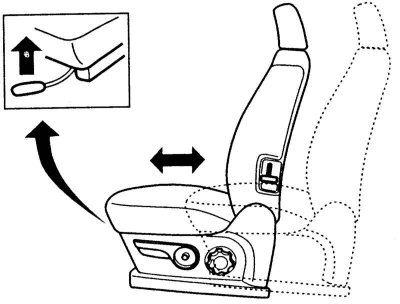
Longitudinal adjustment of the seat
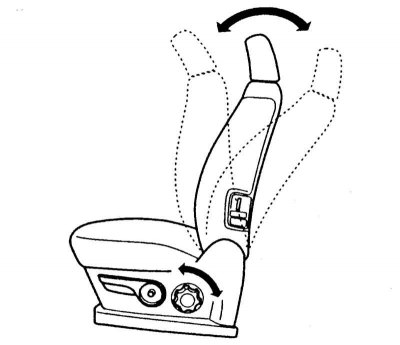
Backrest tilt adjustment
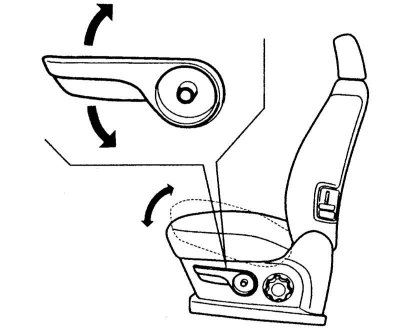
Adjusting the position of the seat cushion
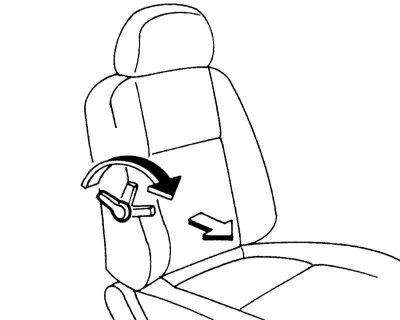
Adjusting the lumbar support
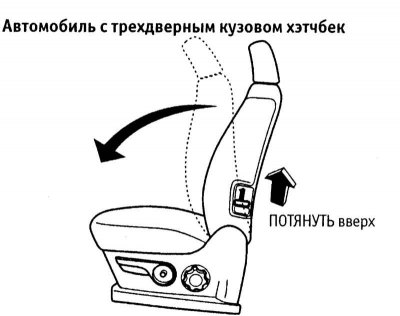
To facilitate entry and exit of rear seat passengers, the front seat backrests of the front seats on 3-door vehicles can be folded forward. To do this, pull the lever on the side of the seat back up. The seat back will automatically tilt forward. When the seat back is returned to the upright position, the memory device (with appropriate equipment) ensures that the backrest is set at its original angle
Folding the rear seats
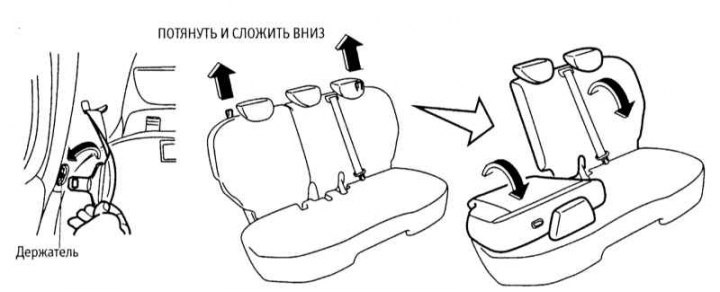
Folding the rear seat back
To access the luggage compartment from the passenger compartment, it is possible to fold the side parts of the rear seat back. To do this, insert the seat belt buckle into the holder, lower the headrests to the lowest position and remove the luggage compartment shelf. Then pull the strap and lower the seat back. When returning the back to its original position, make sure that it is securely locked.
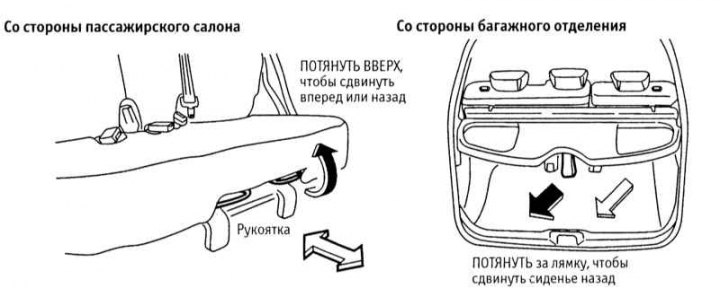
Moving the rear seat
On some models, the rear seat can be moved forward and backward. To do this, while in the passenger compartment, lift the locking lever located under the seat cushion. Additionally, the rear seat can be moved backwards from the luggage compartment by pulling the strap.