


Table of contents: Speedometer and tachometer ↓ Fuel gauge ↓ Display in the instrument cluster ↓ Control lamps and indicators ↓
Location of control and measuring instruments
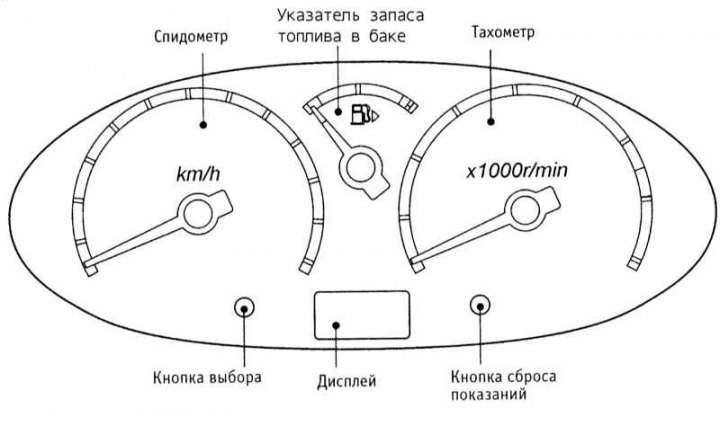
Speedometer and tachometer
Speedometer shows the speed of the car in km/h; tachometer shows the engine crankshaft speed in thousands of rpm and is designed to monitor engine speed – the arrow should not enter the red zone of the scale.
Note. Previously, upshifting allows you to save fuel and reduce powertrain noise. During the run-in period of the vehicle, too high crankshaft speeds should be avoided.
Fuel gauge
The fuel gauge serves for visual monitoring of the fuel remaining in the tank. The error of the fuel gauge readings is minimal when the car is in a strictly horizontal position, and increases when the car is moving on winding or hilly roads. The gauge works when the ignition is on. When the gauge enters the reserve fuel zone, the corresponding K/L is switched on, and on some models, a corresponding message is displayed on the multifunctional display. In this case, the car should be refueled at the first opportunity. The arrow next to the image of the filling station under the fuel gauge scale indicates the side of the fuel tank filler neck.
Display in the instrument cluster
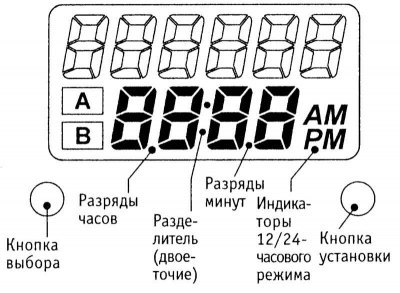
The display in the instrument cluster is designed to display time, odometer and tripmeter data. Odometer data is shown in the upper field of the display. Short (no longer than a second) pressing the selection button located to the left of the display switches the display lower field display modes in a cyclic sequence: clock, mileage indicator A, mileage indicator B, clock. Odometer records the total mileage (km) of the vehicle since it was put into operation.
Watch
Set the clock mode using the selection button.
For switching between 12- and 24-hour mode display the time, briefly press the setting button. When the 12-hour mode is selected, the AM indicator lights up to the right of the clock (before noon) or PM (afternoon).
For setting the current hour, press and hold the setup button for at least three seconds. The images of the numbers in the senior digits (hours), the separator (colon) and the symbols AM or RM (if the watch operates in 12-hour time display mode) will start to flash. Each subsequent press of the setting button changes the hour readings by 1 hour. If you hold the button for more than one second, the hour readings will change at a rate of 2 hours per second. If you do not press the setting button for 5 seconds, the watch will go into the minute setting mode.
In mode minute settings the images of the digits in the lower digits (minutes) and the separator (colon) flash. Depending on how long you press the setting button, the readings in the minute digits change at different speeds (from 1 to 8 minutes per second). To reset the readings in seconds digits (these digits are not displayed on the watch display) make the separator (colon) start blinking and press the setting button. After that, the watch returns to the normal time indication mode. If the setting button is not pressed within 60 seconds, the time indication in the minute digits increases by 1 minute, and the watch returns to the normal mode. A sign that the watch has returned to the normal time indication mode is the absence of blinking of the digits, separator and AM and PM indicators.
Dual odometer
Dual trip odometer allows you to simultaneously monitor the vehicle's mileage starting from two different points in time (trip A, Trip B).
To reset the selected trip odometer, press the reset button (located to the right of the display) and hold it down for at least one second.
In case of malfunction of some systems, in addition to switching on the corresponding K/L on the multifunction display (with appropriate equipment) the corresponding message is displayed.
Control lamps and indicators
The following describes the K/L and indicators located in the instrument cluster.
For k/L malfunction control and indicators, set the parking brake and turn on the ignition. The following K/L should light up:
 ,
,  ,
,  ,
,  and
and  (blue color). The following K/L lights will come on briefly and then should go out:
  ,
,  ,
,  ,
,  (red color),
  ,
,  (red color),
  and
and  . If any K/L does not turn on during testing, this may mean that it has burned out or there is a break in its circuit.
 — K/L of the SRS system, its description is given in Section Supplemental Restraint System (SRS).
 — K/L brake system malfunction/parking brake arming indicator. Comes on when the parking brake is armed or when the brake fluid level drops to a critical value.
 — Battery charge indicator. If it turns on while the engine is running, it may indicate a charging system failure. Turn off the engine and check the condition of the alternator drive belt. Tighten the belt if necessary. If the belt is tensioned correctly and the indicator does not go out, check the charging system (see Chapter Engine electrical systems and Electrical equipment diagrams).
 — K/L of an open door, lights up if one of the car doors is not closed or is not closed tightly. The ignition must be on.
 — Low coolant temperature K/L (blue color)/engine overheating (red color). The K/L lights up blue until the coolant warms up to a temperature of approximately 50 degrees, and when the coolant temperature is above 108 degrees, it lights up red. When the K/L engine overheating is turned on, you should stop at the first opportunity and check the coolant level (see section Checking fluid levels, leak monitoring).
 — Low engine oil pressure K/L. If this K/L comes on or flashes while the vehicle is being driven under normal conditions, you should stop at the first opportunity and check the engine oil level (see section Checking fluid levels, leak monitoring). Operating the engine with a low oil level can cause serious engine damage.
 — Electric Power Steering (EPAS) Malfunction Indicator Light. If the indicator light does not go out after the control check when the ignition is turned on, or lights up while the vehicle is moving, the EPAS may be faulty. In some cases, external factors may influence the activation of this indicator light. Stop, wait for about 20 seconds, and turn the ignition on again. If the indicator light continues to light, check the EPAS system.
Note: If the power steering is faulty, the vehicle can still be driven, but you will have to apply more force to the steering wheel than with a functioning EPAS system.
 - K / L of the ignition switch (only on models with the system "Intelligent Key"). Warns the driver that a gear or AT mode (except "P") is engaged when the ignition switch is in the "LOCK" position. See subsection for more information Ignition and steering wheel lock/switch.
 — NATS anti-theft system K/L. Flashes when the key or ignition switch is turned to the "LOCK" or "Acc" position, indicating that the vehicle is equipped with the NATS system. See also Section Anti-theft system.
 — K/L of unfastened seat belt, reminds the driver of the need to fasten the seat belt. K/L comes on when the ignition is turned on and remains lit until the seat belt on the front seat is fastened. If the front seat belt is not fastened at a speed above 25 km/h. the buzzer comes on.
 — K/L (green color) and K/L (red color) system malfunctions "Intelligent Key". The indicator comes on when the ignition switch is turned from the "OFF" position to the "Acc" position, if the brake pedal is pressed and the key fob of the system "Intelligent Key" is in the vehicle. In the "Acc" position, the indicator goes out. If the control unit of the system "Intelligent Key" detects any voltage from the battery, the indicator lights up when you turn the ignition switch from the "OFF" position to the "ON" position. When you turn the ignition switch to the "Acc" or "ON" position, the K/L lights up for a few seconds and then should go out, which indicates that the system is working properly "Intelligent Key". K/L flashes if the ignition switch is set to the "Acc" or "ON" position and the unit is moved outside its operating range (for example, through an open window). In this case, the buzzer is additionally turned on.
 — K/L ABS. When the indicator comes on while driving, it indicates a malfunction in the ABS system. However, the working main system continues to function normally.
 — K/L reserve fuel supply, turns on if the minimum amount of fuel remains in the tank. Refuel as soon as possible. Do not allow the fuel to run out completely.
Read more on the website nissanbook.ru
 — Engine malfunction K/L. If K/L is constantly lit, the engine management system is faulty; if the K/L is flashing, there may be a malfunction in the ignition system, which may lead to failure of the engine management system. In this case, to avoid or reduce the risk of damage to the engine management system, do not exceed 70 km/h, avoid sudden acceleration and braking, steep climbs and towing a heavy trailer.
 — K/L overdrive lock (on models with AT). Lights up if the overdrive switch is in the "OFF" position. If the AT is operating in emergency mode, then when the ignition is turned on again, this K/L will turn on for 2 seconds and then flash for about 8 seconds. Although the car can move under its own power under these conditions, it should be remembered that the AT will constantly operate in 3rd gear. The AT may switch to emergency mode under severe driving conditions, even if it is completely functional. In this case, turn off the ignition and turn it on after 3 seconds. If the AT remains in emergency mode, repair it.
 — K/L for switching on the rear fog light.
 — Direction indicator and hazard warning lights.
 — K/L for switching on high beam headlights.