


Table of contents: General information ↓ Adjusting the air flow intensity ↓ Air distribution modes ↓ Air circulation and supply…↓ Functioning of the ventilation and…↓ K/V system ↓ Automatic control (only models with…↓
General information
The vehicles in question may be equipped with one of two types of ventilation, heating and air conditioning systems: mechanically and electronically controlled. Not all models in question are equipped with an air conditioning system.
Air is drawn in through the windshield cowl grille and into the cabin, passing through the filter and, if the heater is on, through the heater core. Keep the windshield cowl grille clear of leaves and other debris, and replace the cabin filter periodically to get the most out of your ventilation system.
Regardless of the type of control unit of these systems, deflectors (two side and two central) the air supply to the cabin is located in the same places (see illustration Interior controls and equipment). The deflector grilles have built-in handles that can be used to adjust the direction of air flow, and under the grilles there are rotary controls for the intensity of air flow.
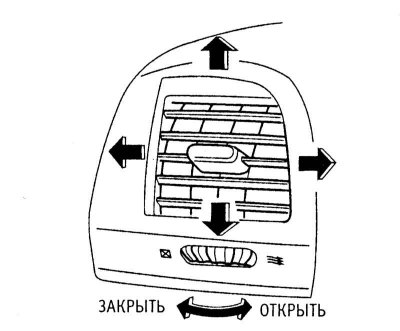
Side deflector control
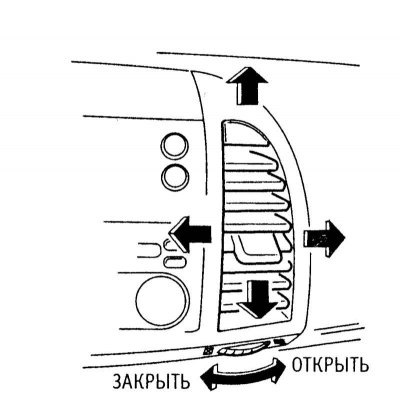
Central deflector control
The heater and air conditioning operate only when the engine is running.
Control unit with mechanical adjustment of parameters (type A)
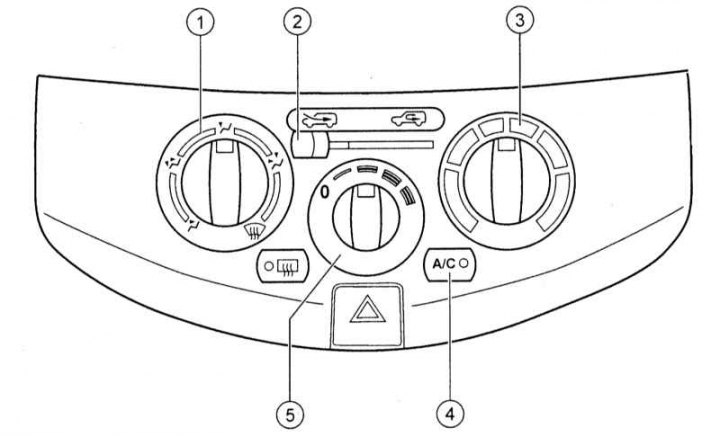
1 - Air distribution mode switch; 2 - Circulation mode switch; 3 - Temperature regulator; 4 - K/V switch; 5 - Fan speed controller
Control unit with electronic parameter adjustment (type B)
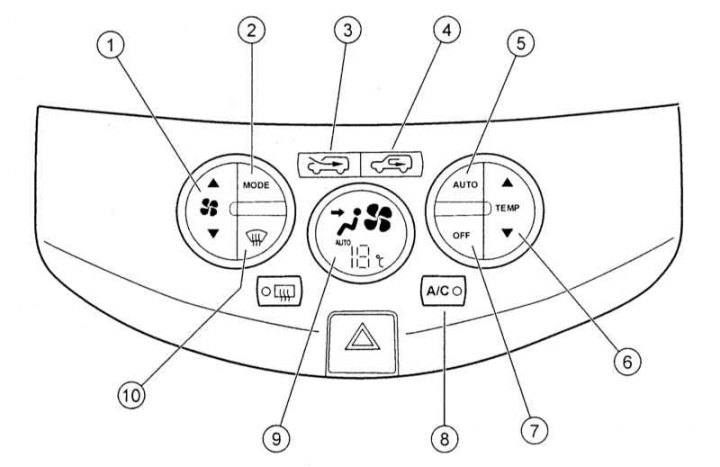
1 - Fan speed controller; 2 - Air distribution mode switch (button "MODE"); 3 - Supply ventilation mode switch; 4 - Circulation mode switch; 5 - Automatic mode switch for K/V operation; 6 - Temperature regulator; 7 - System switch; 8 - K/V switch; 9 - Display; 10 - Windscreen defroster switch
Adjusting the air flow intensity
The air supply intensity is adjusted by changing the fan speed using the appropriate regulator. If regulator 5 in the illustration Control unit with mechanical adjustment of parameters (type A) on the type A control unit is set to position "0", the fan is switched off. On the type B control unit, to switch on the fan and adjust its speed, press the arrows on the appropriate regulator.
Air distribution modes
Using the appropriate switch, you can select the following air distribution modes:
 — Air enters the cabin through the central and side deflectors (to the face);
 — Air enters the cabin through the central and side deflectors, as well as through the lower ventilation openings (to the face and to the feet);
 — Air enters the cabin mainly through the lower ventilation openings (to the feet);
 — Air enters the passenger compartment through the windshield defroster nozzles and lower vents (on the windshield and at the feet);
 — Air comes mainly through the windshield blower nozzles. This mode on the type B unit is switched on and off with a separate button (No. 10 in the illustration Control unit with electronic adjustment of parameters (type B)).
Information obtained from the website [NISSANBOOK.ru]
On the control unit type B to change the air distribution mode, press the "MODE" button successively. The unit display shows the icon of the current air distribution mode, as well as the "MANUAL" indicator.
Air circulation and supply ventilation modes
When the air circulation mode is turned on (on the unit type A control for this, move the switch lever to the extreme right position) the air in the car circulates in a closed circuit. Air from outside the car is not supplied to the car. The circulation mode should be used when driving on dusty roads or in heavy traffic to prevent dust, unpleasant odors and exhaust gases from entering the car. In addition, the circulation mode allows you to significantly speed up the temperature reduction in the car when using air conditioning.
Warning! Do not turn on the air circulation mode for a long time, as this will make the air in the car stale and condensation will appear on the windows.
On models with a block type B the air circulation mode is switched off automatically when the windshield defrost mode is switched on or when the fresh air ventilation switch is pressed.
Supply ventilation mode (on the control unit type A the switch lever is in the extreme left position) is the normal operating mode of the ventilation system.
Switching on the circulation or supply ventilation mode on the unit type B accompanied by the switching on of the K/L built into the corresponding switch.
Functioning of the ventilation and heating system
The heater starts to operate only as the engine warms up. In heating mode, warm air enters the passenger compartment through the lower vents. For normal operation of the heating system, turn on the supply ventilation and footwell air supply modes, and then set the desired temperature and fan speed. To speed up the heating of a cold passenger compartment, turn on the circulation mode, but do not forget to turn it off as soon as the air in the passenger compartment warms up enough. If you need to blow air on the windows along with the passenger compartment heating, change the air supply mode
 on the regime
  .
.
Some models have a two-level interior heating mode, in which outside air is supplied to the interior through the side and central deflectors, and warm air is supplied through the lower ventilation openings. To activate this mode, turn on the supply ventilation, select the air supply mode "to the face and to the feet", select the required fan speed and set the temperature to 25÷32 degrees (on the unit type A this temperature corresponds to the position of the controller between the middle and far right positions).
To remove condensation and frost from the glass, turn on the supply ventilation, set the glass blowing mode, turn on the fan at medium speed, and set the temperature regulator between the central and extreme right positions. Set the side deflectors so that the air flow from them is directed to the side windows. To speed up the removal of frost from the glass, turn on the circulation mode.
Note: On models with a type B unit, to remove condensation and frost from the glass, it is sufficient to turn on the glass blowing mode in automatic mode.
K/V system
The K/V system is designed to obtain an air temperature in the cabin lower than the outside air temperature. The system only operates when the ambient air temperature is above -5 degrees and when the engine is running, since the K/V compressor is driven by the engine crankshaft. When the K/V system is on, (this is evidenced by the K/L built into the switch) fuel consumption increases.
To get the most out of your A/C system, keep your windows and sunroof closed when using it. Keep in mind that the air being cooled is dehumidified, so A/C can be used to remove condensation from your windows. To keep your A/C system in good working order, run it for 10 minutes at least once a month.
If the coolant temperature rises significantly, the air conditioning system may automatically switch off to reduce the load on the engine.
Automatic control (only models with type B block)
When automatic mode is enabled, the operating parameters of the heating, ventilation and air conditioning systems are selected automatically in such a way as to maintain the set temperature.
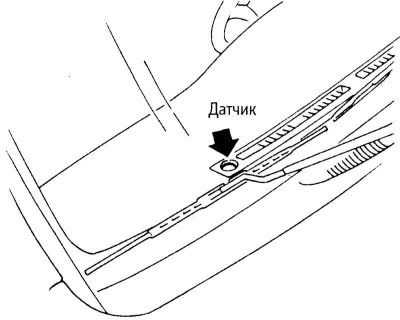
To stabilize the temperature in the cabin, a sun sensor is used, do not cover it, so as not to disrupt the operation of the automatic system. If necessary, you can manually change the air supply mode, turn on the circulation or supply ventilation mode, and adjust the fan speed. When making changes to the automatic mode, the "MANUAL" indicator lights up on the display. To turn off the system, press button 7 in the illustration Control unit with electronic adjustment of parameters (type B).