


Note. The curb state is the state of the vehicle in which it is fully filled with fuel, coolant and oil and is ready to drive. Spare wheel, jack, hand tools and floor mats are in place.
Preliminary check
You need to check the following:
- Check tire pressure for wear.
- Check wheel runout.
- Check the end play in the wheel bearings.
- Check the operation of the shock absorber.
- Check the reliability of fastening and the condition of each element of the suspension.
- Check all levers, rods and other suspension elements for cracks, deformation and other damage.
- Check vehicle height.
Camber check
Measure the right and left camber using suitable equipment.
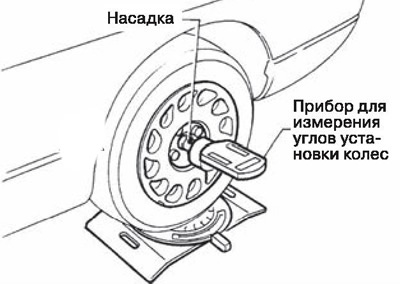
If the camber value exceeds the set value (see section «Service data and specification» at the end of the chapter), replace the rear suspension beam (front wheel drive versions) or adjust with the adjusting bolt on the lower link (all wheel drive versions).
Wheel alignment check
Measure wheel alignment as described below.
Attention.
- Wheel alignment must only be checked on a level surface.
- Before pushing the vehicle, make sure that no one is in front of it.
1. Rock the front of the car several times to stabilize the height of the car body.
2. While pushing, roll the vehicle forward approximately 5 m.
3. Mark (A) on the main tread line of the tire (from the back) on both wheels at the same height corresponding to the center of the wheel hub. These are measurement points.
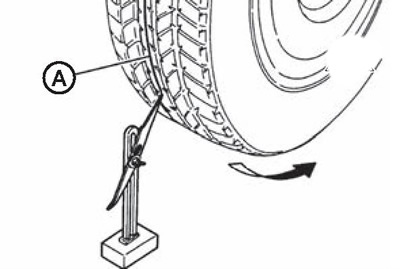
4. Measure distance (A) (from the back).
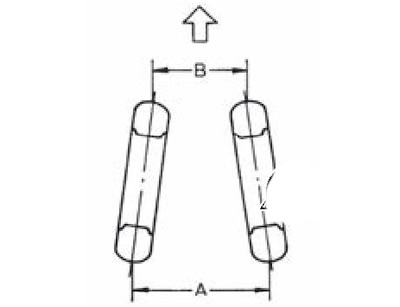
5. Slowly push the car forward so that the wheels turn 180° (half turn).
Note. If the wheel turns more than 180° (half turn), you need to start the procedure from the beginning. Do not roll the vehicle back.
6. Measure distance (IN) (from the front). Calculate the wheel toe value using the formula:
- General convergence = A - B.
Note. The value of the convergence of the wheels is given in the section «Service data and specification» at the end of the chapter.
If the toe value exceeds the standard value (see section «Service data and specification» at the end of the chapter), replace the rear suspension beam (front wheel drive versions) or adjust by turning the adjusting bolt on the suspension arm (all wheel drive versions).
Camber adjustment
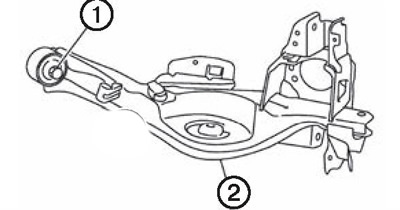
If the camber is greater than the standard value, adjust it with the adjusting bolt (1) on the lower arm (2).
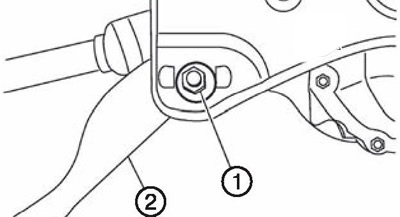
Attention. After adjusting the camber, check the amount of convergence of the wheels.
If camber is greater than standard, inspect and replace any damaged or worn suspension parts.
Toe adjustment
If the toe-in exceeds the standard value, adjust it with the adjusting bolt (1) in suspension arm (2).
Attention. Make sure that the toe difference between the left and right sides is minimal.
If toe-in is greater than standard, check and replace any damaged or worn suspension parts.