


General description
If, during self-diagnosis, malfunctions are detected in the main sensors necessary for the operation of the ECCS unit, fault codes are recorded in the memory of the control unit, which simplifies fault diagnosis. Malfunctions are read in two ways: using the CONSULT service tester and by flashing the engine warning lamp in the instrument cluster.
There are two diagnostic modes. Mode 1 is the normal state, mode 2 is the diagnostic mode or oxygen sensor monitoring (ABOUT2).
Description of the operation of the self-diagnosis system
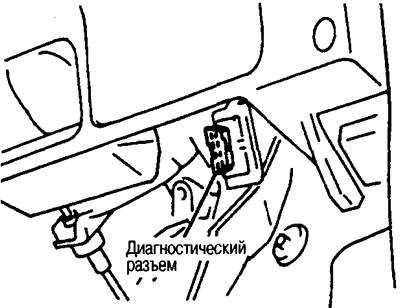
Self-diagnosis mode 2 is activated after turning the ignition key to the ON position (engine not running) and closing for 2 seconds of the contacts of the diagnostic connector SNK and IGN (right side of the lower section of the instrument panel on the driver's side).
Self-diagnosis is carried out after turning the ignition key to the ON position (mode 2 self-diagnosis).
After starting the engine from the self-diagnosis mode, it switches to the O2 sensor test mode (O sensor test2 in mode 2).
After turning the ignition key to the OFF position, it automatically returns to mode 1 (normal state).
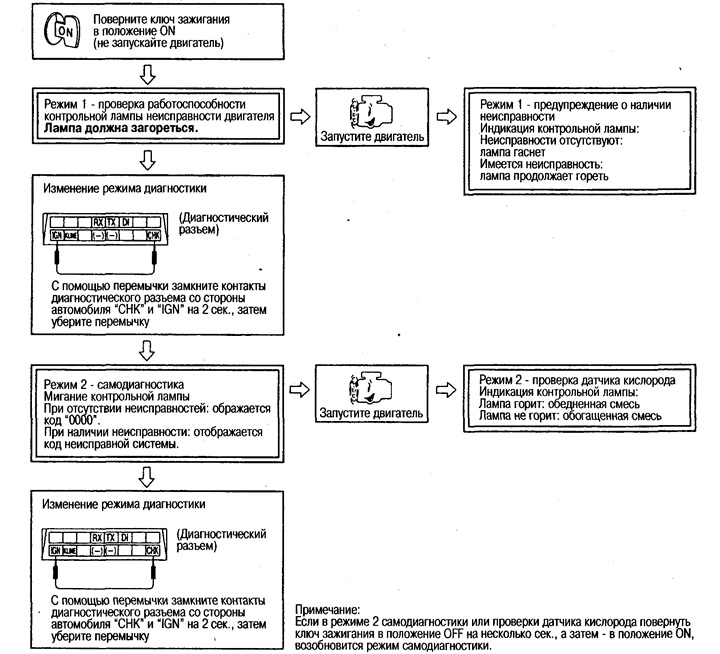
Operating modes of a control lamp of malfunction of the engine
Mode 1 - lamp test
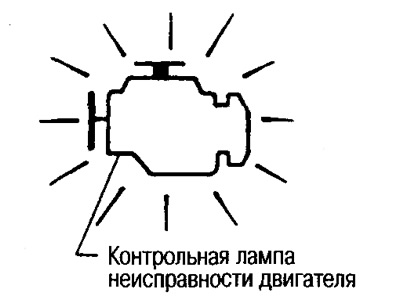
The lamp should light up when the ignition key is turned to the ON position.
The lamp should go out after starting the engine.
Mode 1 - fault indication
When one of the following conditions occurs, the warning lamp lights up in the malfunction alert mode.
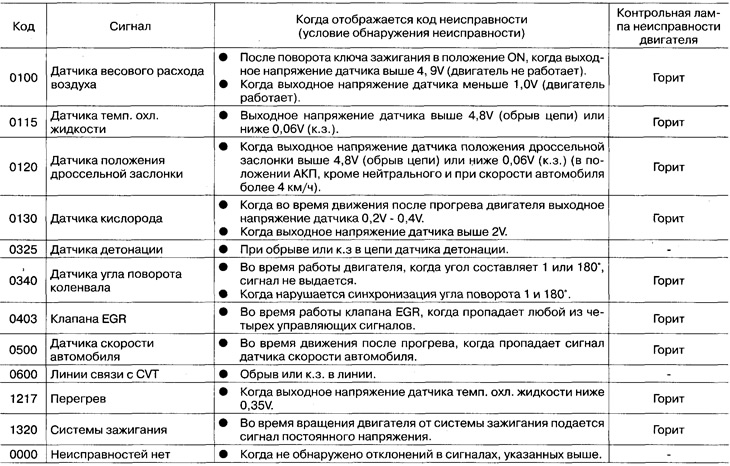
During self-diagnosis, a malfunction of the mass air flow sensor is detected.
During self-diagnosis, a malfunction of the temp, cool sensor is detected. liquids.
During self-diagnosis, a malfunction of the throttle sensor is detected.
During self-diagnosis, a malfunction of the oxygen sensor is determined.
During self-diagnosis, a malfunction of the crankshaft angle sensor is detected.
During self-diagnosis, a malfunction of the EGR valve is determined.
During self-diagnosis, a malfunction of the vehicle speed sensor is detected.
During self-diagnosis, engine overheating is detected.
During self-diagnosis, an abnormal ignition signal is detected.
Mode 2 - self-diagnosis
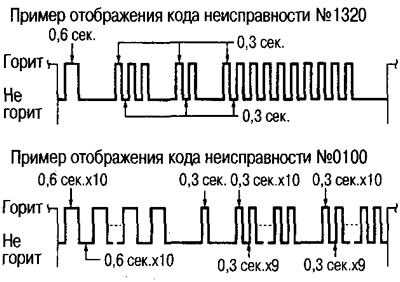
The faulty system code is determined by the blinking of the engine malfunction indicator lamp.
If there are no faults, a code is displayed «0000».
Mode 2 - oxygen sensor test
The blinking of the engine malfunction indicator lamp in this mode indicates the ratio of the components in the air-fuel mixture.
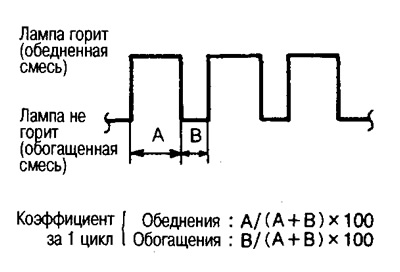
After the engine warms up, check at 2000 rpm if the warning light comes on 5 times or more within 10 seconds. [In the future, the ratio of the components in the air-fuel mixture at the speed x.x. adjustable with feedback (closed loop control)].
When feedback control works:
When the oxygen sensor output is high (the mixture is enriched): Lamp goes out When the oxygen sensor output is low (the mixture is lean): lamp on
When closed loop control is disabled: the state that existed immediately before entering this mode is retained.
At the moment when feedback control stops: the lamp goes out.
Self-diagnosis codes
How to clear self-test results
Turn the ignition key to the ON position (engine not running) in mode 2 and bridge the SNK and IGN pins of the diagnostic connector for 2 seconds or more.