


Table of contents: 1. Entering self-diagnosis mode ↓ 2. Step 1: LEDs and display segments…↓ 3. Check your progress to stage 2 ↓ 4. Check the return to stage-1 ↓ 6. Step 3: Check the positions of…↓ 7. Stage 4: the operation of all…↓ 8. Check the actuators ↓ 9. Step 5: The temperature detected…↓ 10. Check the ambient air…↓ 11. Check the cabin air temperature…↓ 12. Check the intake air temperature…↓ 13. Check the faulty sensor ↓ 14. Check for faulty throttle motor…↓
1. Entering self-diagnosis mode
1. Turn the ignition key to the "ON" position.
2. To enter the self-diagnostic mode, within 10 seconds after starting the engine (the ignition key is turned to the "ON" position), press the "OFF" button for at least 5 seconds.
Caution: If the battery voltage drops below 12V during Step-3 of the diagnostics, the throttle motor speed will slow down, causing the system to generate an error even if it is normal. To avoid this situation, start the engine before performing this diagnostic step. Proceed to step 2.
2. Step 1: LEDs and display segments are checked
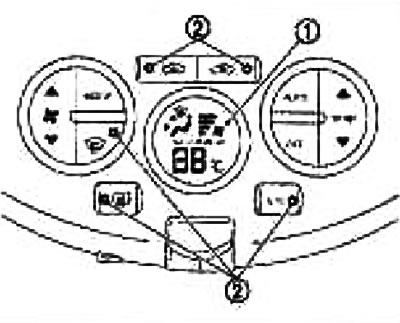
Check the display screen (1) and the LED lights (2)
OK: Proceed to step 3.
Abnormal: The "OFF" button or automatic regulator is faulty.
3. Check your progress to stage 2
Press the temperature control button (▲ up).
Is progress towards Stage 2 happening?
Yes: Proceed to step 4.
No: Replace automatic (the temperature control button is faulty).
4. Check the return to stage-1
Press the temperature control button (▼ down).
Is there a return to Stage 1?
Yes: Proceed to step 5.
No: Replace the automatic regulator (the temperature control button is faulty).
5. Stage 2: The sensor circuits are checked to detect breaks or short circuits.
Press the temperature control button (▲ up).
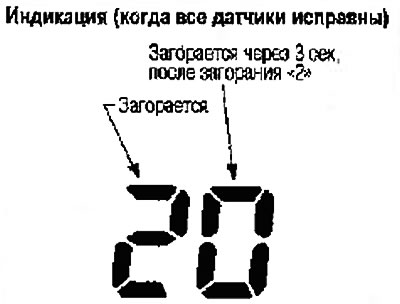
Does the display show the code number "20"?
Yes: Proceed to step 6.
No: Proceed to step 13.
6. Step 3: Check the positions of the mixing flap and the blower mode flap
Press the temperature control button (▲ up).
Does the display show the code number "30"?
Yes: Proceed to step 7.
No: Proceed to step 14.
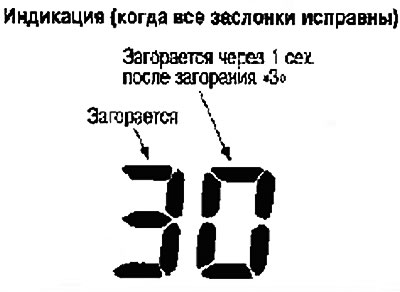
7. Stage 4: the operation of all damper motors is checked
1. Press the temperature control button (▲ up).
2. Press the (DEF) button, the display shows the code number of each damper motor.
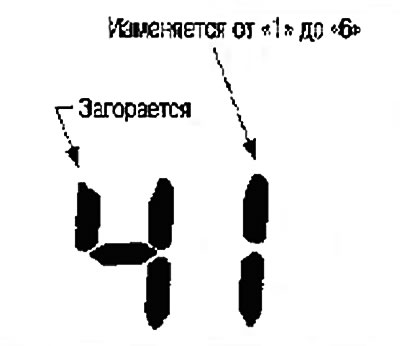
Proceed to point 8.
8. Check the actuators
Using the table below, check the blowing mode through the various air ducts, the temperature of the air supplied to the cabin, the voltage of the blower motor, the operation of the compressor, ionizer and indicator (in the "ION" mode).
Blowing mode
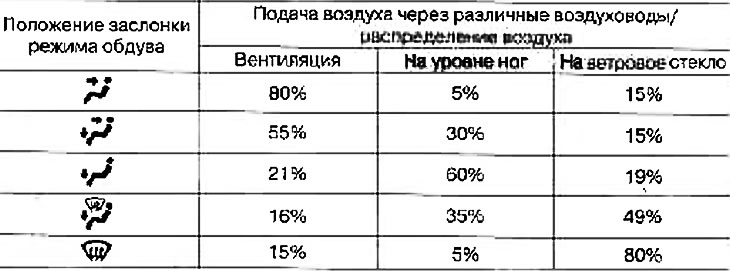
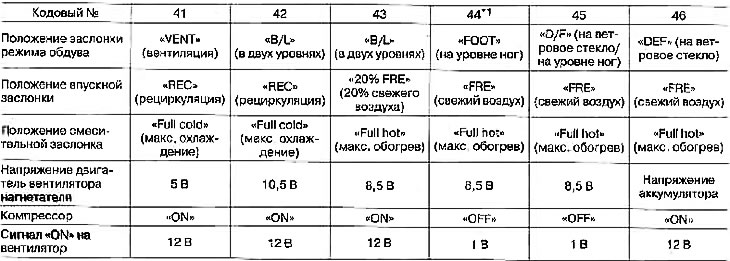
The operation should be checked visually, by listening to the sound of operation or by touching the ventilation grilles with your hand
Are the test results OK?
OK: Proceed to step 9.
Abnormal: The airflow mode through certain vents does not change.
The position of the intake valve does not change.
The blower fan motor is not working.
The magnetic clutch does not engage.
The temperature of the air supplied to the passenger compartment does not change.
9. Step 5: The temperature detected by the sensors is checked
1. Press the temperature control button (▲ up).
2. The display shows the code number "5".
Proceed to point 10.
10. Check the ambient air temperature sensor
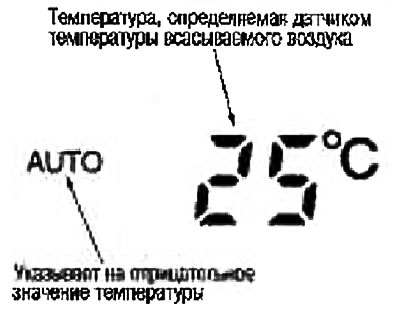
Press the (DEF) button once. The display shows the temperature detected by the ambient air temperature sensor.
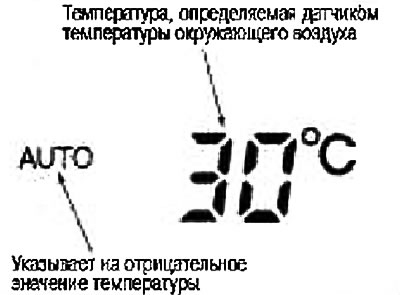
Note: If the temperature displayed on the display differs significantly from the actual temperature, first check the sensor circuit and then the sensor.
Are the test results OK?
OK: Proceed to step 11.
Abnormal: The ambient air temperature sensor is faulty.
11. Check the cabin air temperature sensor
Press the (DEF) button a second time. The display shows the temperature detected by the cabin air temperature sensor.
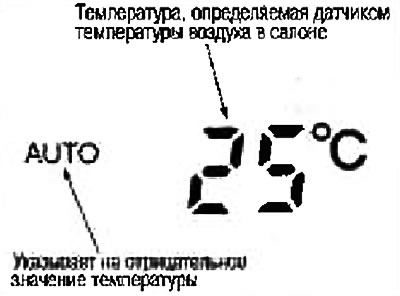
Note: If the temperature displayed on the display differs significantly from the actual temperature, first check the sensor circuit and then the sensor.
Are the test results OK?
OK: Proceed to step 12.
Abnormal: The cabin air temperature sensor is faulty.
12. Check the intake air temperature sensor
Press the (DEF) button a third time. The display shows the temperature detected by the intake air temperature sensor.
Note: If the temperature displayed on the display differs significantly from the actual temperature, first check the sensor circuit and then the sensor.
Are the test results OK?
Fine:
- 1. Turn the ignition key to the "OFF" position or press the "AUTO" button to the "ON" position
- 2. End of verification
Abnormal: Intake air temperature sensor is faulty.
13. Check the faulty sensor
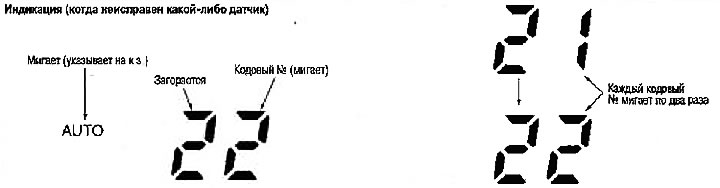
For fault code number, see table below, (if two or more sensors are faulty, the corresponding code numbers flash 2 times, respectively)
*1: Perform Step-2 self-diagnosis in bright sunlight.
If self-diagnosis is carried out in a closed room, direct the light from a flashlight (more than 60 W) to the sunlight intensity sensor. Otherwise, code #25 will be displayed, even though the sensor is working properly.
| Code No | Faulty sensor (Including chains) |
| 21 /auto 21 | Ambient air temperature sensor |
| 22 /auto 22 | Cabin air temperature sensor |
| 24 /auto 24 | Intake air temperature sensor |
| 25 /auto 25 | Sunlight intensity sensor*1 |
| 26 /auto 26 | Potentiometer (PBR) of the mixing flap motor |
End of verification.
14. Check for faulty throttle motor position switch
The electric motor of the mixing flap or the blower mode flap is faulty.
Throttle body motor corresponding to malfunction code (DTC).
| Code No *1 *2 | 31, 32, 33, 34 | 35, 36, 37, 38 |
| Electric motor of the corresponding damper | Mixing flap | Blow-off mode flap |
Diagnostic Trouble Code (DTC) for faulty wiring.
| Electric motor of the corresponding damper | Mixing flap electric motor | Blower mode flap electric motor | ||||||
| Relevant contact (from the side of the damper motor) | 3 | 4 | 1 | 6 | 3 | 4 | 1 | 6 |
| Relevant contact (from the automatic regulator side) | 19 | 22 | 21 | 20 | 23 | 26 | 25 | 24 |
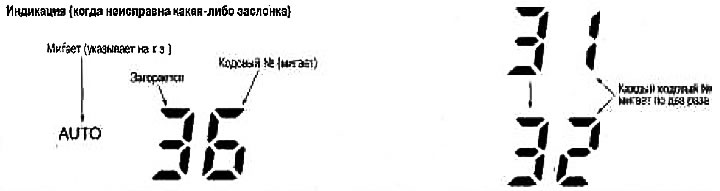
| Code number for K.Z. | AUTO31 | AUTO32 | AUTO33 | AUTO34 | AUTO35 | AUTO36 | AUTO37 | AUTO38 |
| Code number for break | 31 | 32 | 33 | 34 | 35 | 36 | 37 | 38 |
(If two or more mixing flaps or blower mode flaps are faulty, the corresponding code numbers will flash 2 times respectively).
*1: When the connector from the mixing flap motor is disconnected, the display changes in the order: 31→32→33→34→ Return to 31.
*2: When the connector from the blower mode flap motor is disconnected, the display changes in the order: 35→36→37→38→ Return to 35.
End of verification.