


Table of contents: Removal and installation the water…↓ Checking the water level sensor ↓ Removal air from the fuel filter ↓ Fuel filter replacement intervals ↓ Removal water from the fuel filter ↓
Removal and installation the water level sensor
1. Remove the water level sensor together with the fuel filter (see chapter Accelerator, fuel system and exhaust system).
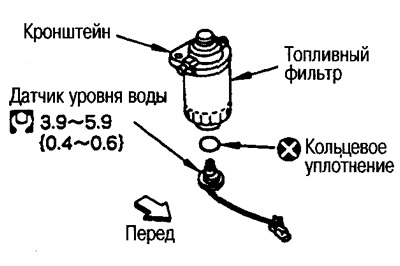
2. Remove the water level sensor from the fuel filter.
Checking the water level sensor
Remove the water level sensor and connect the wiring connector. Turn the ignition key to the ON position.
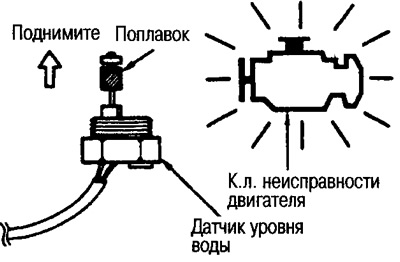
When the float rises, the engine malfunction indicator light should come on.
- Water level sensor: 3.9-5.9 Nm (0.4-0.6 kg·m)
Caution: Do not reuse the O-ring.
Removal air from the fuel filter
Remove air from the fuel filter using the lever from the on-board tool kit while pumping the priming pump.
Once all the air is removed, the pumping force will increase sharply.
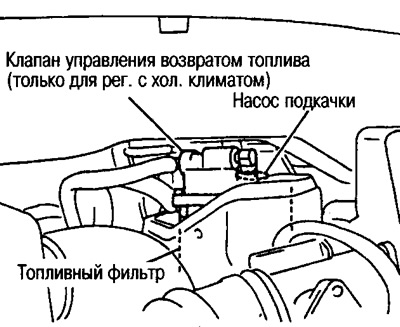 |
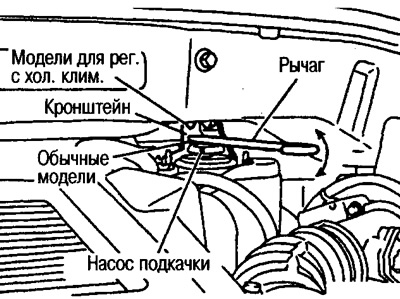 |
If the booster pump does not remove air well (pumping force does not increase), remove the fuel supply hose that connects the fuel filter to the injection pump and make sure that fuel is supplied. During this check, use a cup to prevent fuel from getting on engine parts. After checking, reinstall the hose and bleed again.
Fuel filter replacement intervals
Fuel filter replacement frequency: every 60,000 km or every 5 years.
Removal water from the fuel filter
If the engine malfunction indicator lamp comes on while the engine is running (except when the lamp is blinking), remove water from the fuel filter in the following order.
1. Remove the fuel filter, its bracket and the guard assembly from the vehicle.
(1) Remove the following parts.
Upper air cleaner housing and air duct assembly.
Air hose between intercooler and intake manifold.
Caution: Cover any open holes to prevent foreign particles from entering the engine.
(2) Disconnect the fuel hoses, water level sensor wiring connector.
(3) Unscrew 2 fastening nuts and 1 bolt from the side of the partition with the engine compartment, remove the fuel filter, its bracket and the guard assembly from the vehicle.
Data copied from web resource (Nissanbook.ru)
Caution: Do not damage the brake pipes in the ABS drive area and the sound insulation in the hood top area.
2. Using pliers or a similar tool, loosen the water drain valve located at the bottom of the fuel filter.
3. Bleed the fuel using a fuel pump.
Connect the drain hose to the water drain tap.
- The amount of water at which the indicator lamp lights up: 65-100 cm².
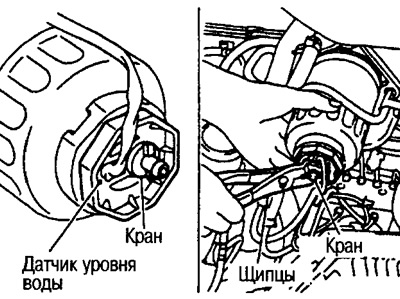
Caution: When removing water, fuel will also leak out, so prepare a collecting container in advance and make sure that fuel does not get on insulators, bushings and other rubber parts.
4. Tighten the tap and install the fuel filter, bracket and guard assembly in the reverse order of removal.
Caution: If the tap is tightened too much, water and fuel may leak out due to damage to the tap thread.
5. Bleed the fuel filter.
6. Start the engine and check that the check engine light goes out.