


Table of contents: Malfunction indicator ↓ Switching diagnostic modes ↓ Diagnostic mode I - Malfunction…↓ Diagnostic mode II - output of…↓ Clearing fault codes ↓ Diagnostic mode II - oxygen sensor…↓ Engine operation in emergency mode ↓
Malfunction indicator
The Malfunction Indicator Lamp (MIL) comes on when the ignition is turned on to check the lamp. It should go out after the engine starts.
If the indicator does not light after turning on the ignition, you must first check the lamp and contacts in the indicator circuit.
Switching diagnostic modes
Diagnostic mode I: is set immediately after the ignition is turned on (checking the Malfunction Indicator Lamp). After starting the engine, the indicator will issue a warning about detected faults.
Diagnostic mode II: when the engine is not running and the ignition is on, the self-diagnostic results are displayed on the indicator. After starting the engine, the oxygen sensor is continuously monitored in this mode.
Switching modes is possible only with the engine off and the ignition on. To do this, turn the mode selector on the engine control unit clockwise until it stops, wait at least 2 seconds and turn the selector back. Another way to switch is to close the contacts of the SNK and IGN of the diagnostic connector with a suitable conductor for at least 2 seconds. (for SR engine only this method is applicable).
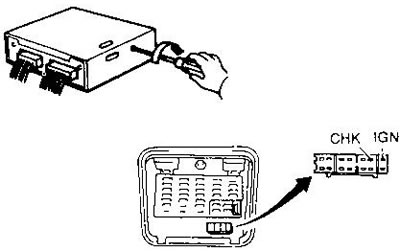
If you turn off the ignition in diagnostic mode II, the power supply to the ECM will be removed after about 5 seconds in GA engines and after 1 second in SR engines. After turning on the ignition, mode I will be set automatically.
During normal operation of the vehicle, the mode selector should be turned counterclockwise until it stops.
Diagnostic mode I - Malfunction warning
If the malfunction indicator comes on in mode 1 with the engine running, this indicates that a malfunction has been detected in the coolant temperature sensor circuit, or that the engine is overheating, or that the control unit microprocessor is not working properly.
Diagnostic mode II - output of self-diagnostic results
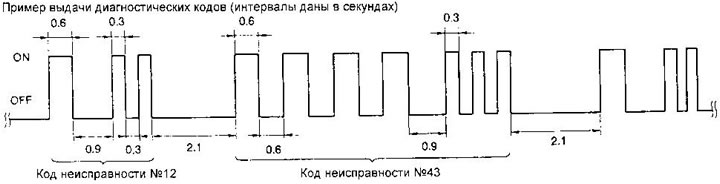
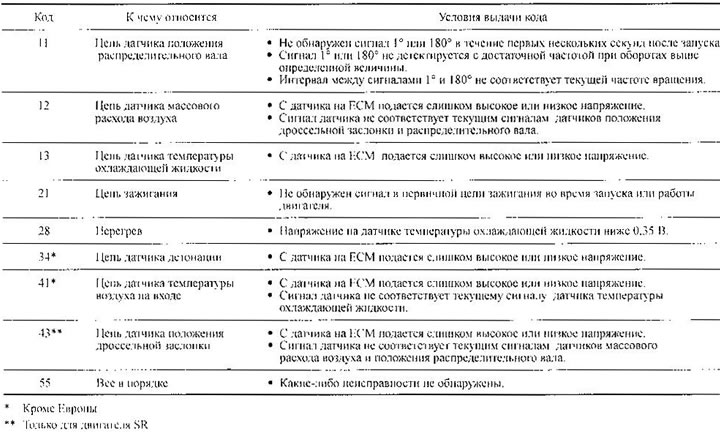
In this mode, fault codes are issued, for which the fault indicator flashes. Long flashes (0.6 s) indicate tens, short ones (0.3 s) indicate units (see picture).
The issuance of code 55 indicates that there are no faults.
Clearing fault codes
The fault codes generated as a result of self-diagnosis are erased from the backup memory of the control unit when switching from mode II to mode I.
When the battery is disconnected, the codes are stored in memory for about 24 hours.
Diagnostic mode II - oxygen sensor monitoring
In this mode, the malfunction indicator indicates the composition of the combustible mixture (enriched or depleted). The indicator is on - lean mixture, off - rich mixture. Oxygen sensor monitoring is only possible with a closed feedback loop. The feedback loop opens when starting, warming up and running the engine at normal idle speed. In this case, the malfunction indicator will be constantly on or off. The oxygen sensor must be checked as follows:
- Start the engine in diagnostic mode II and warm it up until the coolant temperature gauge needle reaches the middle of the scale.
- Maintain the speed at 2000 min⁻¹ for 2 minutes without load, then, without reducing the speed, check the flashing frequency of the malfunction indicator. It should be at least 0.5 Hz (more than 5 times in 10 sec).
Engine operation in emergency mode
The engine goes into emergency mode in the following situations:
- The MAF sensor circuit is faulty. Engine speed will be limited to 3000 rpm⁻¹ for GA engines and 2400 rpm⁻¹ for SR engines.
- Coolant temperature sensor circuit faulty (code #13). Engine temperature will be determined by the time elapsed from the start: 35°C immediately after ignition or starter is turned on, 80°C after 4.5 minutes. The cooling system fan will be on constantly.
- The throttle position sensor circuit is faulty. The throttle position will be determined by the amount of fuel injected and the engine speed. Acceleration dynamics will be poor.
- Start signal circuit faulty (sR engine). If the ECM continuously receives a crank signal, then after 1000 min⁻¹ it is assumed that this signal is absent, which prevents over-rich combustion.
- Incorrect operation of the processor or other elements of the control unit. In this case, the engine speed is limited to 3000 min⁻¹, injection is carried out simultaneously by all injectors twice during the working cycle, a constant ignition advance angle is set, the fan and fuel pump are constantly on while the engine is running, the IACV-AAC valve is fully open.